Section of Neuroscience and Cell Biology Department of Experimental and Clinical Medicine School of Medicine Università Politecnica delle Marche Ancona Italy.
Division of Neurology Madonna del Soccorso Hospital San Benedetto del Tronto Italy.
Brain Behav. 2017 Feb 22;7(3):e00624. doi: 10.1002/brb3.624. eCollection 2017 Mar.
Cerebral autosomal dominant arteriopathy with subcortical infarcts and leukoencephalopathy (CADASIL) is a hereditary systemic vascular disorder. Granular osmiophilic material (GOM) is its ultrastructural marker. We reviewed tissue biopsies from CADASIL patients to establish whether ultrastructural observations help clarify the pathogenic mechanism of CADASIL. Given the resemblance of the GOM deposits to the immunoglobulin deposits seen in glomerulonephritis and focal segmental glomerulosclerosis (FSGS), their morphologies were investigated and compared.
Skin, skeletal muscle, kidney, and pericardium tissue biopsies from 13 patients with a clinical and molecular diagnosis of CADASIL, and kidney biopsies from five patients with IgA nephropathy and five patients with primary FSGS were subjected to ultrastructural examination.
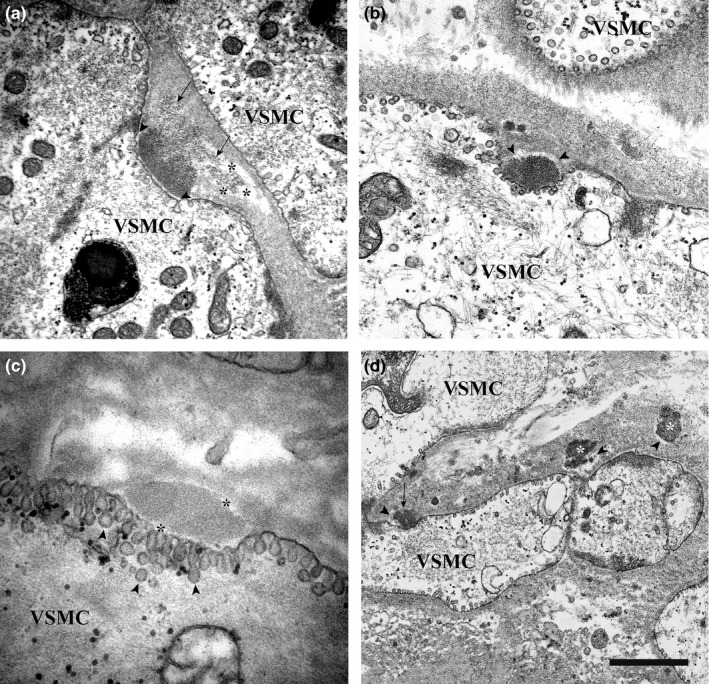
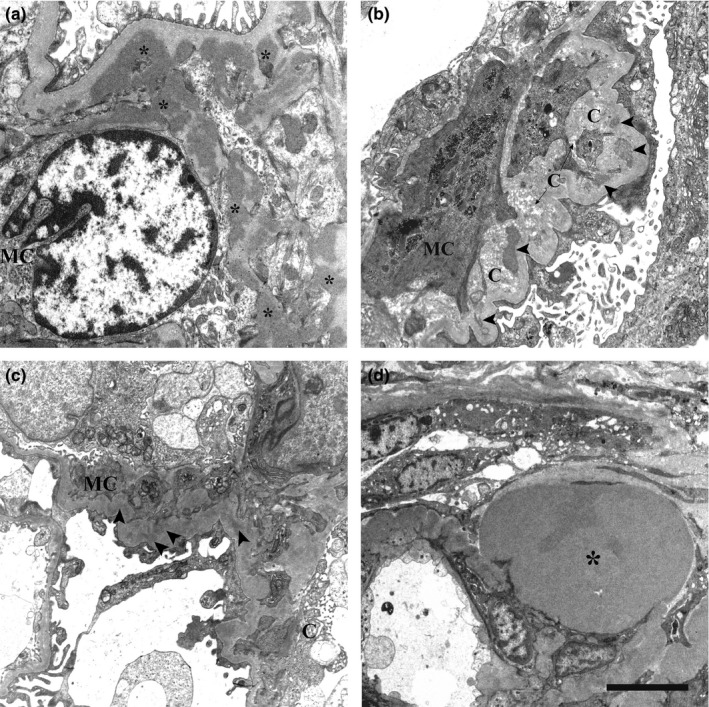
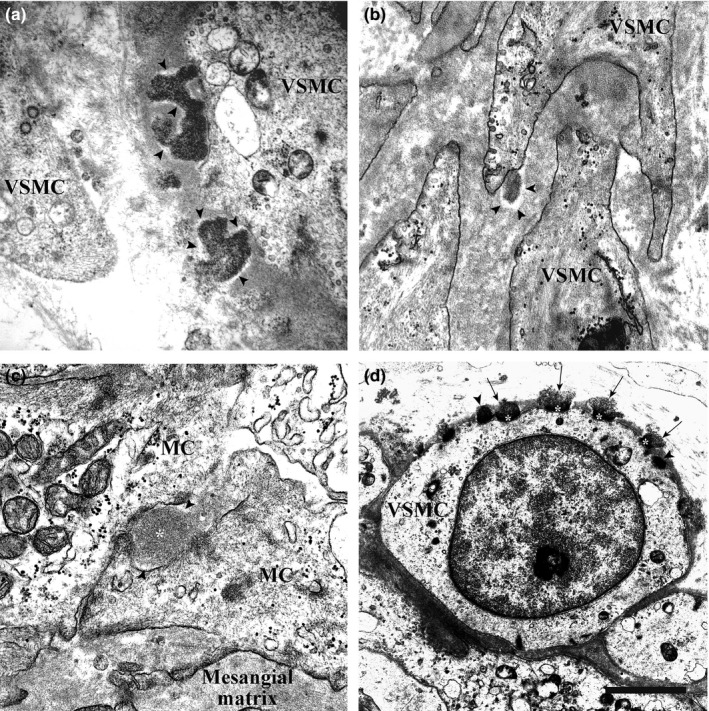
In CADASIL patients, several GOM deposits from all sites were partially or totally surrounded by an electron-lucent halo. The deposits frequently had a more electron-dense portion with a regular outline on the inner side and a less osmiophilic, looser outer side displaying a less regular profile. The uniformly dense deposits tended to be more osmiophilic if located close to the cell membrane and less osmiophilic if laid farther away from it. The immunoglobulin deposits from the glomerulonephritis and FSGS patients lacked both the granular pattern and the halo.
This study demonstrates that GOM deposits may have a nonuniform morphology and describes in detail an electron-lucent halo surrounding several of them. It is conceivable that the halo is the morphological evidence and possibly the cause of an aberrant NOTCH3 processing, already suspected to be involved in CADASIL.
伴有皮质下梗死和白质脑病的脑常染色体显性遗传性动脉病(CADASIL)是一种遗传性系统性血管疾病。颗粒性亲银物质(GOM)是其超微结构标志物。我们回顾了 CADASIL 患者的组织活检,以确定超微结构观察是否有助于阐明 CADASIL 的发病机制。鉴于 GOM 沉积物与肾小球肾炎和局灶节段性肾小球硬化症(FSGS)中所见的免疫球蛋白沉积物相似,我们研究并比较了它们的形态。
对 13 例临床和分子诊断为 CADASIL 的患者的皮肤、骨骼肌、肾脏和心包组织活检,以及 5 例 IgA 肾病和 5 例原发性 FSGS 患者的肾脏活检进行了超微结构检查。
在 CADASIL 患者中,来自所有部位的多个 GOM 沉积物部分或完全被电子透明晕环绕。沉积物经常在内侧具有较电子致密的部分,具有规则的轮廓,而在外侧具有较不亲电子、较疏松的部分,显示出较不规则的轮廓。如果位于靠近细胞膜的位置,则均匀致密的沉积物往往更亲电子,如果位于远离细胞膜的位置,则更不亲电子。来自肾小球肾炎和 FSGS 患者的免疫球蛋白沉积物既没有颗粒状形态,也没有晕环。
本研究表明 GOM 沉积物可能具有不均匀的形态,并详细描述了几个沉积物周围的电子透明晕。可以想象,晕环是异常 NOTCH3 加工的形态学证据,可能是已经怀疑与 CADASIL 相关的原因。