Hu Shui-Yi, Gu Qiu-Hua, Wang Jia, Wang Miao, Jia Xiao-Yu, Cui Zhao, Zhao Ming-Hui
Renal Division, Peking University First Hospital, Beijing, China.
Institute of Nephrology, Peking University, Beijing, China.
J Cell Mol Med. 2017 Sep;21(9):2117-2128. doi: 10.1111/jcmm.13134. Epub 2017 Mar 10.
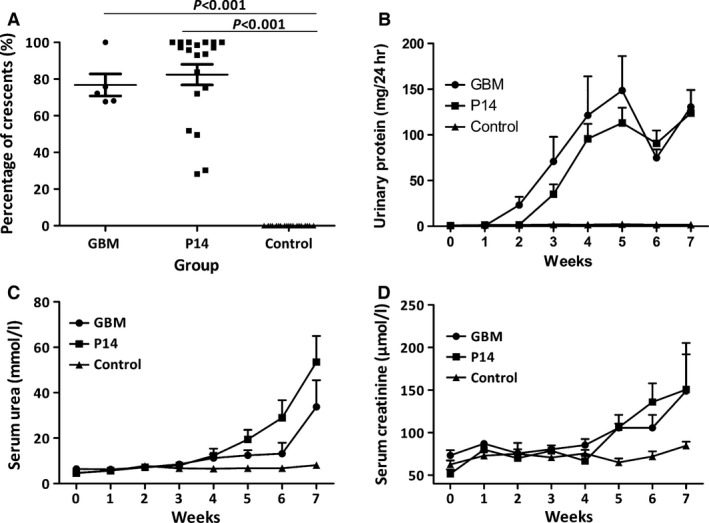
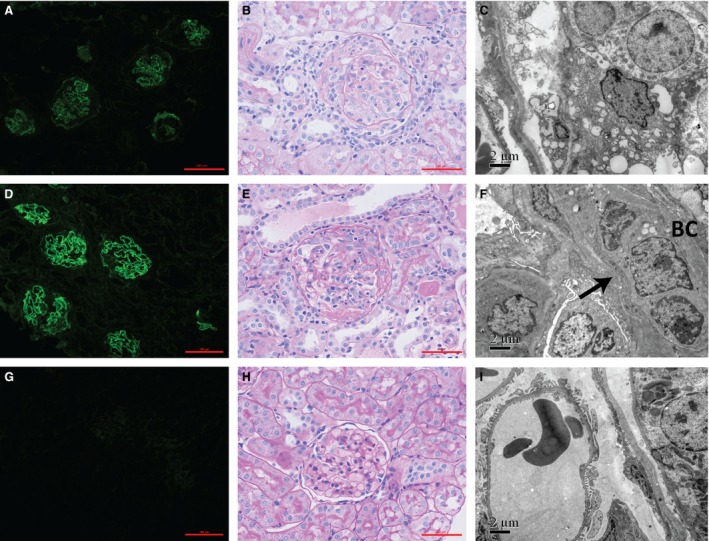
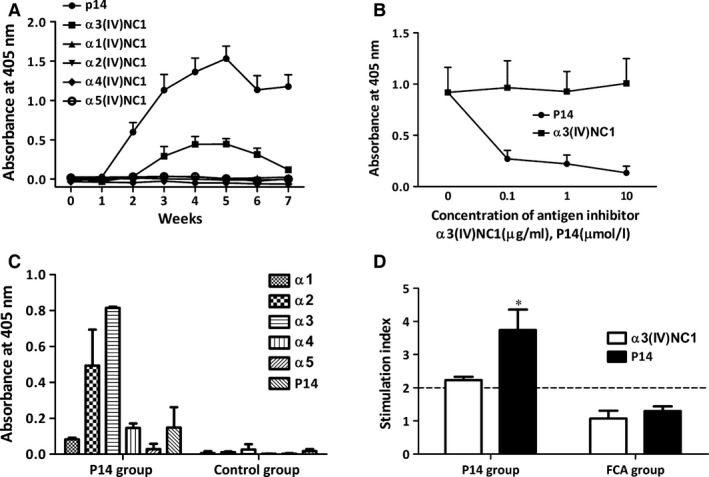
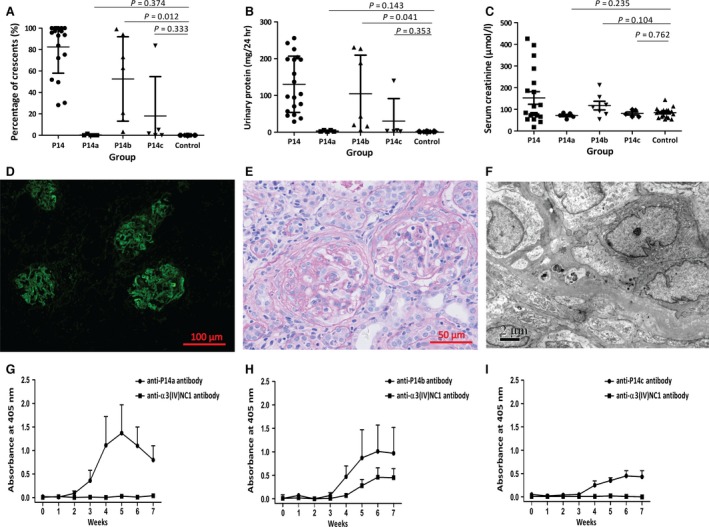
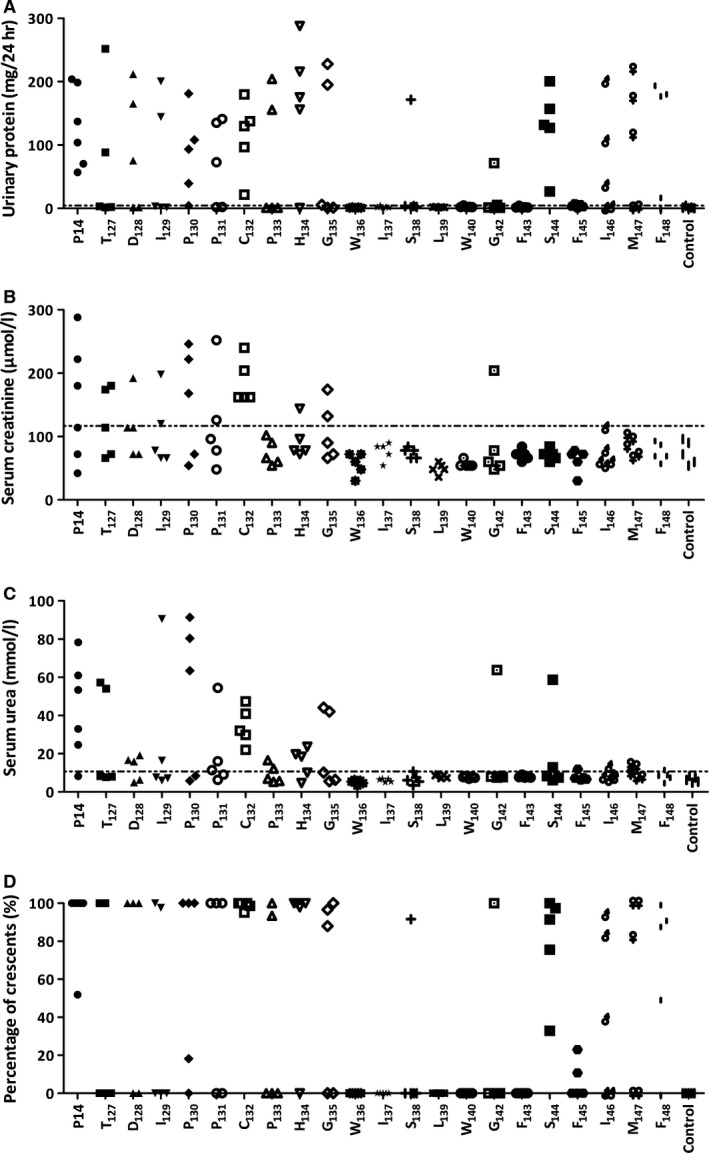
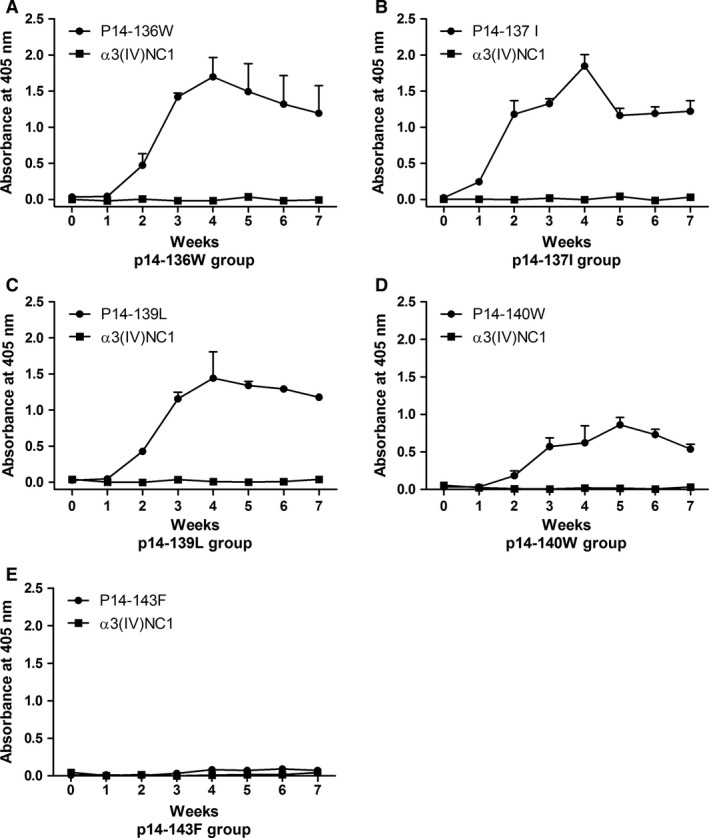
Goodpasture antigen, the non-collagenous domain of α3 chain of type IV collagen [α3(IV)NC1], is the target antigen of anti-glomerular basement membrane (GBM) antibodies. The pathogenicity of T cell epitopes is not elucidated clearly. In this study, we aim to define the nephritogenic T cell epitopes and its critical amino acid residues. Twenty-four overlapping linear peptides were synthesized covering the whole sequence of human α3(IV)NC1. Wistar-Kyoto rats were immunized with linear peptides, and experimental autoimmune glomerulonephritis was evaluated. Critical amino acid was identified by the loss of nephritogenic function after each amino acid substitution by alanine. Of the 24 peptides, P14 (α3 ) could induce 90.5% (19/21) of WKY rats developing anti-GBM glomerulonephritis with proteinuria, elevated serum urea and creatinine, IgG linear deposit on GBM and substantial (in average 82.4 ± 5.6%) crescent formation in glomeruli. Lymphocytes of immunized rats proliferated in response to α3 and α3(IV)NC1 in vitro. Sera of these rats recognized α3 and later on together with intact human α3(IV)NC1. Antibodies towards α3 and intact α3(IV)NC1 could also be detected from the kidney elutes. These antibodies showed no cross-reaction with each other, which implies intramolecular epitope spreading during disease progress. After sequential amino acid substitution, the α3 with substitution of tryptophan , isoleucine , leucine or tryptophan lost its nephritogenicity. Human α3 is a nephritogenic T cell epitope in WKY rats, with the critical amino acids as W I xL W . These findings might facilitate future investigation on microbial aetiology and potential specific immunotherapy of anti-GBM disease.
Goodpasture抗原,即IV型胶原α3链的非胶原结构域[α3(IV)NC1],是抗肾小球基底膜(GBM)抗体的靶抗原。T细胞表位的致病性尚未完全阐明。在本研究中,我们旨在确定致肾炎性T细胞表位及其关键氨基酸残基。合成了覆盖人α3(IV)NC1全序列的24个重叠线性肽段。用线性肽段免疫Wistar-Kyoto大鼠,并评估实验性自身免疫性肾小球肾炎。通过将每个氨基酸用丙氨酸替代后致肾炎功能的丧失来鉴定关键氨基酸。在这24个肽段中,P14(α3 )可诱导90.5%(19/21)的WKY大鼠发生抗GBM肾小球肾炎,伴有蛋白尿、血清尿素和肌酐升高、GBM上IgG线性沉积以及肾小球中大量(平均82.4±5.6%)新月体形成。免疫大鼠的淋巴细胞在体外对α3和α3(IV)NC1有增殖反应。这些大鼠的血清识别α3,随后还识别完整的人α3(IV)NC1。从肾脏洗脱物中也可检测到针对α3和完整α3(IV)NC1的抗体。这些抗体彼此之间没有交叉反应,这意味着在疾病进展过程中存在分子内表位扩展。经过连续的氨基酸替代后,色氨酸 、异亮氨酸 、亮氨酸或色氨酸被替代的α3失去了致肾炎性。人α3是WKY大鼠中的一个致肾炎性T细胞表位,关键氨基酸为W I xL W 。这些发现可能有助于未来对抗GBM疾病的微生物病因学和潜在特异性免疫治疗的研究。