Jämsä Pyry, Jämsen Esa, Lyytikäinen Leo-Pekka, Kalliovalkama Jarkko, Eskelinen Antti, Oksala Niku
a Coxa Hospital for Joint Replacement.
b School of Medicine , University of Tampere.
Acta Orthop. 2017 Aug;88(4):370-376. doi: 10.1080/17453674.2017.1301743. Epub 2017 Mar 15.
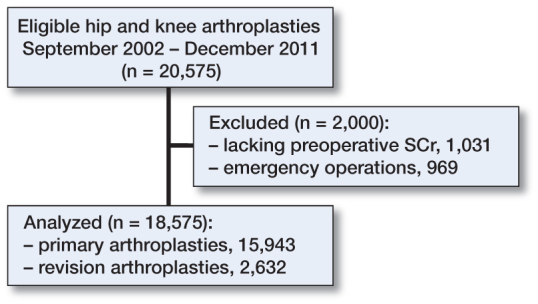
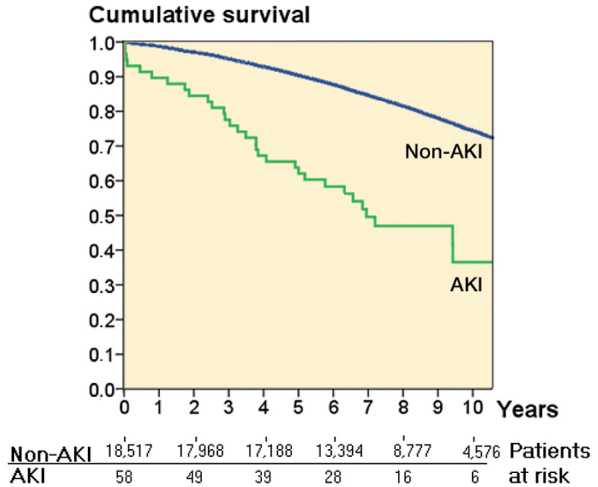
Background and purpose - Patients developing postoperative acute kidney injury (AKI) are at risk of higher morbidity and mortality. In arthroplasty patients, many pre- and perioperative factors are associated with AKI but some of the risk factors are unclear. We report the incidence of postoperative AKI, the conditions associated with it, and survival rates in AKI patients. Patients and methods - We obtained data from 20,575 consecutive hip or knee arthroplasties. Postoperative AKI, occurring within 7 days after the operation, was defined using the risk, injury, failure, loss, and end-stage (RIFLE) criteria. We analyzed independent risk factors for AKI using binary logistic regression. In addition, we reviewed the records of AKI patients and performed a survival analysis. Results - The AKI incidence was 3.3 per 1,000 operations. We found preoperative estimated glomerular filtration rate, ASA classification, body mass index, and duration of operation to be independent risk factors for AKI. Infections, paralytic ileus, and cardiac causes were the predominant underlying conditions, whereas half of all AKI cases occurred without any clear underlying condition. Survival rates were lower in AKI patients. Interpretation - Supporting earlier results, existing renal insufficiency and patient-related characteristics were found to be associated with an increased risk of postoperative AKI. Furthermore, duration of operation was identified as an independent risk factor. We suggest careful renal monitoring postoperatively for patients with these risk factors.
背景与目的——发生术后急性肾损伤(AKI)的患者有更高的发病和死亡风险。在关节置换术患者中,许多术前和围手术期因素与AKI相关,但一些危险因素尚不清楚。我们报告术后AKI的发生率、与之相关的情况以及AKI患者的生存率。
患者与方法——我们从连续的20575例髋或膝关节置换术中获取数据。术后AKI定义为术后7天内发生的,采用风险、损伤、衰竭、丧失和终末期(RIFLE)标准进行判定。我们使用二元逻辑回归分析AKI的独立危险因素。此外,我们查阅了AKI患者的记录并进行了生存分析。
结果——AKI的发生率为每1000例手术3.3例。我们发现术前估计肾小球滤过率、美国麻醉医师协会(ASA)分级、体重指数和手术时长是AKI的独立危险因素。感染、麻痹性肠梗阻和心脏病因是主要的潜在病因,而所有AKI病例中有一半发生时没有任何明确的潜在病因。AKI患者的生存率较低。
解读——支持早期结果,发现现有的肾功能不全和患者相关特征与术后AKI风险增加有关。此外,手术时长被确定为一个独立危险因素。我们建议对有这些危险因素的患者术后进行仔细的肾脏监测。