Hilal Ziad, Kumpernatz Anne K, Rezniczek Günther A, Cetin Cem, Tempfer-Bentz Eva-Katrin, Tempfer Clemens B
Department of Obstetrics and Gynecology, Ruhr Universität Bochum, Bochum, Germany.
Medicine (Baltimore). 2017 Mar;96(11):e6355. doi: 10.1097/MD.0000000000006355.
To compare medical students' skills for vaginal operative delivery by vacuum extraction (VE) after hands-on training versus video demonstration.
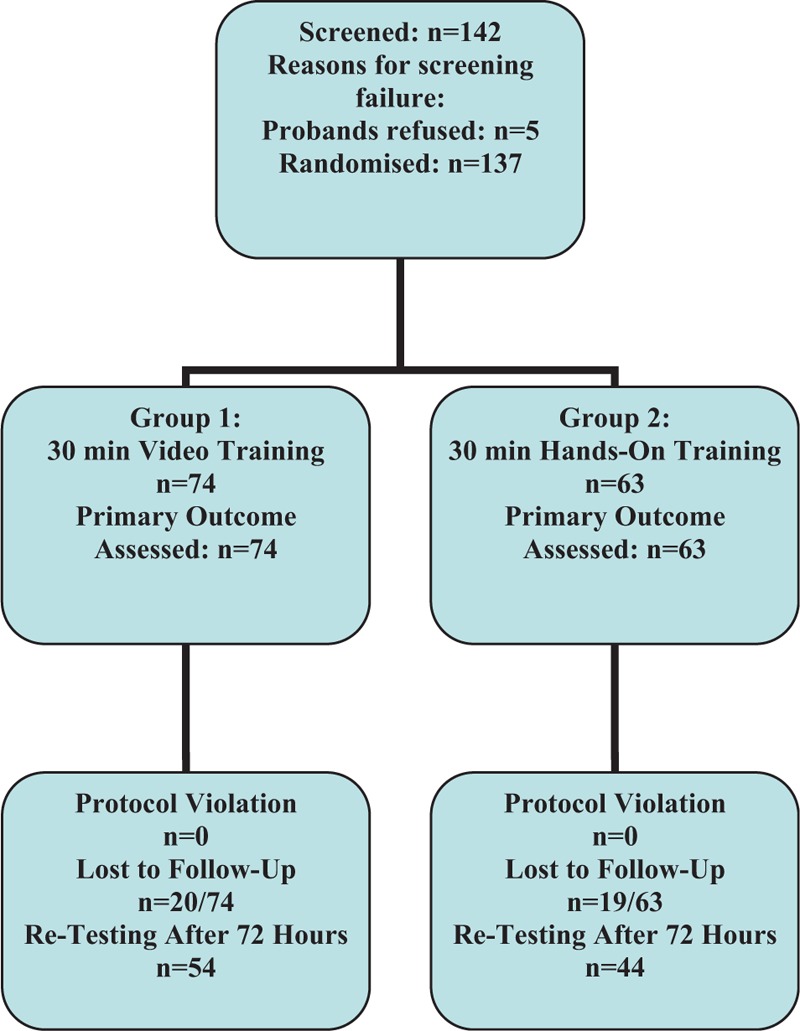
We randomized medical students to an expert demonstration (group 1) or a hands-on (group 2) training using a standardized VE algorithm on a pelvic training model. Students were tested with a 40-item Objective Structured Assessment of Technical Skills (OSATS) scoring system after training and 4 days later. OSATS scores were the primary outcome. Performance time, self-assessment, confidence, and global rating scale were secondary outcomes. We assessed the constructive validity of OSATS in this VE model comparing metric scores of experts and students.
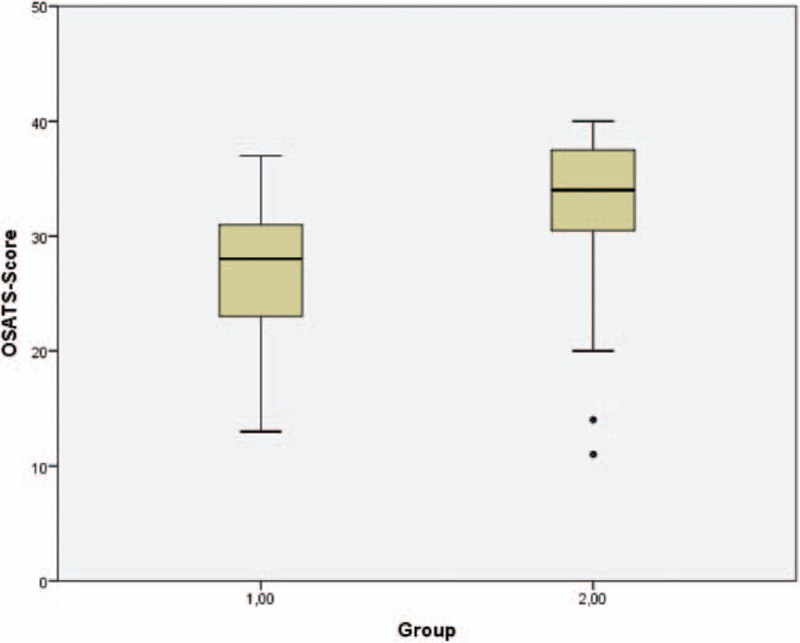
In all, 137 students were randomized. OSATS scores were higher in group 2 (n = 63) compared with group 1 (n = 74) (32.89 ± 6.39 vs 27.51 ± 10.27, respectively; P < 0.0001). Global rating scale (1.49 ± 0.76 vs 2.33 ± 0.94, respectively; P < 0.0001), confidence (2.22 ± 0.75 vs 3.26 ± 0.94, respectively; P = 0.04), self-assessment (2.03 ± 0.62 vs 2.51 ± 0.77, respectively; P < 0.0001), and performance time (38.81 ± 11.58 seconds vs 47.23 ± 17.35 seconds, respectively; P = 0.001) also favored group 2. After 4 days, this effect persisted with OSATS scores still being significantly higher in group 2 (30.00 ± 6.50 vs 25.59 ± 6.09, respectively; P = 0.001). The assessed OSATS scores showed constructive validity. In a multiple linear regression analysis, group assignment independently influenced OSATS scores, whereas sex, handedness, sports activities, and type of curriculum were not independently associated with OSATS scores.
Hands-on training is superior to video demonstration for teaching VE on a pelvic model.
比较医学生在接受实践培训与视频演示后通过真空吸引术(VE)进行阴道手术分娩的技能。
我们将医学生随机分为两组,一组接受专家演示(第1组),另一组在盆腔训练模型上使用标准化的VE算法进行实践(第2组)培训。培训后及4天后,使用40项技术技能客观结构化评估(OSATS)评分系统对学生进行测试。OSATS评分是主要结果。操作时间、自我评估、信心和整体评分量表是次要结果。我们在这个VE模型中通过比较专家和学生的指标评分来评估OSATS的结构效度。
总共137名学生被随机分组。第2组(n = 63)的OSATS评分高于第1组(n = 74)(分别为32.89 ± 6.39和27.51 ± 10.27;P < 0.0001)。整体评分量表(分别为1.49 ± 0.76和2.33 ± 0.94;P < 0.0001)、信心(分别为2.22 ± 0.75和3.26 ± 0.94;P = 0.04)、自我评估(分别为2.03 ± 0.62和2.51 ± 0.77;P < 0.0001)以及操作时间(分别为38.81 ± 11.58秒和47.23 ± 17.35秒;P = 0.001)也都有利于第2组。4天后,这种效果仍然存在,第2组的OSATS评分仍然显著更高(分别为30.00 ± 6.50和25.59 ± 6.09;P = 0.001)。评估的OSATS评分显示出结构效度。在多元线性回归分析中,分组独立影响OSATS评分,而性别、利手、体育活动和课程类型与OSATS评分没有独立关联。
在盆腔模型上进行VE教学时,实践培训优于视频演示。