LaDage Lara D, Roth Timothy C, Downs Cynthia J, Sinervo Barry, Pravosudov Vladimir V
Division of Mathematics and Natural Sciences, Penn State University Altoona Altoona, PA, USA.
Department of Psychology, Franklin and Marshall College Lancaster, PA, USA.
Front Neurosci. 2017 Mar 1;11:97. doi: 10.3389/fnins.2017.00097. eCollection 2017.
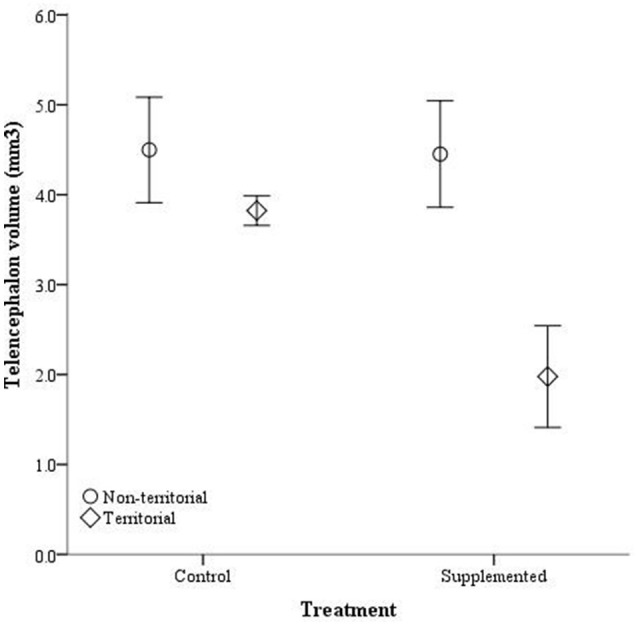
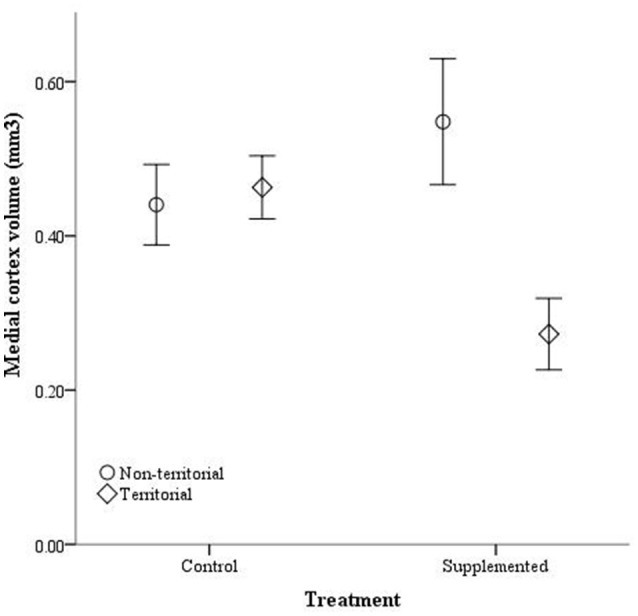
Variation in an animal's spatial environment can induce variation in the hippocampus, an area of the brain involved in spatial cognitive processing. Specifically, increased spatial area use is correlated with increased hippocampal attributes, such as volume and neurogenesis. In the side-blotched lizard (), males demonstrate alternative reproductive tactics and are either territorial-defending large, clearly defined spatial boundaries-or non-territorial-traversing home ranges that are smaller than the territorial males' territories. Our previous work demonstrated cortical volume (reptilian hippocampal homolog) correlates with these spatial niches. We found that territorial holders have larger medial cortices than non-territory holders, yet these differences in the neural architecture demonstrated some degree of plasticity as well. Although we have demonstrated a link among territoriality, spatial use, and brain plasticity, the mechanisms that underlie this relationship are unclear. Previous studies found that higher testosterone levels can induce increased use of the spatial area and can cause an upregulation in hippocampal attributes. Thus, testosterone may be the mechanistic link between spatial area use and the brain. What remains unclear, however, is if testosterone can affect the cortices independent of spatial experiences and whether testosterone differentially interacts with territorial status to produce the resultant cortical phenotype. In this study, we compared neurogenesis as measured by the total number of doublecortin-positive cells and cortical volume between territorial and non-territorial males supplemented with testosterone. We found no significant differences in the number of doublecortin-positive cells or cortical volume among control territorial, control non-territorial, and testosterone-supplemented non-territorial males, while testosterone-supplemented territorial males had smaller medial cortices containing fewer doublecortin-positive cells. These results demonstrate that testosterone can modulate medial cortical attributes outside of differential spatial processing experiences but that territorial males appear to be more sensitive to alterations in testosterone levels compared with non-territorial males.
动物空间环境的变化会诱发海马体的变化,海马体是大脑中参与空间认知处理的一个区域。具体而言,空间区域使用的增加与海马体属性的增加相关,如体积和神经发生。在侧斑蜥蜴中,雄性表现出不同的繁殖策略,要么是捍卫领地——保卫大片明确界定的空间边界——要么是非领地性的——穿越比领地雄性的领地更小的活动范围。我们之前的研究表明,皮质体积(爬行动物海马体的同源物)与这些空间生态位相关。我们发现,领地占有者的内侧皮质比非领地占有者的更大,但这些神经结构上的差异也表现出一定程度的可塑性。虽然我们已经证明了领地性、空间使用和大脑可塑性之间的联系,但这种关系背后的机制尚不清楚。先前的研究发现,较高的睾酮水平会导致空间区域使用增加,并会引起海马体属性的上调。因此,睾酮可能是空间区域使用与大脑之间的机制性联系。然而,尚不清楚的是,睾酮是否能独立于空间体验影响皮质,以及睾酮是否与领地状态有不同的相互作用,从而产生最终的皮质表型。在这项研究中,我们比较了补充睾酮的领地雄性和非领地雄性之间,以双皮质素阳性细胞总数衡量的神经发生和皮质体积。我们发现,对照领地雄性、对照非领地雄性和补充睾酮的非领地雄性之间,双皮质素阳性细胞数量或皮质体积没有显著差异,而补充睾酮的领地雄性的内侧皮质较小,双皮质素阳性细胞较少。这些结果表明,睾酮可以在不同的空间处理体验之外调节内侧皮质属性,但与非领地雄性相比,领地雄性似乎对睾酮水平的变化更敏感。