Simpson Matthew J, Lo Kai-Yin, Sun Yung-Shin
School of Mathematical Sciences, Queensland University of Technology (QUT), Brisbane, Australia.
Department of Agricultural Chemistry, National Taiwan University, Taipei, 10617, Taiwan.
BMC Syst Biol. 2017 Mar 17;11(1):39. doi: 10.1186/s12918-017-0413-5.
Directed cell migration can be driven by a range of external stimuli, such as spatial gradients of: chemical signals (chemotaxis); adhesion sites (haptotaxis); or temperature (thermotaxis). Continuum models of cell migration typically include a diffusion term to capture the undirected component of cell motility and an advection term to capture the directed component of cell motility. However, there is no consensus in the literature about the form that the advection term takes. Some theoretical studies suggest that the advection term ought to include receptor saturation effects. However, others adopt a much simpler constant coefficient. One of the limitations of including receptor saturation effects is that it introduces several additional unknown parameters into the model. Therefore, a relevant research question is to investigate whether directed cell migration is best described by a simple constant tactic coefficient or a more complicated model incorporating saturation effects.
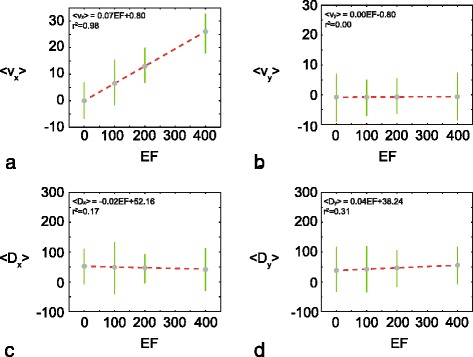
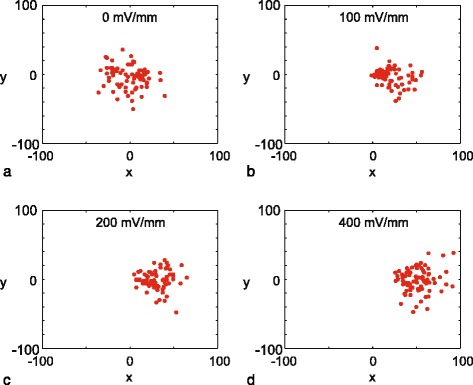
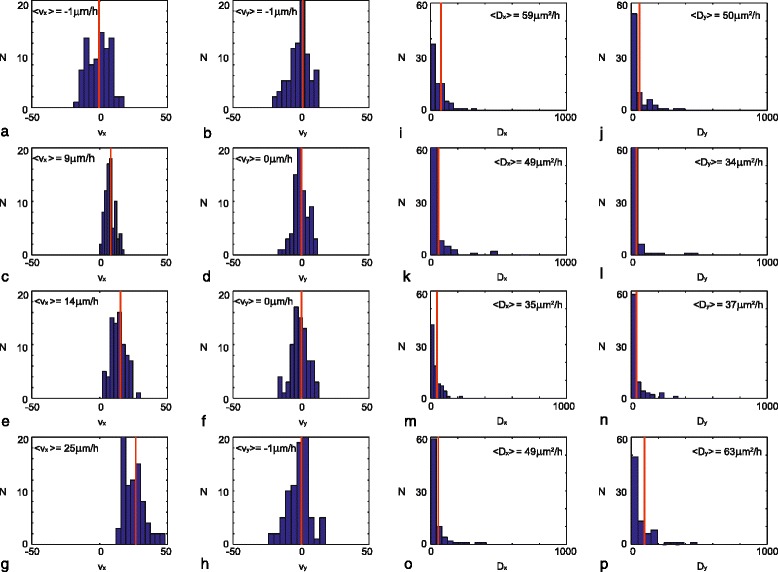
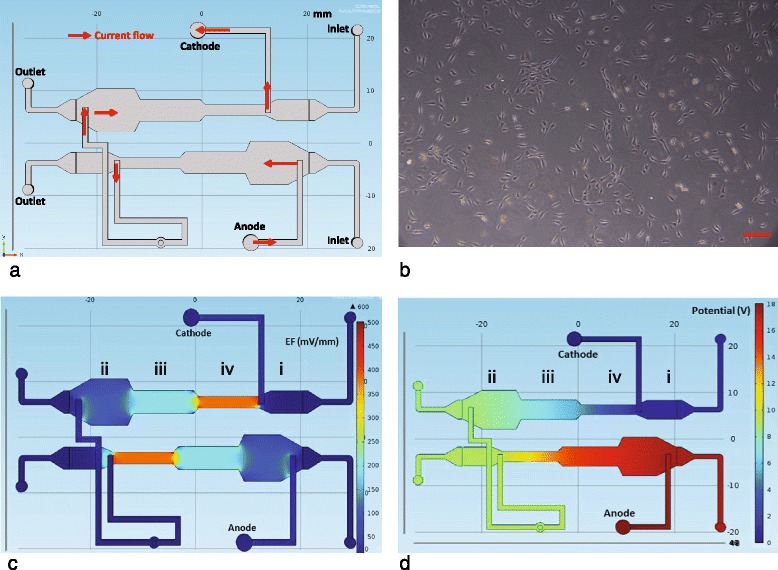
We study directed cell migration using an experimental device in which the directed component of the cell motility is driven by a spatial gradient of electric potential, which is known as electrotaxis. The electric field (EF) is proportional to the spatial gradient of the electric potential. The spatial variation of electric potential across the experimental device varies in such a way that there are several subregions on the device in which the EF takes on different values that are approximately constant within those subregions. We use cell trajectory data to quantify the motion of 3T3 fibroblast cells at different locations on the device to examine how different values of the EF influences cell motility. The undirected (random) motility of the cells is quantified in terms of the cell diffusivity, D, and the directed motility is quantified in terms of a cell drift velocity, v. Estimates D and v are obtained under a range of four different EF conditions, which correspond to normal physiological conditions. Our results suggest that there is no anisotropy in D, and that D appears to be approximately independent of the EF and the electric potential. The drift velocity increases approximately linearly with the EF, suggesting that the simplest linear advection term, with no additional saturation parameters, provides a good explanation of these physiologically relevant data.
We find that the simplest linear advection term in a continuum model of directed cell motility is sufficient to describe a range of different electrotaxis experiments for 3T3 fibroblast cells subject to normal physiological values of the electric field. This is useful information because alternative models that include saturation effects involve additional parameters that need to be estimated before a partial differential equation model can be applied to interpret or predict a cell migration experiment.
定向细胞迁移可由一系列外部刺激驱动,例如以下物质的空间梯度:化学信号(趋化性);黏附位点(趋触性);或温度(趋温性)。细胞迁移的连续介质模型通常包括一个扩散项以捕捉细胞运动的无向成分,以及一个平流项以捕捉细胞运动的定向成分。然而,文献中对于平流项的形式尚无共识。一些理论研究表明平流项应包括受体饱和效应。然而,其他研究采用了更为简单的常数系数。纳入受体饱和效应的局限性之一在于它会给模型引入几个额外的未知参数。因此,一个相关的研究问题是探究定向细胞迁移用简单的常数趋性系数描述还是用包含饱和效应的更复杂模型描述更佳。
我们使用一种实验装置研究定向细胞迁移,在该装置中细胞运动的定向成分由电势的空间梯度驱动,这被称为电趋性。电场(EF)与电势的空间梯度成正比。实验装置上电势的空间变化方式使得装置上有几个子区域,其中EF取不同的值,且在这些子区域内近似恒定。我们使用细胞轨迹数据来量化装置上不同位置的3T3成纤维细胞的运动,以研究EF的不同值如何影响细胞运动。细胞的无向(随机)运动以细胞扩散系数D来量化,定向运动以细胞漂移速度v来量化。在对应正常生理条件的四种不同EF条件范围内获得D和v的估计值。我们的结果表明D不存在各向异性,并且D似乎大致与EF和电势无关。漂移速度随EF近似线性增加,这表明最简单的线性平流项,无需额外的饱和参数,就能很好地解释这些生理相关数据。
我们发现,在定向细胞运动的连续介质模型中,最简单的线性平流项足以描述一系列针对处于正常生理电场值的3T3成纤维细胞的不同电趋性实验。这是有用的信息,因为包含饱和效应的替代模型涉及额外的参数,在将偏微分方程模型应用于解释或预测细胞迁移实验之前需要对这些参数进行估计。