Department of Pathology and Laboratory Medicine, Perelman School of Medicine, University of Pennsylvania, Philadelphia, Pennsylvania 19104, USA.
Cell and Molecular Biology Program, Biomedical Graduate Studies, University of Pennsylvania, Philadelphia, Pennsylvania 19104, USA.
Nat Commun. 2017 Mar 17;8:14766. doi: 10.1038/ncomms14766.
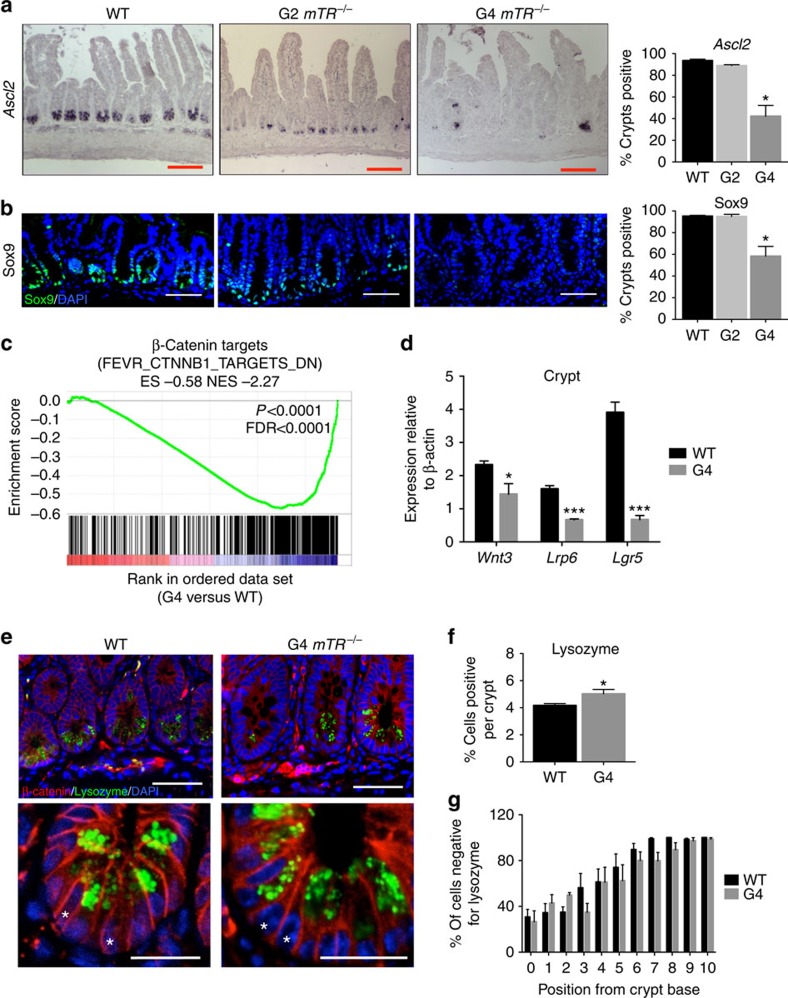
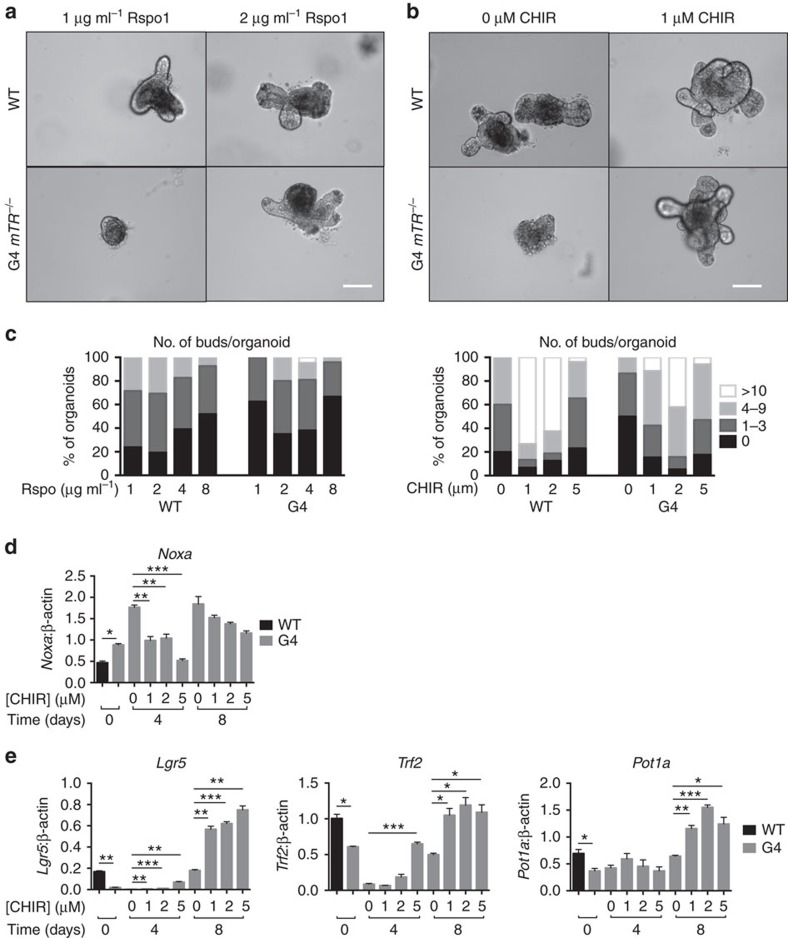
Critical telomere shortening (for example, secondary to partial telomerase deficiency in the rare disease dyskeratosis congenita) causes tissue pathology, but underlying mechanisms are not fully understood. Mice lacking telomerase (for example, mTR telomerase RNA template mutants) provide a model for investigating pathogenesis. In such mice, after several generations of telomerase deficiency telomeres shorten to the point of uncapping, causing defects most pronounced in high-turnover tissues including intestinal epithelium. Here we show that late-generation mTR mutants experience marked downregulation of Wnt pathway genes in intestinal crypt epithelia, including crypt base columnar stem cells and Paneth cells, and in underlying stroma. The importance of these changes was revealed by rescue of crypt apoptosis and Wnt pathway gene expression upon treatment with Wnt pathway agonists. Rescue was associated with reduced telomere-dysfunction-induced foci and anaphase bridges, indicating improved telomere capping. Thus a mutually reinforcing feedback loop exists between telomere capping and Wnt signalling, and telomere capping can be impacted by extracellular cues in a fashion independent of telomerase.
严重的端粒缩短(例如,由于罕见疾病先天性角化不良中部分端粒酶缺乏引起的)会导致组织病理学改变,但潜在机制尚未完全了解。缺乏端粒酶的小鼠(例如,mTR 端粒酶 RNA 模板突变体)为研究发病机制提供了一个模型。在这些小鼠中,经过几代端粒酶缺乏后,端粒缩短到去帽的程度,导致包括肠道上皮在内的高周转率组织中出现最明显的缺陷。在这里,我们表明,晚期 mTR 突变体在肠道隐窝上皮中经历了 Wnt 途径基因的显著下调,包括隐窝基柱状干细胞和潘氏细胞,以及下方的基质。这些变化的重要性通过用 Wnt 途径激动剂处理来挽救隐窝细胞凋亡和 Wnt 途径基因表达来揭示。挽救与减少端粒功能障碍诱导的焦点和后期桥有关,表明端粒封端得到改善。因此,端粒封端和 Wnt 信号之间存在相互增强的反馈回路,并且端粒封端可以通过与端粒酶无关的细胞外信号受到影响。