Narayan Ravi S, Fedrigo Carlos A, Brands Eelke, Dik Rogier, Stalpers Lukas J A, Baumert Brigitta G, Slotman Ben J, Westerman Bart A, Peters Godefridus J, Sminia Peter
Department of Radiation Oncology, VU University Medical Center/Cancer Center Amsterdam, P.O. Box 7057, Amsterdam, 1007, MB, The Netherlands.
Department of Radiation Oncology, Academic Medical Center, Amsterdam, The Netherlands.
BMC Cancer. 2017 Mar 21;17(1):204. doi: 10.1186/s12885-017-3193-9.
Glioblastoma multiforme (GBM) is the most common, invasive and deadly primary type of malignant brain tumor. The Phosphatidylinositol-3-Kinase/AKT (PI3K/AKT) pathway is highly active in GBM and has been associated with increased survival and resistance to therapy. The aim of this study is to investigate the effects of AKT inhibition in combination with the current standard of care which consists of irradiation and temozolomide (TMZ) on human malignant glioma cells growing adherent and as multicellular spheroids in vitro.
The effects of the allosteric inhibitor MK2206 combined with irradiation and TMZ were assessed on glioma cells growing adherent and as multicellular 3D spheroids. The interaction was studied on proliferation, clonogenic cell survival, cell invasion, -migration and on expression of key proteins in the PI3K-AKT pathway by western blot.
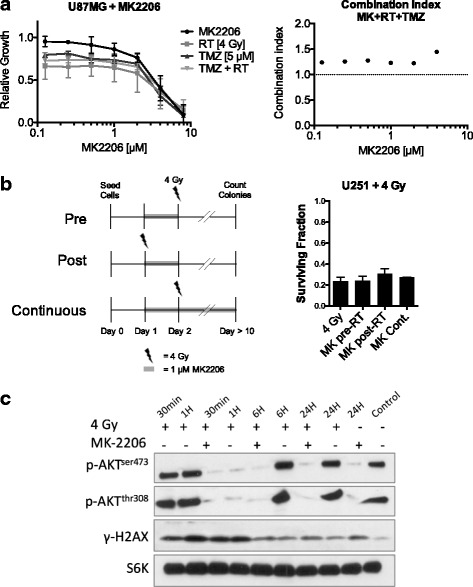
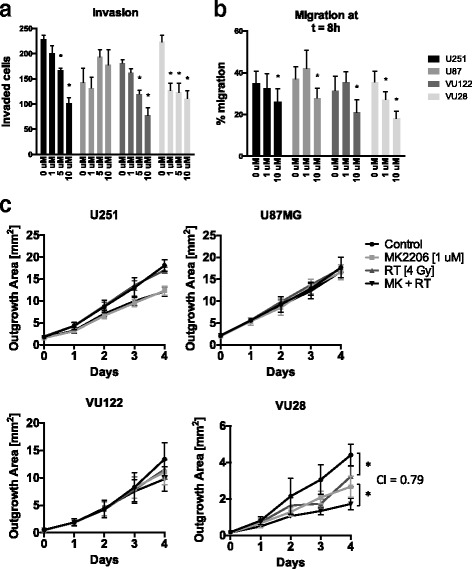
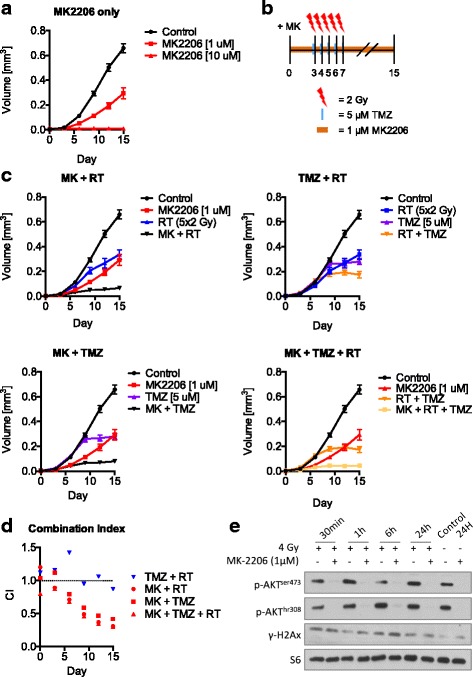
A differential effect was found at low- (1 μM) and high dose (10 μM) MK2206. At 1 μM, the inhibitor reduced phosphorylation of Thr308 and Ser473 residues of AKT in both adherent cells and spheroids. Low dose MK2206 delayed spheroid growth and sensitized spheroids to both irradiation and TMZ in a synergistic way (Combination index <0.35). In contrast, neither low nor high dose MK2206 did enhance therapy sensitivity in adherent growing cells. Effective inhibition of invasion and migration was observed only at higher doses of MK2206 (>5 μM).
The data show that a 3D spheroid model show different sensitivity to irradiation when combined with AKT inhibition. Thereby we show that MK2206 has potential synergistic efficacy to the current standard of care for glioma patients.
多形性胶质母细胞瘤(GBM)是最常见、具有侵袭性且致命的原发性恶性脑肿瘤类型。磷脂酰肌醇-3-激酶/蛋白激酶B(PI3K/AKT)通路在GBM中高度活跃,且与生存期延长及治疗耐药相关。本研究旨在探究AKT抑制联合由放疗和替莫唑胺(TMZ)组成的当前标准治疗方案对体外贴壁生长及形成多细胞球体的人恶性胶质瘤细胞的影响。
评估变构抑制剂MK2206联合放疗和TMZ对贴壁生长及形成多细胞3D球体的胶质瘤细胞的影响。通过蛋白质免疫印迹法研究其在增殖、克隆形成细胞存活、细胞侵袭、迁移以及PI3K-AKT通路关键蛋白表达方面的相互作用。
在低剂量(1 μM)和高剂量(10 μM)MK2206作用下发现了不同的效应。在1 μM时,该抑制剂降低了贴壁细胞和球体中AKT苏氨酸308和丝氨酸473残基的磷酸化水平。低剂量MK2206延缓了球体生长,并以协同方式使球体对放疗和TMZ均敏感(联合指数<0.35)。相比之下,低剂量和高剂量MK2206均未增强贴壁生长细胞的治疗敏感性。仅在较高剂量的MK2206(>5 μM)时观察到对侵袭和迁移的有效抑制。
数据表明,3D球体模型在联合AKT抑制时对放疗表现出不同的敏感性。由此我们证明MK2206对胶质瘤患者当前的标准治疗方案具有潜在的协同疗效。