Pike Daniel, Shiu Yan-Ting, Somarathna Maheshika, Guo Lingling, Isayeva Tatyana, Totenhagen John, Lee Timmy
Department of Bioengineering, University of Utah, Salt Lake City, UT, USA.
Division of Nephrology and Hypertension, Department of Internal Medicine, University of Utah, Salt Lake City, UT, USA.
Theor Biol Med Model. 2017 Mar 20;14(1):5. doi: 10.1186/s12976-017-0053-x.
Arteriovenous fistula (AVF) maturation failure remains a major cause of morbidity and mortality in hemodialysis patients. The two major etiologies of AVF maturation failure are early neointimal hyperplasia development and persistent inadequate outward remodeling. Although hemodynamic changes following AVF creation may impact AVF remodeling and contribute to neointimal hyperplasia development and impaired outward remodeling, detailed AVF hemodynamics are not yet fully known. Since murine AVF models are valuable tools for investigating the pathophysiology of AVF maturation failure, there is a need for a new approach that allows the hemodynamic characterization of murine AVF at high resolutions.
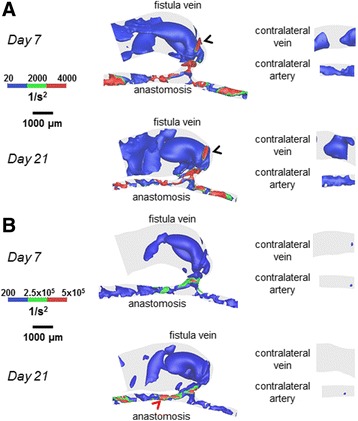
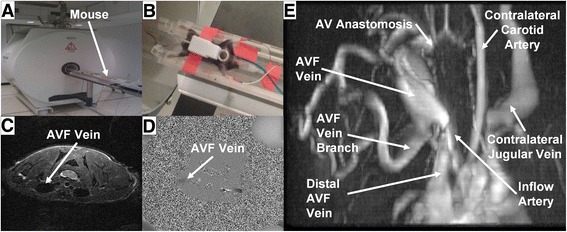
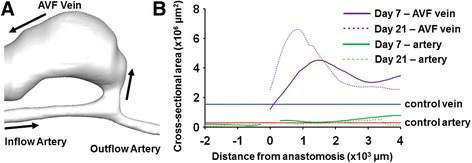
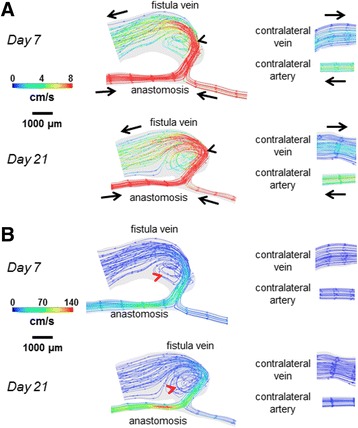
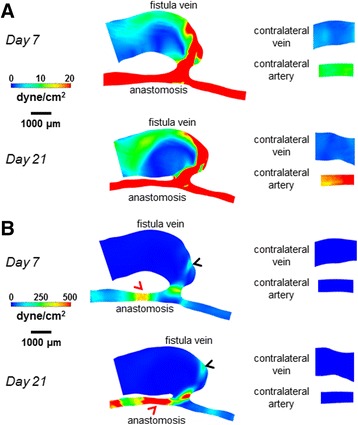
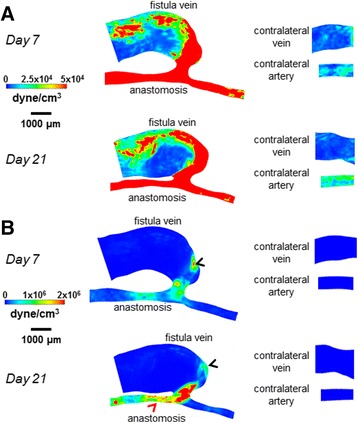
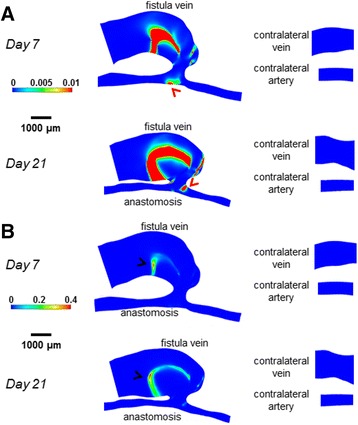
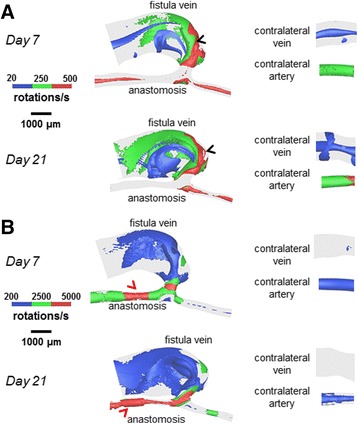
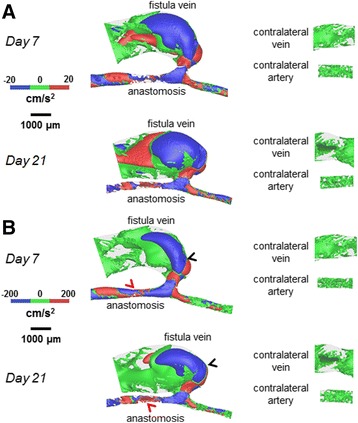
This methods paper presents a magnetic resonance imaging (MRI)-based computational fluid dynamic (CFD) method that we developed to rigorously quantify the evolving hemodynamic environment in murine AVF. The lumen geometry of the entire murine AVF was reconstructed from high resolution, non-contrast 2D T2-weighted fast spin echo MRI sequence, and the flow rates of the AVF inflow and outflow were extracted from a gradient echo velocity mapping sequence. Using these MRI-obtained lumen geometry and inflow information, CFD modeling was performed and used to calculate blood flow velocity and hemodynamic factors at high resolutions (on the order of 0.5 μm spatially and 0.1 ms temporally) throughout the entire AVF lumen. We investigated both the wall properties (including wall shear stress (WSS), wall shear stress spatial gradient, and oscillatory shear index (OSI)) and the volumetric properties (including vorticity, helicity, and Q-criterion).
Our results demonstrate increases in AVF flow velocity, WSS, spatial WSS gradient, and OSI within 3 weeks post-AVF creation when compared to pre-surgery. We also observed post-operative increases in flow disturbances and vortices, as indicated by increased vorticity, helicity, and Q-criterion.
This novel protocol will enable us to undertake future mechanistic studies to delineate the relationship between hemodynamics and AVF development and characterize biological mechanisms that regulate local hemodynamic factors in transgenic murine AVF models.
动静脉内瘘(AVF)成熟失败仍然是血液透析患者发病和死亡的主要原因。AVF成熟失败的两个主要病因是早期新生内膜增生的发展和持续的向外重塑不足。尽管AVF建立后的血流动力学变化可能影响AVF重塑,并导致新生内膜增生的发展和向外重塑受损,但详细的AVF血流动力学尚未完全清楚。由于小鼠AVF模型是研究AVF成熟失败病理生理学的有价值工具,因此需要一种新方法来高分辨率地表征小鼠AVF的血流动力学。
本方法论文介绍了一种基于磁共振成像(MRI)的计算流体动力学(CFD)方法,该方法是我们为严格量化小鼠AVF中不断变化的血流动力学环境而开发的。整个小鼠AVF的管腔几何结构由高分辨率、非对比2D T2加权快速自旋回波MRI序列重建,AVF流入和流出的流速从梯度回波速度映射序列中提取。利用这些通过MRI获得的管腔几何结构和流入信息,进行CFD建模,并用于在整个AVF管腔内以高分辨率(空间上约为0.5μm,时间上约为0.1ms)计算血流速度和血流动力学因素。我们研究了管壁特性(包括壁面剪应力(WSS)、壁面剪应力空间梯度和振荡剪应力指数(OSI))和体积特性(包括涡度、螺旋度和Q准则)。
我们的结果表明,与手术前相比,AVF建立后3周内AVF流速、WSS、空间WSS梯度和OSI增加。我们还观察到术后血流紊乱和涡流增加,如涡度、螺旋度和Q准则增加所示。
这种新方案将使我们能够开展未来的机制研究,以阐明血流动力学与AVF发展之间的关系,并表征转基因小鼠AVF模型中调节局部血流动力学因素的生物学机制。