
α-突触核蛋白作为散发性克雅氏病脑脊液生物标志物的验证。
Validation of α-Synuclein as a CSF Biomarker for Sporadic Creutzfeldt-Jakob Disease.
机构信息
Clinical Dementia Center, Department of Neurology, University Medical Center Göttingen, Robert Koch Stasse 40, 37075, Göttingen, Germany.
German Center for Neurodegenerative Diseases (DZNE), Site Göttingen, Robert Koch Stasse 40, 37075, Göttingen, Germany.
出版信息
Mol Neurobiol. 2018 Mar;55(3):2249-2257. doi: 10.1007/s12035-017-0479-5. Epub 2017 Mar 21.
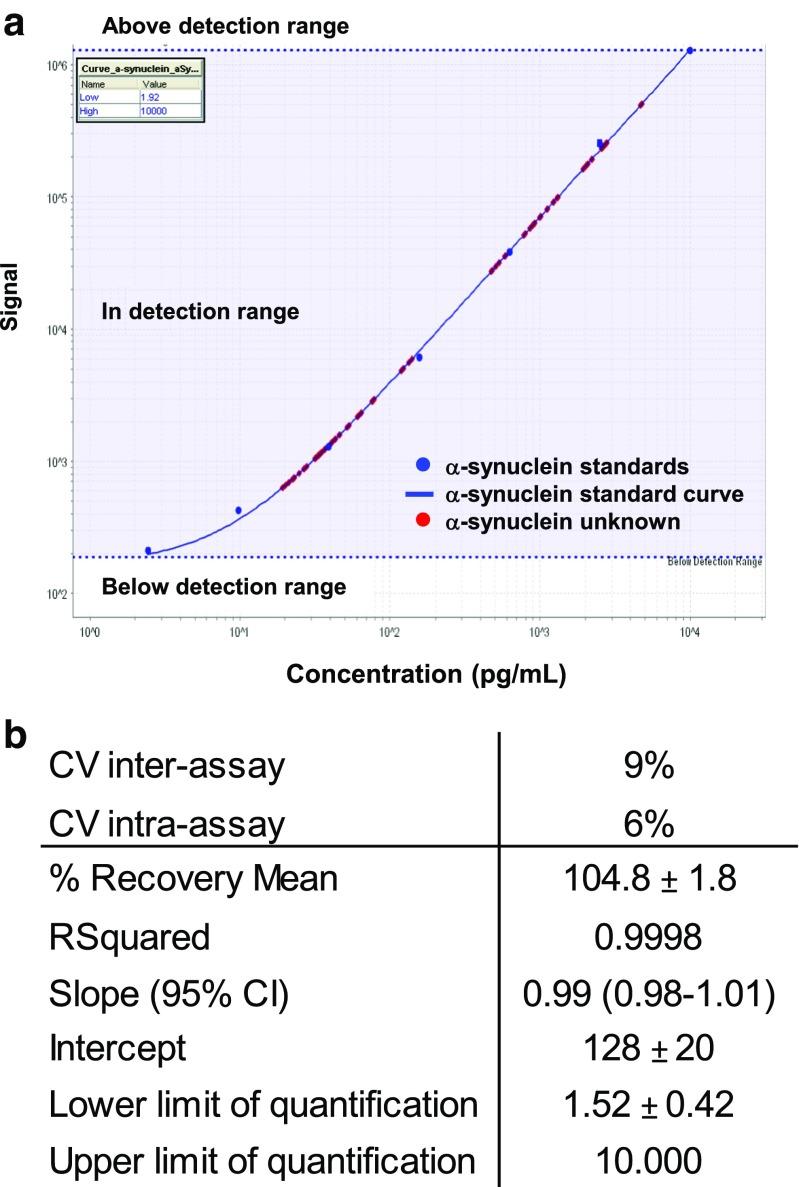
The analysis of cerebrospinal fluid (CSF) biomarkers gains importance in the differential diagnosis of prion diseases. However, no single diagnostic tool or combination of them can unequivocally confirm prion disease diagnosis. Electrochemiluminescence (ECL)-based immunoassays have demonstrated to achieve high diagnostic accuracy in a variety of sample types due to their high sensitivity and dynamic range. Quantification of CSF α-synuclein (a-syn) by an in-house ECL-based ELISA assay has been recently reported as an excellent approach for the diagnosis of sporadic Creutzfeldt-Jakob disease (sCJD), the most prevalent form of human prion disease. In the present study, we validated a commercially available ECL-based a-syn ELISA platform as a diagnostic test for correct classification of sCJD cases. CSF a-syn was analysed in 203 sCJD cases with definite diagnosis and in 445 non-CJD cases. We investigated reproducibility and stability of CSF a-syn and made recommendations for its analysis in the sCJD diagnostic workup. A sensitivity of 98% and a specificity of 97% were achieved when using an optimal cut-off of 820 pg/mL a-syn. Moreover, we were able to show a negative correlation between a-syn levels and disease duration suggesting that CSF a-syn may be a good prognostic marker for sCJD patients. The present study validates the use of a-syn as a CSF biomarker of sCJD and establishes the clinical and pre-analytical parameters for its use in differential diagnosis in clinical routine. Additionally, the current test presents some advantages compared to other diagnostic approaches: it is fast, economic, requires minimal amount of CSF and a-syn levels are stable along disease progression.
脑脊液(CSF)生物标志物分析在朊病毒病的鉴别诊断中具有重要意义。然而,没有单一的诊断工具或其组合可以明确确认朊病毒病的诊断。基于电化学发光(ECL)的免疫分析因其高灵敏度和动态范围已在各种样本类型中证明可实现高诊断准确性。最近有报道称,通过内部基于 ECL 的 ELISA 测定法定量 CSF α-突触核蛋白(a-syn)是诊断散发性克雅氏病(sCJD)的一种极好方法,sCJD 是人类朊病毒病最常见的形式。在本研究中,我们验证了一种商业上可用的基于 ECL 的 a-syn ELISA 平台作为正确分类 sCJD 病例的诊断测试。分析了 203 例确诊 sCJD 病例和 445 例非 CJD 病例的 CSF a-syn。我们研究了 CSF a-syn 的可重复性和稳定性,并为其在 sCJD 诊断中的分析提出了建议。当使用 820 pg/mL a-syn 的最佳截断值时,灵敏度为 98%,特异性为 97%。此外,我们能够显示出 a-syn 水平与疾病持续时间之间的负相关,这表明 CSF a-syn 可能是 sCJD 患者的良好预后标志物。本研究验证了 a-syn 作为 sCJD 脑脊液生物标志物的用途,并为其在临床常规中的鉴别诊断中建立了临床和分析前参数。此外,与其他诊断方法相比,目前的测试具有一些优势:它快速、经济,需要的 CSF 量最少,并且 a-syn 水平在疾病进展过程中保持稳定。



 Zotero 插件