Khodadad Christina L, Wong Gregory M, James Leandro M, Thakrar Prital J, Lane Michael A, Catechis John A, Smith David J
1 Sierra Lobo, Inc., Kennedy Space Center , Florida.
2 Department of Geosciences, Pennsylvania State University, University Park , Pennsylvania.
Astrobiology. 2017 Apr;17(4):337-350. doi: 10.1089/ast.2016.1549. Epub 2017 Mar 21.
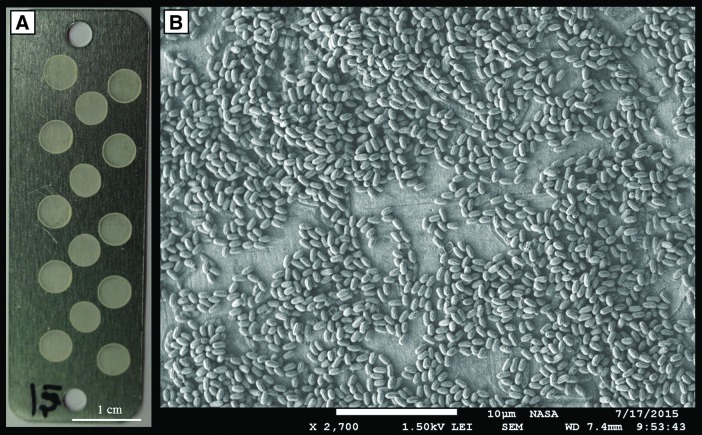
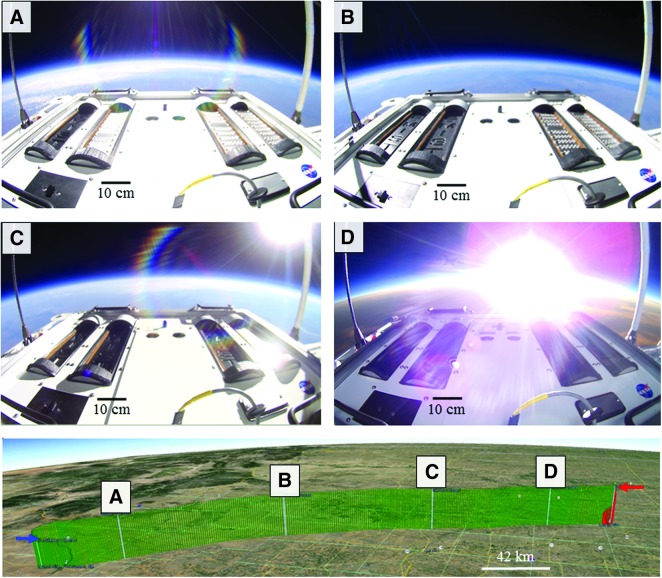
Every spacecraft sent to Mars is allowed to land viable microbial bioburden, including hardy endospore-forming bacteria resistant to environmental extremes. Earth's stratosphere is severely cold, dry, irradiated, and oligotrophic; it can be used as a stand-in location for predicting how stowaway microbes might respond to the martian surface. We launched E-MIST, a high-altitude NASA balloon payload on 10 October 2015 carrying known quantities of viable Bacillus pumilus SAFR-032 (4.07 × 10 spores per sample), a radiation-tolerant strain collected from a spacecraft assembly facility. The payload spent 8 h at ∼31 km above sea level, exposing bacterial spores to the stratosphere. We found that within 120 and 240 min, spore viability was significantly reduced by 2 and 4 orders of magnitude, respectively. By 480 min, <0.001% of spores carried to the stratosphere remained viable. Our balloon flight results predict that most terrestrial bacteria would be inactivated within the first sol on Mars if contaminated spacecraft surfaces receive direct sunlight. Unfortunately, an instrument malfunction prevented the acquisition of UV light measurements during our balloon mission. To make up for the absence of radiometer data, we calculated a stratosphere UV model and conducted ground tests with a 271.1 nm UVC light source (0.5 W/m), observing a similarly rapid inactivation rate when using a lower number of contaminants (640 spores per sample). The starting concentration of spores and microconfiguration on hardware surfaces appeared to influence survivability outcomes in both experiments. With the relatively few spores that survived the stratosphere, we performed a resequencing analysis and identified three single nucleotide polymorphisms compared to unexposed controls. It is therefore plausible that bacteria enduring radiation-rich environments (e.g., Earth's upper atmosphere, interplanetary space, or the surface of Mars) may be pushed in evolutionarily consequential directions. Key Words: Planetary protection-Stratosphere-Balloon-Mars analog environment-E-MIST payload-Bacillus pumilus SAFR-032. Astrobiology 17, 337-350.
每一艘被派往火星的航天器都可能携带具有生存能力的微生物生物负荷,包括能形成耐极端环境的坚硬芽孢的细菌。地球平流层寒冷、干燥、受辐射且营养匮乏,可作为预测偷渡微生物对火星表面反应的替代地点。2015年10月10日,我们发射了E-MIST,这是美国国家航空航天局(NASA)的一个高空气球搭载装置,携带了已知数量的具有生存能力的短小芽孢杆菌SAFR-032(每个样本4.07×10个孢子),这是一种从航天器装配设施收集的耐辐射菌株。该搭载装置在海拔约31千米处停留了8小时,使细菌孢子暴露于平流层。我们发现,在120分钟和240分钟内,孢子的生存能力分别显著降低了2个和4个数量级。到480分钟时,被携带到平流层的孢子中只有不到0.001%仍具生存能力。我们的气球飞行结果预测,如果受污染的航天器表面受到阳光直射,大多数陆地细菌会在登陆火星的首个火星日(sol)内失活。不幸的是,仪器故障导致我们在气球任务期间无法获取紫外线测量数据。为了弥补辐射计数据的缺失,我们计算了一个平流层紫外线模型,并使用271.1纳米的UVC光源(0.5瓦/平方米)进行了地面测试,当使用较少数量的污染物(每个样本640个孢子)时,观察到了类似的快速失活率。硬件表面孢子的起始浓度和微观结构似乎在两个实验中都影响了生存结果。对于在平流层中存活下来的相对较少的孢子,我们进行了重测序分析,与未暴露的对照相比,鉴定出三个单核苷酸多态性。因此,在富含辐射的环境(如地球高层大气、行星际空间或火星表面)中生存的细菌可能会被推向具有进化意义的方向,这是有道理的。关键词:行星保护 - 平流层 - 气球 - 火星模拟环境 - E-MIST搭载装置 - 短小芽孢杆菌SAFR-032。《天体生物学》17卷,337 - 350页