Kang Sun-Young, Lim Gyeong Eun, Kim Yang Keun, Kim Hye Won, Lee Kayoung, Park Tae-Jin, Kim Jinseung
Department of Family Medicine, Busan Paik Hospital, Inje University College of Medicine, Busan, Korea.
J Bone Metab. 2017 Feb;24(1):9-14. doi: 10.11005/jbm.2017.24.1.9. Epub 2017 Feb 28.
Menopause contributes to an increase in visceral fat mass and a decrease in muscle protein synthesis. Therefore, we performed this study to examine their relationship how effect the changes of body composition as obesity and sarcopenia on metabolic syndrome (MS) as a predictor of cardiovascular disease in postmenopausal women.
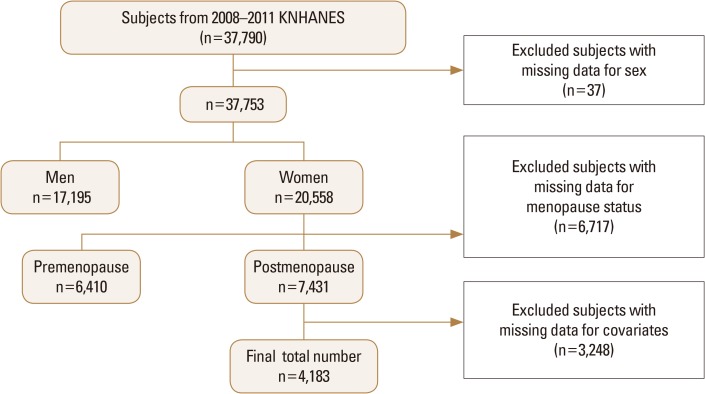
Using data from the Korean National Health and Nutrition Examination Survey (KNHANES) from 2008 to 2011, we estimated that 4,183 postmenopausal women underwent dual energy X-ray absorptiometry scans. Sarcopenia was defined as an appendicular skeletal muscle mass divided by body weight that was less than 1 standard deviation below the sex specific mean for the young reference group. After classification into four groups, the results were adjusted with menopausal age and hormonal treatment. The relationship between sarcopenic obesity (SO) and MS in postmenopausal women was analyzed by logistic regression analysis in a complex sampling.
In an unadjusted model, the odds ratio (OR) of MS for sarcopenia was 1.94 (95% confidence interval [CI], 1.52-2.49); the obesity group had an OR of 4.55 (95% CI, 3.63-5.71); and distinctly, the SO group had an OR of 6.26 (95% CI, 5.10-7.70). Even though there was controlling for variable adjustment, no definite difference was seen in the results.
Sarcopenia and obesity were associated with MS independent of other metabolic impairment risk factors in both early menopausal and postmenopausal women. The results showed that, in particular, the prevalence of MS has increased more in postmenopausal women compared with previous research.
绝经会导致内脏脂肪量增加以及肌肉蛋白质合成减少。因此,我们开展了本研究,以探讨它们之间的关系如何影响绝经后女性身体成分变化(如肥胖和肌肉减少症)对作为心血管疾病预测指标的代谢综合征(MS)的影响。
利用2008年至2011年韩国国家健康与营养检查调查(KNHANES)的数据,我们估计有4183名绝经后女性接受了双能X线吸收测定扫描。肌肉减少症的定义为四肢骨骼肌质量除以体重,低于年轻参照组特定性别的均值1个标准差以下。分为四组后,结果根据绝经年龄和激素治疗进行了调整。采用复杂抽样的逻辑回归分析方法分析绝经后女性肌肉减少性肥胖(SO)与MS之间的关系。
在未调整模型中,肌肉减少症患者患MS的比值比(OR)为1.94(95%置信区间[CI],1.52 - 2.49);肥胖组的OR为4.55(95%CI,3.63 - 5.71);明显地,SO组的OR为6.26(95%CI,5.10 - 7.70)。即使对变量进行了调整控制,结果中也未发现明确差异。
在绝经早期和绝经后女性中,肌肉减少症和肥胖与MS相关,独立于其他代谢损害风险因素。结果表明,特别是与先前的研究相比,绝经后女性中MS的患病率增加得更多。