Nagashima Hidekazu, Shinoda Masamichi, Honda Kuniya, Kamio Noriaki, Watanabe Masahiro, Suzuki Tatsuro, Sugano Naoyuki, Sato Shuichi, Iwata Koichi
1 Division of Applied Oral Sciences, Nihon University Graduate School of Dentistry, Chiyoda-ku, Tokyo, Japan.
2 Department of Physiology, Nihon University School of Dentistry, Chiyoda-ku, Tokyo, Japan.
Mol Pain. 2017 Jan;13:1744806916689269. doi: 10.1177/1744806916689269.
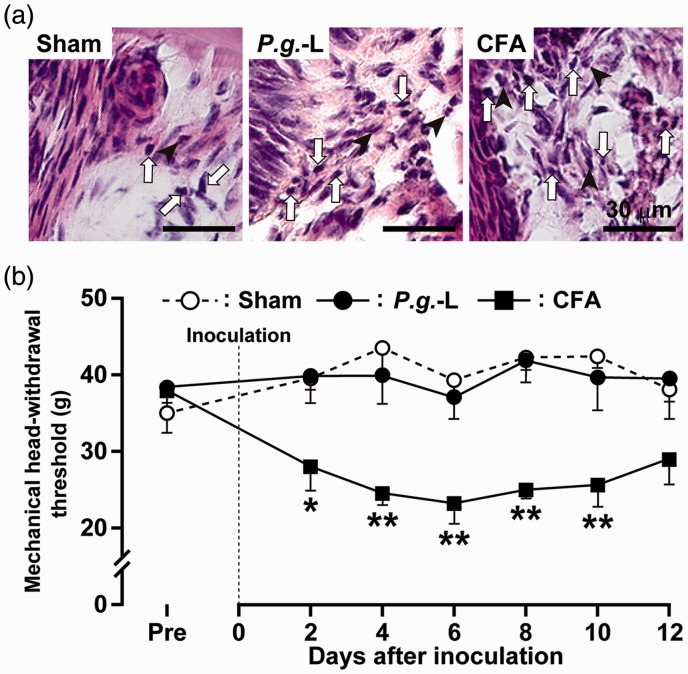
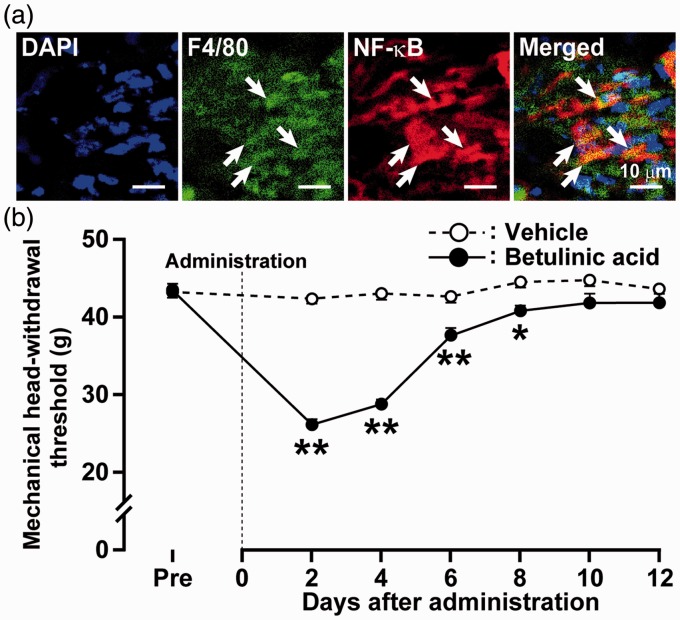
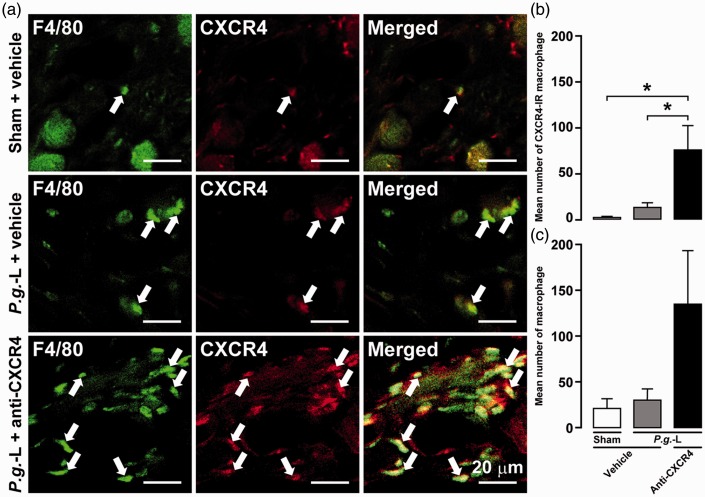
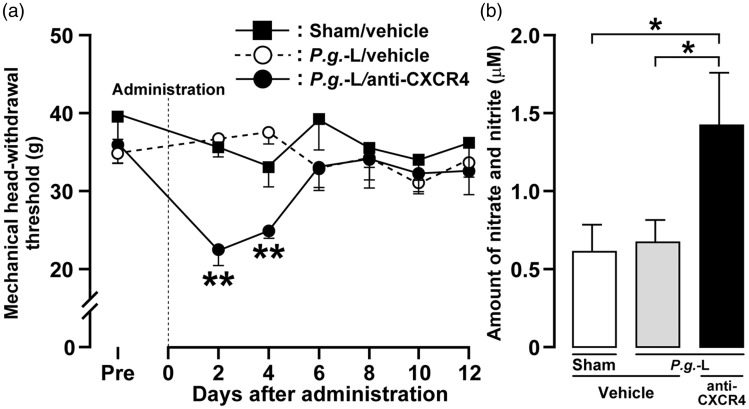
Background Periodontitis is an inflammatory disease accompanied by alveolar bone loss and progressive inflammation without pain. However, the potential contributors eliminating pain associated with gingival inflammation are unknown. Results we examined the involvement of CXC chemokine receptor type 4 (CXCR4) on the mechanical sensitivity of inflamed periodontal tissue, using a mouse model of periodontitis established by the ligation of the tooth cervix of a maxillary second molar and inoculation with Porphyromonas gingivalis (P. gingivalis). Infiltration of inflammatory cells into gingival tissue was not observed following the inoculation. Under light anesthesia, the mechanical head withdrawal threshold (MHWT) on the buccal gingiva was measured using an electronic von Frey anesthesiometer. No significant changes in MHWT were observed in the mice with P. gingivalis-induced periodontitis during the experimental period. Continuous administration of CXCR4 neutralizing antibody to the gingival tissue significantly decreased MHWT and increased the number of gingival CXCR4 immunoreactive macrophages in the periodontitis group. Nitric oxide metabolites in the gingival tissue were significantly increased after the inoculation of P. gingivalis and were reduced by gingival CXCR4 neutralization. Gingival L-arginine administration induced gingival mechanical allodynia in naive animals. Moreover, the decrease in MHWT after treatment with P. gingivalis and CXCR4 neutralization was partially reversed by nitric oxide synthase inhibition in the gingival tissue. Nuclear factor-kappa B was expressed in infiltrating macrophages after inoculation of P. gingivalis and administration of the nuclear factor-kappa B activator betulinic acid induced gingival mechanical allodynia in naive mice. Conclusions These findings suggest that CXCR4 signaling inhibits nitric oxide release from infiltrating macrophages and is involved in modulation of the mechanical sensitivity in the periodontal tissue in P. gingivalis-induced periodontitis.
牙周炎是一种伴有牙槽骨丧失和进行性炎症且无疼痛的炎症性疾病。然而,消除与牙龈炎症相关疼痛的潜在因素尚不清楚。结果:我们使用通过结扎上颌第二磨牙牙颈部并接种牙龈卟啉单胞菌(P. gingivalis)建立的牙周炎小鼠模型,研究了CXC趋化因子受体4(CXCR4)对炎症牙周组织机械敏感性的影响。接种后未观察到炎症细胞浸润到牙龈组织中。在轻度麻醉下,使用电子von Frey麻醉计测量颊侧牙龈的机械性头部撤离阈值(MHWT)。在实验期间,P. gingivalis诱导的牙周炎小鼠的MHWT没有显著变化。向牙周炎组牙龈组织持续给予CXCR4中和抗体可显著降低MHWT,并增加牙龈CXCR4免疫反应性巨噬细胞的数量。接种P. gingivalis后牙龈组织中的一氧化氮代谢产物显著增加,而牙龈CXCR4中和可使其减少。向未感染动物的牙龈组织给予L-精氨酸可诱导牙龈机械性异常性疼痛。此外,牙龈组织中一氧化氮合酶抑制可部分逆转P. gingivalis和CXCR4中和处理后MHWT的降低。接种P. gingivalis后,核因子-κB在浸润的巨噬细胞中表达,给予核因子-κB激活剂桦木酸可诱导未感染小鼠出现牙龈机械性异常性疼痛。结论:这些发现表明,CXCR4信号传导抑制浸润巨噬细胞释放一氧化氮,并参与P. gingivalis诱导的牙周炎中牙周组织机械敏感性的调节。