Zehnbauer B A, Small D, Brodeur G M, Seeger R, Vogelstein B
Oncology Center, Johns Hopkins University School of Medicine, Baltimore, Maryland 21205.
Mol Cell Biol. 1988 Feb;8(2):522-30. doi: 10.1128/mcb.8.2.522-530.1988.
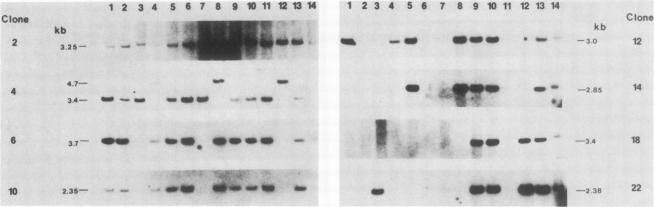
A set of DNA clones comprising 48 independent HindIII fragments (215 kilobases of sequence) was derived from the N-myc amplification unit of the neuroblastoma cell line NGP. These clones were used to investigate N-myc amplification units in NGP cells and 12 primary neuroblastoma tumors. Three parameters were evaluated: (i) the number of rearrangements from germ line configuration that had occurred during the amplification process; (ii) the homogeneity of amplification units within individual tumors; and (iii) the conservation of amplified sequences among different tumors. The results indicated that remarkably few rearrangements had occurred during amplification, that the amplification units within any one tumor were quite homogeneous, and that although each tumor contained a unique pattern of amplified DNA fragments, there was considerable similarity between the amplification units of different tumors. In particular, the amplification units were strikingly similar over a contiguous domain of at least 140 kilobases surrounding the N-myc structural gene.
一组由48个独立的HindIII片段(215千碱基序列)组成的DNA克隆,源自神经母细胞瘤细胞系NGP的N - myc扩增单元。这些克隆用于研究NGP细胞和12例原发性神经母细胞瘤肿瘤中的N - myc扩增单元。评估了三个参数:(i)在扩增过程中发生的与种系构型的重排数量;(ii)单个肿瘤内扩增单元的同质性;(iii)不同肿瘤之间扩增序列的保守性。结果表明,扩增过程中发生的重排非常少,任何一个肿瘤内的扩增单元相当同质,并且尽管每个肿瘤包含独特的扩增DNA片段模式,但不同肿瘤的扩增单元之间存在相当大的相似性。特别是,在围绕N - myc结构基因的至少140千碱基的连续区域上,扩增单元惊人地相似。