Havrdova E, Giovannoni G, Gold R, Fox R J, Kappos L, Phillips J Theodore, Okwuokenye M, Marantz J L
Department of Neurology, First Faculty of Medicine, Charles University, Prague, Czech Republic.
Queen Mary University of London, Blizard Institute, London, UK.
Eur J Neurol. 2017 May;24(5):726-733. doi: 10.1111/ene.13272. Epub 2017 Mar 22.
Significant effects on clinical/neuroradiological disease activity have been reported in patients with relapsing-remitting multiple sclerosis treated with delayed-release dimethyl fumarate (DMF) in phase III DEFINE/CONFIRM trials. We conducted a post hoc analysis of integrated data from DEFINE/CONFIRM to evaluate the effect of DMF on achieving no evidence of disease activity (NEDA) in patients with relapsing-remitting multiple sclerosis.
The analysis included patients randomized to DMF 240 mg twice daily, placebo or glatiramer acetate (CONFIRM only) for ≤2 years. A time-to-event method was used to estimate the percentage of patients achieving NEDA. Clinical NEDA (no relapses/no 12-week confirmed disability progression) was analysed in the intention-to-treat (ITT) population. Neuroradiological (no new/newly enlarging T2 hyperintense lesions/no gadolinium-enhancing lesions) and overall NEDA (clinical and neuroradiological NEDA) were analysed in the magnetic resonance imaging (MRI) cohort.
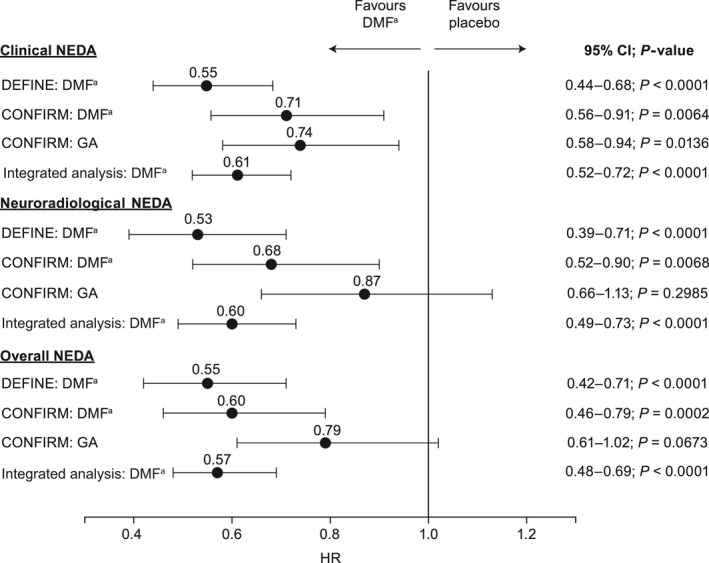
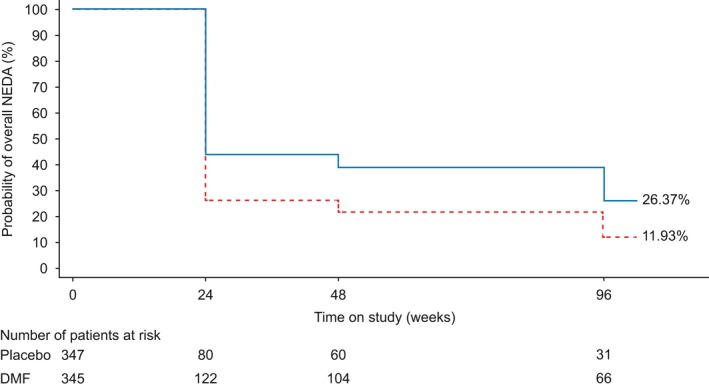
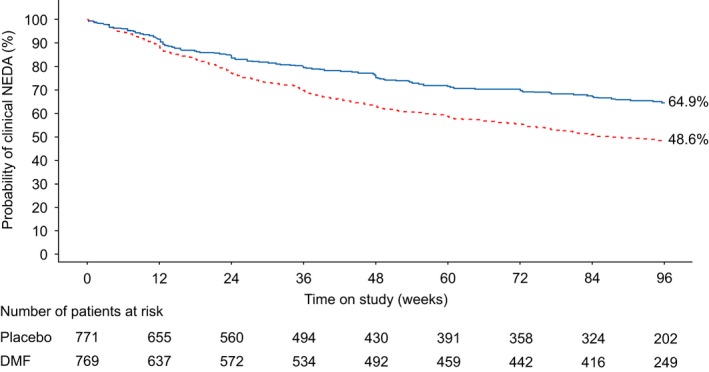
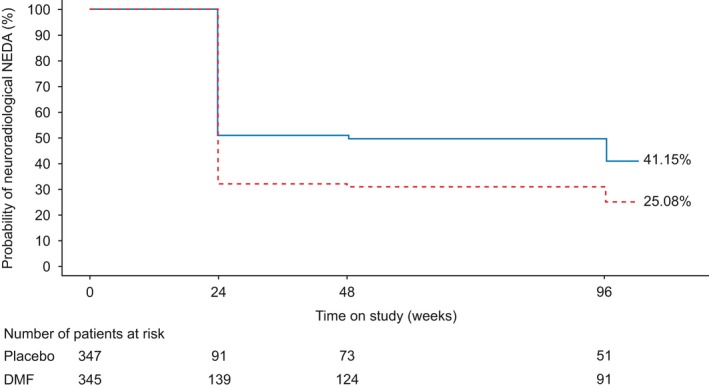
The ITT and MRI populations comprised 1540 and 692 patients, respectively. The percentage of patients with clinical NEDA (ITT population) and neuroradiological NEDA (MRI cohort) was higher with DMF versus placebo over 2 years [clinical NEDA: 38.9% relative reduction; hazard ratio (HR), 0.61; 95% confidence interval (CI), 0.52-0.72; P < 0.0001; neuroradiological NEDA: 40.0% relative reduction; HR, 0.60; 95% CI, 0.49-0.73; P < 0.0001]. The percentage of patients achieving overall NEDA (MRI cohort) was also higher with DMF (26%) versus placebo (12%) over 2 years, with a relative risk reduction of 42.7% (HR, 0.57; 95% CI, 0.48-0.69; P < 0.0001).
A significantly higher percentage of patients treated with DMF achieved NEDA status over 2 years compared with placebo.
在III期DEFINE/CONFIRM试验中,对于复发缓解型多发性硬化症患者,使用缓释富马酸二甲酯(DMF)治疗对临床/神经放射学疾病活动有显著影响。我们对DEFINE/CONFIRM的综合数据进行了事后分析,以评估DMF对复发缓解型多发性硬化症患者实现无疾病活动证据(NEDA)的效果。
分析包括随机接受每日两次240mg DMF、安慰剂或醋酸格拉替雷(仅在CONFIRM试验中)治疗≤2年的患者。采用事件发生时间方法估计实现NEDA的患者百分比。在意向性治疗(ITT)人群中分析临床NEDA(无复发/无12周确认的残疾进展)。在磁共振成像(MRI)队列中分析神经放射学(无新的/新增大的T2高信号病变/无钆增强病变)和总体NEDA(临床和神经放射学NEDA)。
ITT人群和MRI队列分别包括1540例和692例患者。在2年期间,与安慰剂相比,DMF治疗的患者临床NEDA(ITT人群)和神经放射学NEDA(MRI队列)的百分比更高[临床NEDA:相对降低38.9%;风险比(HR),0.61;95%置信区间(CI),0.52 - 0.72;P < 0.0001;神经放射学NEDA:相对降低40.0%;HR,0.60;95% CI,0.49 - 0.73;P < 0.0001]。在2年期间,与安慰剂(12%)相比,DMF治疗实现总体NEDA(MRI队列)的患者百分比也更高(26%),相对风险降低42.7%(HR,0.57;95% CI,0.48 - 0.69;P < 0.0001)。
与安慰剂相比,接受DMF治疗的患者在2年期间实现NEDA状态的百分比显著更高。