Sgandurra Giuseppina, Lorentzen Jakob, Inguaggiato Emanuela, Bartalena Laura, Beani Elena, Cecchi Francesca, Dario Paolo, Giampietri Matteo, Greisen Gorm, Herskind Anna, Nielsen Jens Bo, Rossi Giuseppe, Cioni Giovanni
Department of Developmental Neuroscience, IRCCS Fondazione Stella Maris, Calambrone, Pisa, Italy.
Department of Clinical and Experimental Medicine, University of Pisa, Pisa, Italy.
PLoS One. 2017 Mar 22;12(3):e0173521. doi: 10.1371/journal.pone.0173521. eCollection 2017.
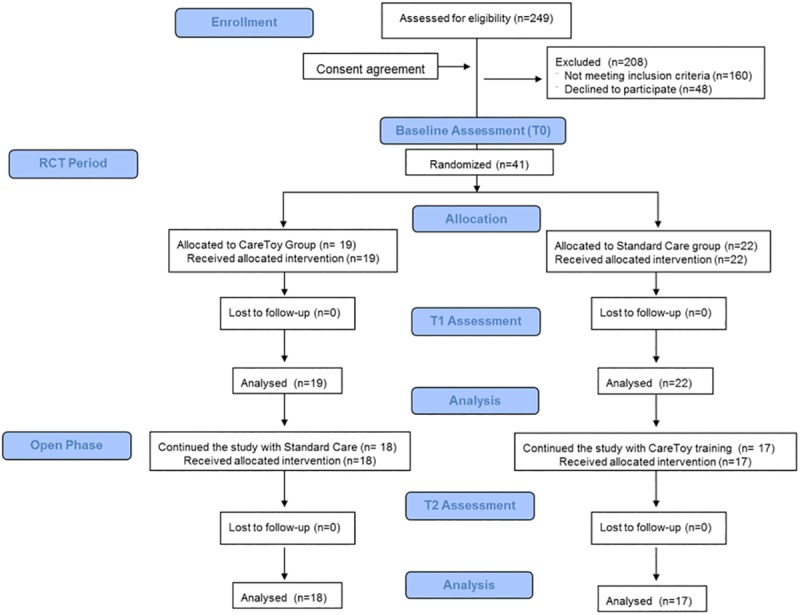
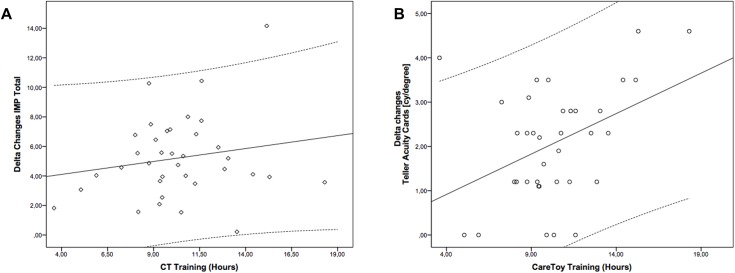
CareToy system is an innovative tele-rehabilitative tool, useful in providing intensive, individualized, home-based, family-centred Early Intervention (EI) in infants. Our aim was to evaluate, through a Randomized Clinical Trial (RCT) study, the effects of CareToy intervention on early motor and visual development in preterm infants. 41 preterm infants (range age: 3.0-5.9 months of corrected age) were enrolled and randomized into two groups, CareToy and Standard Care. 19 infants randomized in CareToy group performed a 4-week CareToy program, while 22 allocated to control group completed 4 weeks of Standard Care. Infant Motor Profile (IMP) was primary outcome measure, Alberta Infant Motor Scale (AIMS) and Teller Acuity Cards were secondary ones. Assessments were carried out at baseline (T0) and at the end of CareToy training or Standard Care period (T1). T1 was the primary endpoint. After RCT phase, 17 infants from control group carried out a 4-week CareToy program, while 18 infants from the CareToy group continued with Standard Care. At the end of this phase, infants were re-assessed at T2. In RCT phase, delta IMP total score and variation and performance sub-domains were significantly higher (P<0.050) in CareToy group if compared to Standard Care group. Similar results were found for Teller Acuity Cards, while no differences between groups were found for AIMS. No differences were found in any outcome measure results (T2-T0), between infants who started CareToy training before or after one month of standard care. This RCT study confirms the results of a previous pilot study, indicating that CareToy system can provide effective home-based EI.
This trial has been registered at www.clinicaltrials.gov (Identifier NCT01990183).
CareToy系统是一种创新的远程康复工具,有助于为婴儿提供强化的、个性化的、基于家庭的、以家庭为中心的早期干预(EI)。我们的目的是通过一项随机临床试验(RCT)研究,评估CareToy干预对早产儿早期运动和视觉发育的影响。41名早产儿(矫正年龄范围:3.0 - 5.9个月)被纳入并随机分为两组,即CareToy组和标准护理组。随机分配到CareToy组的19名婴儿进行了为期4周的CareToy计划,而分配到对照组的22名婴儿完成了4周的标准护理。婴儿运动概况(IMP)是主要结局指标,艾伯塔婴儿运动量表(AIMS)和泰勒视力卡是次要指标。评估在基线(T0)以及CareToy训练或标准护理期结束时(T1)进行。T1是主要终点。在RCT阶段之后,对照组的17名婴儿进行了为期4周的CareToy计划,而CareToy组的18名婴儿继续接受标准护理。在该阶段结束时,在T2对婴儿进行重新评估。在RCT阶段,与标准护理组相比,CareToy组的IMP总分变化以及运动能力和表现子领域显著更高(P<0.050)。泰勒视力卡也得到了类似结果,而AIMS在两组之间未发现差异。在标准护理一个月之前或之后开始CareToy训练的婴儿之间,在任何结局指标结果(T2 - T0)上均未发现差异。这项RCT研究证实了先前一项试点研究的结果,表明CareToy系统可以提供有效的家庭式早期干预。