Medical Oncology Department, Hospital Clínico San Carlos, Madrid, Spain.
Thermo Fisher Scientific, Waltham, Massachusetts, USA.
BMC Cancer. 2017 Mar 22;17(1):210. doi: 10.1186/s12885-017-3185-9.
Accurate measurement of tumor burden in breast cancer disease is essential to improve the clinical management of patients. In this study, we evaluate whether the fluctuations in the fraction of PIK3CA mutant allele correlates with tumor response according to RECIST criteria and tumor markers quantification.
Eighty six plasma samples were analyzed by digital PCR using Rare Mutation Assays for E542K, E545K and H1047R. Mutant cfDNA and tumor markers CA15-3 and CEA were compared with radiographic imaging.
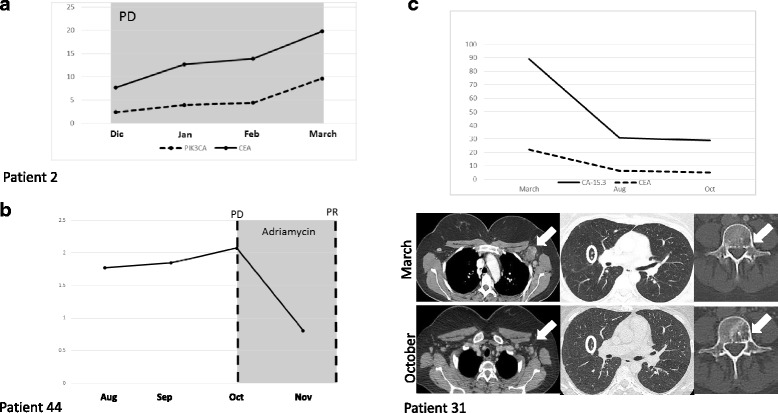
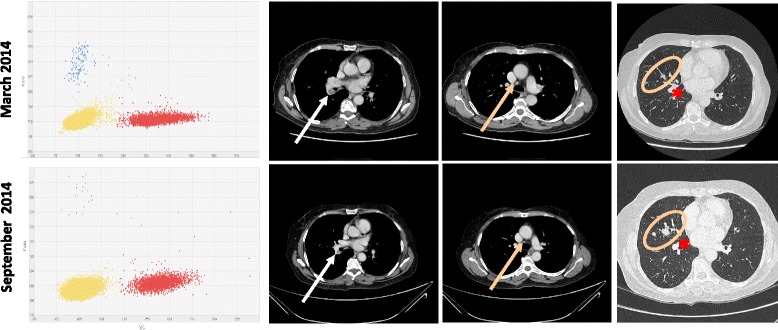
The agreement between PIK3CA mutation status in FFPE samples and circulating tumor DNA (ctDNA) was moderate (K = 0.591; 95% IC = 0.371-0.811). Restricting the analysis to the metastatic patients, we found a good agreement between PIK3CA mutation status assessed in liquid and solid biopsy (K = 0.798 95%; IC = 0.586-1). ctDNA showed serial changes with fluctuations correlating with tumor markers 15.3 and CEA in 7 out of 8 cases with Pearson correlation coefficients ranging from 0.99 to 0.46 and from 0.99 to 0.38 respectively. Similarly, fluctuations in the fraction of PIK3CA mutant allele always correlated with changes in lesion size seen on images, although in two cases it did not correlate with treatment responses as defined by RECIST criteria.
oncogenic mutation quantification in plasma samples can be useful to monitor treatment outcome. However, it might be limited by tumor heterogeneity in advanced disease and it should be evaluated together with radiographic imaging.
准确测量乳腺癌肿瘤负担对于改善患者的临床管理至关重要。在这项研究中,我们评估了根据 RECIST 标准和肿瘤标志物定量,PIK3CA 突变等位基因分数的波动是否与肿瘤反应相关。
使用 Rare Mutation Assays for E542K、E545K 和 H1047R 通过数字 PCR 分析了 86 个血浆样本。比较了突变 cfDNA 和肿瘤标志物 CA15-3 和 CEA 与放射影像学。
FFPE 样本中 PIK3CA 突变状态与循环肿瘤 DNA(ctDNA)之间的一致性为中等(K=0.591;95%CI=0.371-0.811)。将分析仅限于转移性患者,我们发现液体和固体活检中 PIK3CA 突变状态之间具有良好的一致性(K=0.798 95%CI=0.586-1)。ctDNA 显示出与肿瘤标志物 15.3 和 CEA 相关的连续变化,在 7 例中有 8 例存在波动,皮尔逊相关系数范围从 0.99 到 0.46,从 0.99 到 0.38。类似地,PIK3CA 突变等位基因分数的波动总是与图像上看到的病变大小变化相关,尽管在两种情况下,它与 RECIST 标准定义的治疗反应并不相关。
在血浆样本中对致癌突变进行定量可以用于监测治疗结果。然而,它可能受到晚期疾病中肿瘤异质性的限制,并且应该与放射影像学一起进行评估。