
俯卧位腰椎前凸和俯卧位髋关节伸展试验:有和没有腰痛的受试者之间的比较。
Lumbar lordosis in prone position and prone hip extension test: comparison between subjects with and without low back pain.
作者信息
Arab Amir Massoud, Haghighat Arash, Amiri Zahra, Khosravi Fariba
机构信息
Department of Physical Therapy, University of Social Welfare and Rehabilitation Sciences, Evin, Koodakyar Ave, Tehran, 1985713831 Iran.
University of Social Welfare and Rehabilitation Sciences, Evin, Tehran, Iran.
出版信息
Chiropr Man Therap. 2017 Mar 16;25:8. doi: 10.1186/s12998-017-0139-x. eCollection 2017.
BACKGROUND
Prone hip extension (PHE) is a common and widely accepted test used for assessment of the lumbo-pelvic movement pattern. Considerable increased in lumbar lordosis during this test has been considered as impairment of movement patterns in lumbo-pelvic region. The purpose of this study was to investigate the change of lumbar lordosis in PHE test in subjects with and without low back pain (LBP).
METHOD
A two-way mixed design with repeated measurements was used to investigate the lumbar lordosis changes during PHE in two groups of subjects with and without LBP. An equal number of subjects ( = 30) were allocated to each group. A standard flexible ruler was used to measure the size of lumbar lordosis in prone-relaxed position and PHE test in each group.
RESULT
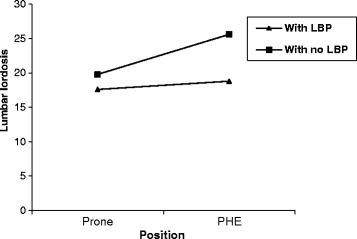
The result of two-way mixed-design analysis of variance revealed significant health status by position interaction effect for lumbar lordosis ( < 0.001). The main effect of test position on lumbar lordosis was statistically significant ( < 0.001). The lumbar lordosis was significantly greater in the PHE compared to prone-relaxed position in both subjects with and without LBP. The amount of difference in positions was statistically significant between two groups ( < 0.001) and greater change in lumbar lordosis was found in the healthy group compared to the subjects with LBP.
CONCLUSIONS
Greater change in lumbar lordosis during this test may be due to more stiffness in lumbopelvic muscles in the individuals with LBP.
背景
俯卧位髋关节伸展(PHE)是一种常用且被广泛接受的用于评估腰骨盆运动模式的测试。在此测试过程中腰椎前凸显著增加被认为是腰骨盆区域运动模式的损伤。本研究的目的是调查有和没有下腰痛(LBP)的受试者在PHE测试中腰椎前凸的变化。
方法
采用重复测量的双向混合设计来研究两组有和没有LBP的受试者在PHE过程中腰椎前凸的变化。每组分配相等数量的受试者(n = 30)。使用标准软尺测量每组在俯卧放松位和PHE测试中腰椎前凸的大小。
结果
双向混合设计方差分析结果显示,腰椎前凸的健康状态×位置交互效应具有统计学意义(P < 0.001)。测试位置对腰椎前凸的主效应具有统计学意义(P < 0.001)。在有和没有LBP的受试者中,PHE时的腰椎前凸均显著大于俯卧放松位。两组之间位置差异量具有统计学意义(P < 0.001),并且与有LBP的受试者相比,健康组的腰椎前凸变化更大。
结论
在此测试过程中腰椎前凸的更大变化可能是由于有LBP的个体腰骨盆肌肉更僵硬。
 Zotero 插件