Hu Zhonghua, Li Zheng
Section on Synapse Development and Plasticity, National Institute of Mental Health, National Institutes of Health, United States; Lieber Institute for Brain Development, Johns Hopkins University Medical Campus, United States.
Section on Synapse Development and Plasticity, National Institute of Mental Health, National Institutes of Health, United States.
Curr Opin Neurobiol. 2017 Aug;45:24-31. doi: 10.1016/j.conb.2017.02.014. Epub 2017 Mar 21.
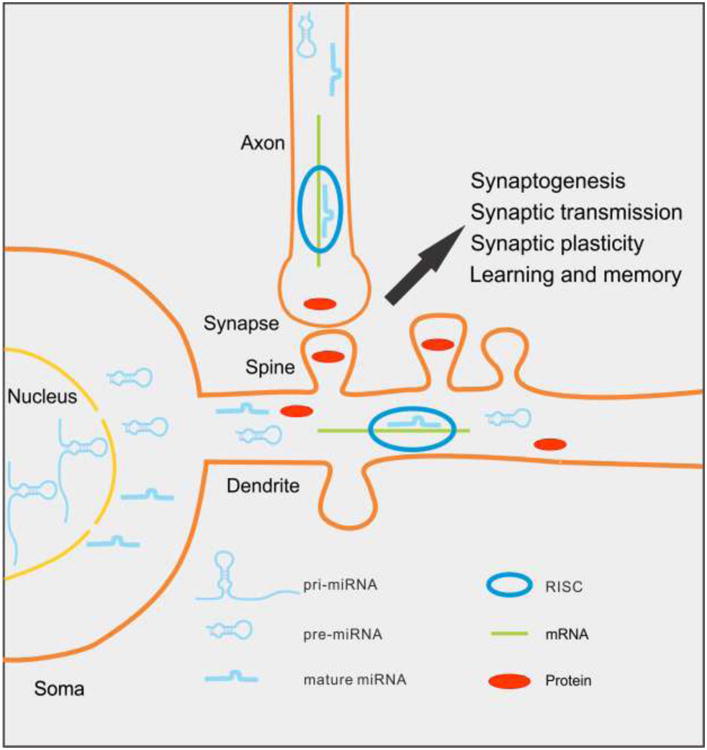
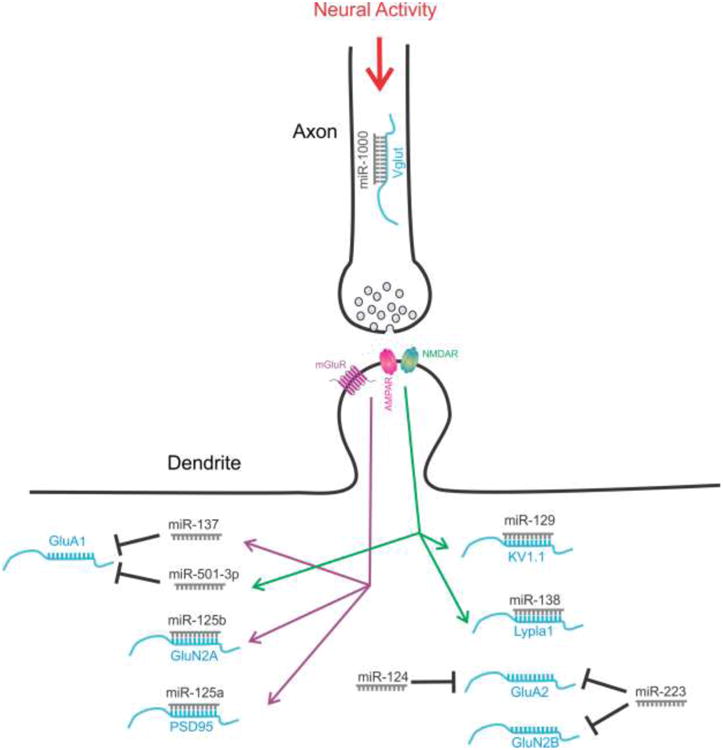
Synapses are functional units of the nervous system, through which information is transferred between neurons. The development and activity-dependent modification of synapses require temporally and spatially controlled modulation of gene expression. microRNAs (miRNAs) have emerged as essential regulators of gene expression. They are small non-coding RNAs that regulate mRNA stability and translation by interacting with the 3' untranslated region (3' UTR) of mRNAs. miRNAs are located to neuronal processes to regulate protein synthesis locally and their expression is regulated by synaptic activity. This article reviews recent findings on the role of miRNAs in synapse development and synaptic plasticity.
突触是神经系统的功能单位,信息通过突触在神经元之间传递。突触的发育和依赖于活动的修饰需要在时间和空间上对基因表达进行调控。微小RNA(miRNA)已成为基因表达的重要调节因子。它们是小的非编码RNA,通过与mRNA的3'非翻译区(3'UTR)相互作用来调节mRNA的稳定性和翻译。miRNA定位于神经元突起以在局部调节蛋白质合成,并且它们的表达受突触活动调控。本文综述了关于miRNA在突触发育和突触可塑性中作用的最新研究发现。