Lynch David S, Rodrigues Brandão de Paiva Anderson, Zhang Wei Jia, Bugiardini Enrico, Freua Fernando, Tavares Lucato Leandro, Macedo-Souza Lucia Inês, Lakshmanan Rahul, Kinsella Justin A, Merwick Aine, Rossor Alexander M, Bajaj Nin, Herron Brian, McMonagle Paul, Morrison Patrick J, Hughes Deborah, Pittman Alan, Laurà Matilde, Reilly Mary M, Warren Jason D, Mummery Catherine J, Schott Jonathan M, Adams Matthew, Fox Nick C, Murphy Elaine, Davagnanam Indran, Kok Fernando, Chataway Jeremy, Houlden Henry
Department of Molecular Neuroscience, UCL Institute of Neurology, London, UK.
Leonard Wolfson Experimental Neurology Centre, UCL Institute of Neurology, London, UK.
Brain. 2017 May 1;140(5):1204-1211. doi: 10.1093/brain/awx045.
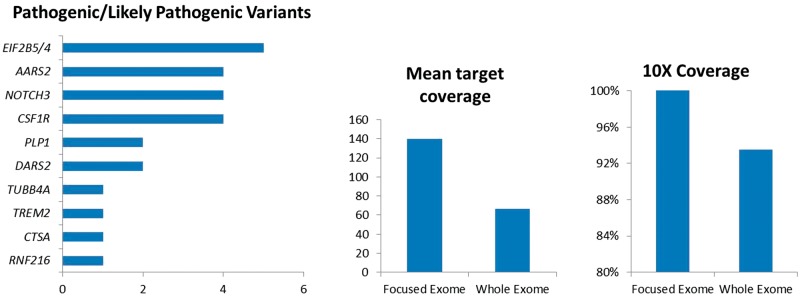
Leukodystrophies and genetic leukoencephalopathies are a rare group of disorders leading to progressive degeneration of cerebral white matter. They are associated with a spectrum of clinical phenotypes dominated by dementia, psychiatric changes, movement disorders and upper motor neuron signs. Mutations in at least 60 genes can lead to leukoencephalopathy with often overlapping clinical and radiological presentations. For these reasons, patients with genetic leukoencephalopathies often endure a long diagnostic odyssey before receiving a definitive diagnosis or may receive no diagnosis at all. In this study, we used focused and whole exome sequencing to evaluate a cohort of undiagnosed adult patients referred to a specialist leukoencephalopathy service. In total, 100 patients were evaluated using focused exome sequencing of 6100 genes. We detected pathogenic or likely pathogenic variants in 26 cases. The most frequently mutated genes were NOTCH3, EIF2B5, AARS2 and CSF1R. We then carried out whole exome sequencing on the remaining negative cases including four family trios, but could not identify any further potentially disease-causing mutations, confirming the equivalence of focused and whole exome sequencing in the diagnosis of genetic leukoencephalopathies. Here we provide an overview of the clinical and genetic features of these disorders in adults.
脑白质营养不良和遗传性脑白质病是一组罕见的疾病,可导致脑白质进行性退化。它们与一系列以痴呆、精神变化、运动障碍和上运动神经元体征为主的临床表型相关。至少60个基因的突变可导致脑白质病,其临床和影像学表现常常重叠。由于这些原因,遗传性脑白质病患者在获得明确诊断之前往往要经历漫长的诊断过程,或者可能根本无法得到诊断。在本研究中,我们使用靶向和全外显子组测序来评估一组转诊至专业脑白质病服务机构的未确诊成年患者。总共对100名患者进行了6100个基因的靶向外显子组测序评估。我们在26例患者中检测到了致病或可能致病的变异。最常发生突变的基因是NOTCH3、EIF2B5、AARS2和CSF1R。然后我们对包括四个家系三联体在内的其余阴性病例进行了全外显子组测序,但未发现任何其他可能致病的突变,证实了靶向和全外显子组测序在遗传性脑白质病诊断中的等效性。在此我们概述了这些疾病在成年人中的临床和遗传特征。