Shin Sung-Ho, Kwon Yang Hyeog, Kim Young-Hwan, Jung Joo-Yun, Nah Junghyo
Department of Electrical Engineering, Chungnam National University, Daejeon 34134, Korea.
Department of Nano Manufacturing Technology, Korea Institute of Machinery and Materials, Daejeon 34103, Korea.
Nanomaterials (Basel). 2016 Oct 14;6(10):186. doi: 10.3390/nano6100186.
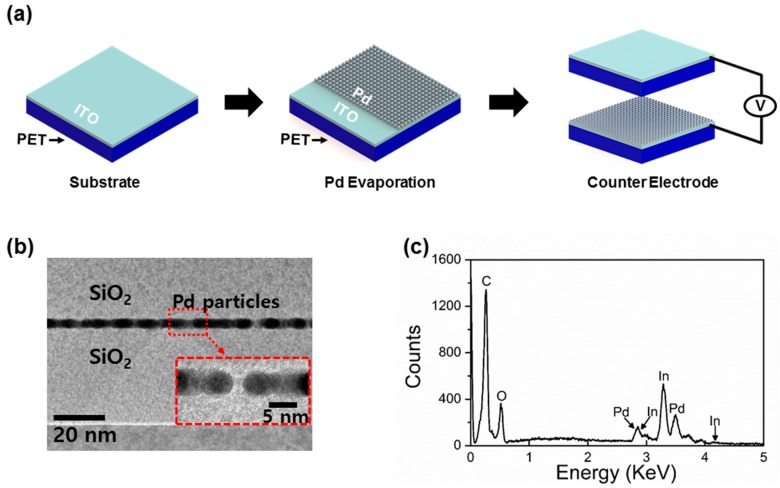
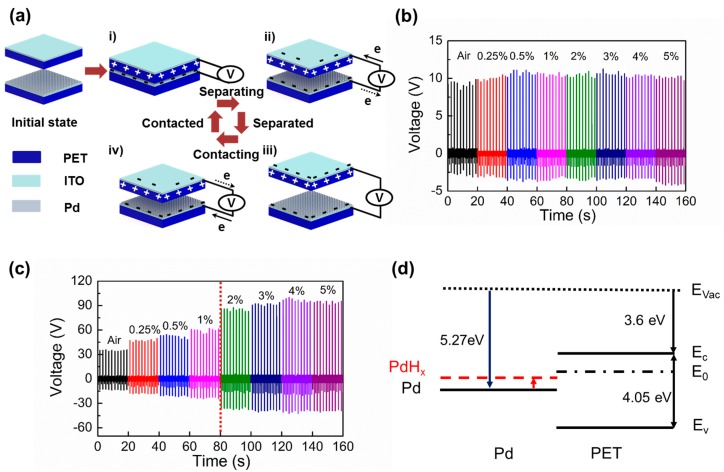
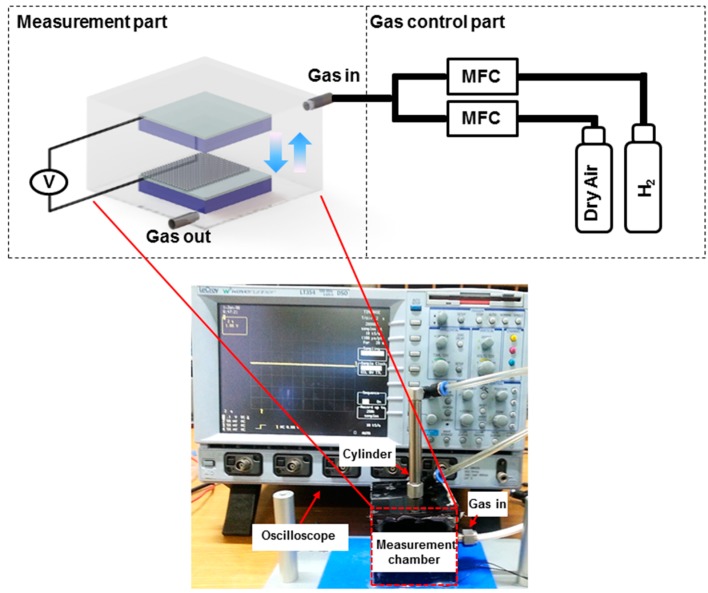
Palladium (Pd)-based hydrogen (H₂) gas sensors have been widely investigated thanks to its fast reaction and high sensitivity to hydrogen. Various sensing mechanisms have been adopted for H₂ gas sensors; however, all the sensors must be powered through an external battery. We report here an H₂ gas sensor that can detect H₂ by measuring the output voltages generated during contact electrification between two friction surfaces. When the H₂ sensor, composed of Pd-coated ITO (indium tin oxide) and PET (polyethylene Terephthalate) film, is exposed to H₂, its output voltage is varied in proportion to H₂ concentration because the work function (WF) of Pd-coated surface changes, altering triboelectric charging behavior. Specifically, the output voltage of the sensor is gradually increased as exposing H₂ concentration increases. Reproducible and sensitive sensor response was observed up 1% H₂ exposure. The approach introduced here can easily be adopted to development of triboelectric gas sensors detecting other gas species.
基于钯(Pd)的氢气(H₂)气体传感器因其对氢气的快速反应和高灵敏度而受到广泛研究。氢气传感器采用了各种传感机制;然而,所有传感器都必须通过外部电池供电。我们在此报告一种氢气传感器,它可以通过测量两个摩擦表面之间接触起电过程中产生的输出电压来检测氢气。当由涂有钯的氧化铟锡(ITO)和聚对苯二甲酸乙二酯(PET)薄膜组成的氢气传感器暴露于氢气中时,其输出电压会随着氢气浓度的变化而成比例变化,这是因为涂有钯的表面的功函数(WF)发生了变化,从而改变了摩擦起电行为。具体而言,随着暴露的氢气浓度增加,传感器的输出电压会逐渐升高。在暴露于1%氢气的情况下,观察到了可重复且灵敏的传感器响应。这里介绍的方法可以很容易地应用于开发检测其他气体种类的摩擦电气体传感器。