Li Shijie, Hu Shiwei, Xu Kaibing, Jiang Wei, Liu Jianshe, Wang Zhaohui
Innovation & Application Institute, Zhejiang Ocean University, Zhoushan 316022, China.
Zhejiang Provincial Key Laboratory of Health Risk Factors for Seafood, Zhoushan Municipal Center for Disease Control and Prevention, Zhoushan 316021, China.
Nanomaterials (Basel). 2017 Jan 23;7(1):22. doi: 10.3390/nano7010022.
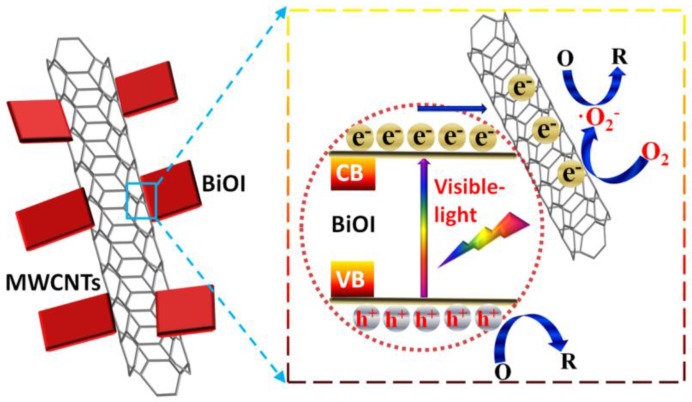
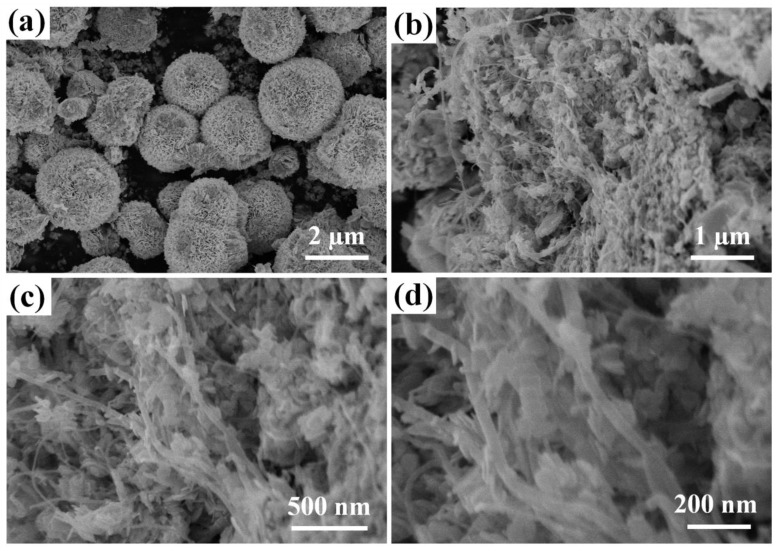
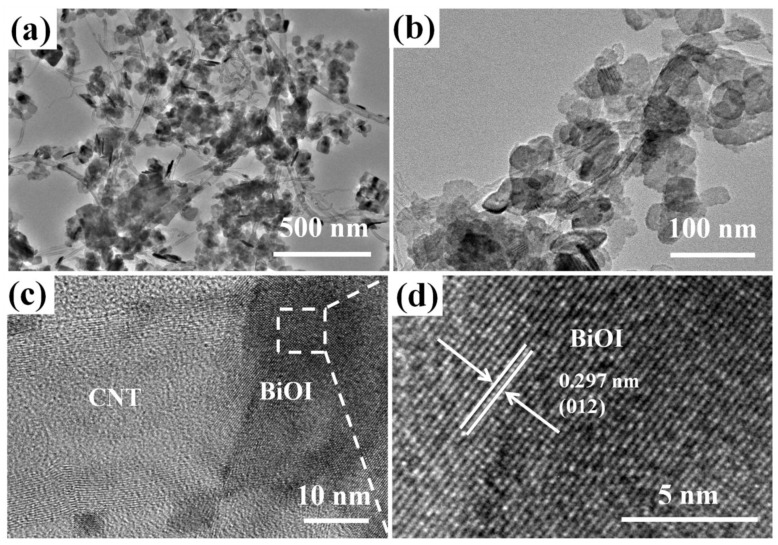
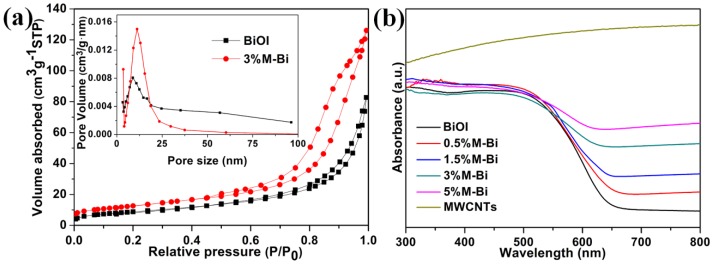
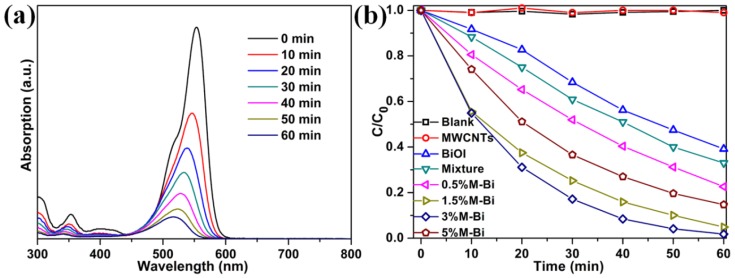
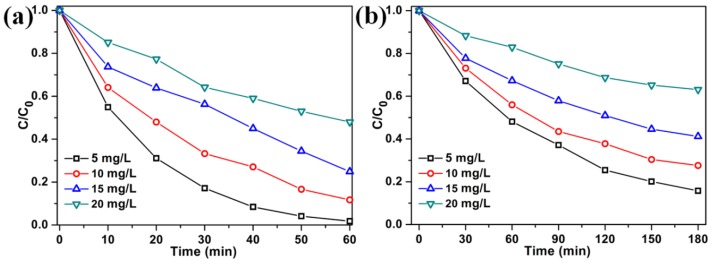
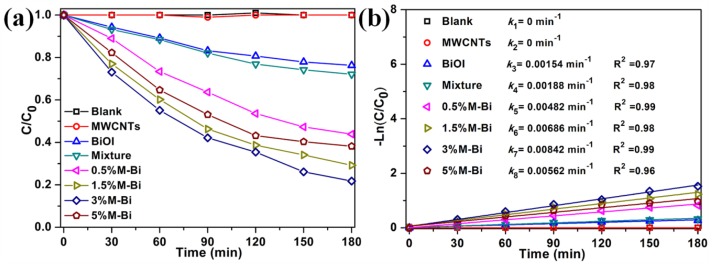
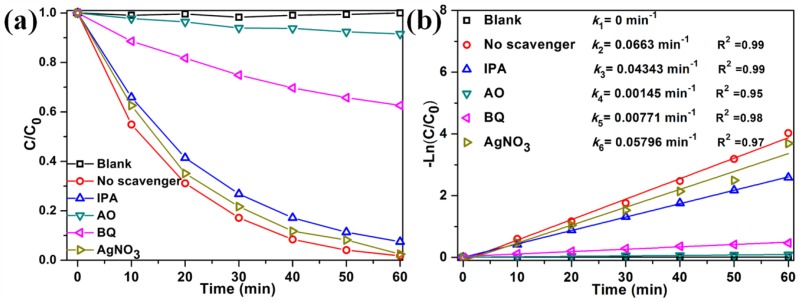
Developing efficient visible-light-driven (VLD) photocatalysts for environmental decontamination has drawn significant attention in recent years. Herein, we have reported a novel heterostructure of multiwalled carbon nanotubes (MWCNTs) coated with BiOI nanosheets as an efficient VLD photocatalyst, which was prepared via a simple solvothermal method. The morphology and structure were characterized by powder X-ray diffraction (XRD), scanning electron microscopy (SEM), transmission electron microscopy (TEM), UV-Vis diffuse reflectance spectroscopy (DRS), and specific surface area measurements. The results showed that BiOI nanosheets were well deposited on MWCNTs. The MWCNTs/BiOI composites exhibited remarkably enhanced photocatalytic activity for the degradation of rhodamine B (RhB), methyl orange (MO), and -chlorophenol (4-CP) under visible-light, compared with pure BiOI. When the MWCNTs content is 3 wt %, the MWCNTs/BiOI composite (3%M-Bi) achieves the highest activity, which is even higher than that of a mechanical mixture (3 wt % MWCNTs + 97 wt % BiOI). The superior photocatalytic activity is predominantly due to the strong coupling interface between MWCNTs and BiOI, which significantly promotes the efficient electron-hole separation. The photo-induced holes (h⁺) and superoxide radicals (O₂) mainly contribute to the photocatalytic degradation of RhB over 3%M-Bi. Therefore, the MWCNTs/BiOI composite is expected to be an efficient VLD photocatalyst for environmental purification.
近年来,开发用于环境净化的高效可见光驱动(VLD)光催化剂引起了广泛关注。在此,我们报道了一种新型的异质结构,即涂覆有BiOI纳米片的多壁碳纳米管(MWCNT)作为一种高效的VLD光催化剂,它是通过简单的溶剂热法制备的。通过粉末X射线衍射(XRD)、扫描电子显微镜(SEM)、透射电子显微镜(TEM)、紫外可见漫反射光谱(DRS)和比表面积测量对其形貌和结构进行了表征。结果表明,BiOI纳米片很好地沉积在MWCNT上。与纯BiOI相比,MWCNT/BiOI复合材料在可见光下对罗丹明B(RhB)、甲基橙(MO)和对氯苯酚(4-CP)的降解表现出显著增强的光催化活性。当MWCNT含量为3 wt%时,MWCNT/BiOI复合材料(3%M-Bi)具有最高活性,甚至高于机械混合物(3 wt% MWCNT + 97 wt% BiOI)。优异的光催化活性主要归因于MWCNT和BiOI之间强大的耦合界面,这显著促进了有效的电子-空穴分离。光生空穴(h⁺)和超氧自由基(O₂)主要促成了3%M-Bi对RhB的光催化降解。因此,MWCNT/BiOI复合材料有望成为一种用于环境净化的高效VLD光催化剂。