
评估神经损伤和神经退行性疾病中半球间通信的新型神经调节技术
Novel Neuromodulation Techniques to Assess Interhemispheric Communication in Neural Injury and Neurodegenerative Diseases.
作者信息
Shin Samuel S, Pelled Galit
机构信息
F.M. Kirby Research Center for Functional Brain Imaging, Kennedy Krieger InstituteBaltimore, MD, USA; Department of Radiology, Johns Hopkins University School of MedicineBaltimore, MD, USA.
出版信息
Front Neural Circuits. 2017 Mar 9;11:15. doi: 10.3389/fncir.2017.00015. eCollection 2017.
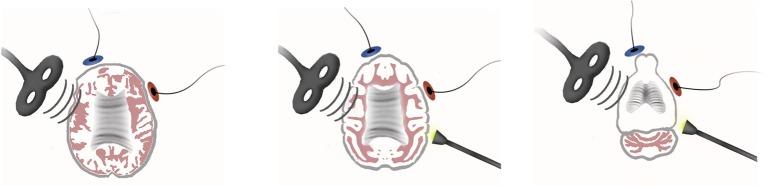
Interhemispheric interaction has a major role in various neurobehavioral functions. Its disruption is a major contributor to the pathological changes in the setting of brain injury such as traumatic brain injury, peripheral nerve injury, and stroke, as well as neurodegenerative diseases. Because interhemispheric interaction has a crucial role in functional consequence in these neuropathological states, a review of noninvasive and state-of-the-art molecular based neuromodulation methods that focus on or have the potential to elucidate interhemispheric interaction have been performed. This yielded approximately 170 relevant articles on human subjects or animal models. There has been a recent surge of reports on noninvasive methods such as transcranial magnetic stimulation and transcranial direct current stimulation. Since these are noninvasive techniques with little to no side effects, their widespread use in clinical studies can be easily justified. The overview of novel neuromodulation methods and how they can be applied to study the role of interhemispheric communication in neural injury and neurodegenerative disease is provided. Additionally, the potential of each method in therapeutic use as well as investigating the pathophysiology of interhemispheric interaction in neurodegenerative diseases and brain injury is discussed. New technologies such as transcranial magnetic stimulation or transcranial direct current stimulation could have a great impact in understanding interhemispheric pathophysiology associated with acquired injury and neurodegenerative diseases, as well as designing improved rehabilitation therapies. Also, advances in molecular based neuromodulation techniques such as optogenetics and other chemical, thermal, and magnetic based methods provide new capabilities to stimulate or inhibit a specific brain location and a specific neuronal population.
半球间相互作用在各种神经行为功能中起着重要作用。其破坏是脑损伤(如创伤性脑损伤、周围神经损伤和中风)以及神经退行性疾病病理变化的主要促成因素。由于半球间相互作用在这些神经病理状态的功能后果中起着关键作用,因此对专注于或有可能阐明半球间相互作用的非侵入性和基于分子的先进神经调节方法进行了综述。这产生了大约170篇关于人类受试者或动物模型的相关文章。最近关于经颅磁刺激和经颅直流电刺激等非侵入性方法的报道激增。由于这些是非侵入性技术,几乎没有副作用,它们在临床研究中的广泛应用很容易得到证明。本文提供了新型神经调节方法的概述以及它们如何应用于研究半球间通信在神经损伤和神经退行性疾病中的作用。此外,还讨论了每种方法在治疗用途以及研究神经退行性疾病和脑损伤中半球间相互作用的病理生理学方面的潜力。经颅磁刺激或经颅直流电刺激等新技术可能对理解与获得性损伤和神经退行性疾病相关的半球间病理生理学以及设计改进的康复治疗产生重大影响。此外,基于分子的神经调节技术(如光遗传学以及其他基于化学、热和磁的方法)的进展提供了刺激或抑制特定脑区和特定神经元群体的新能力。
 Zotero 插件