Krishnan Vijai S, Shin Samuel S, Belegu Visar, Celnik Pablo, Reimers Mark, Smith Kylie R, Pelled Galit
Department of Biomedical Engineering, Michigan State University, East Lansing, MI, United States.
The Institute for Quantitative Health Science and Engineering, Michigan State University, East Lansing, MI, United States.
Front Neurosci. 2019 Apr 24;13:387. doi: 10.3389/fnins.2019.00387. eCollection 2019.
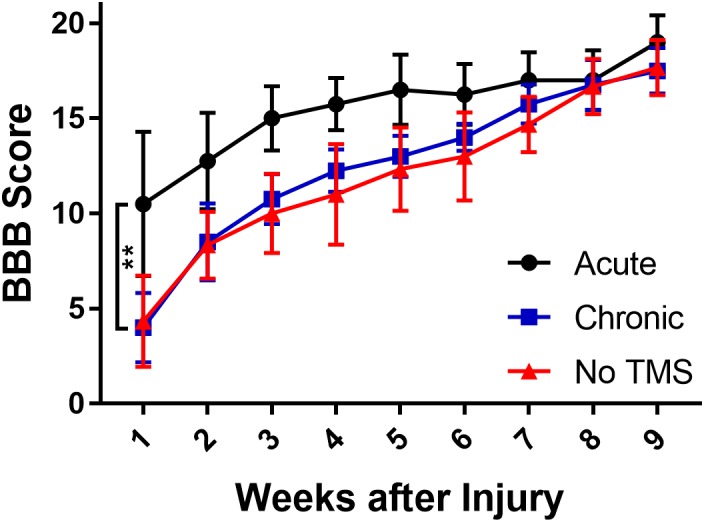
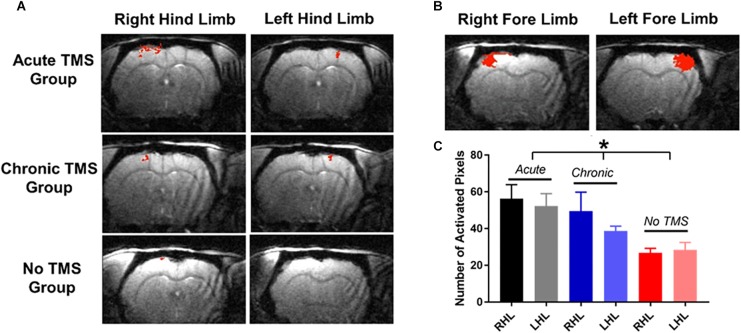
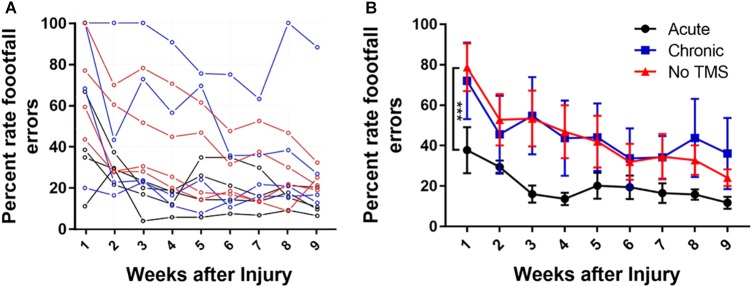
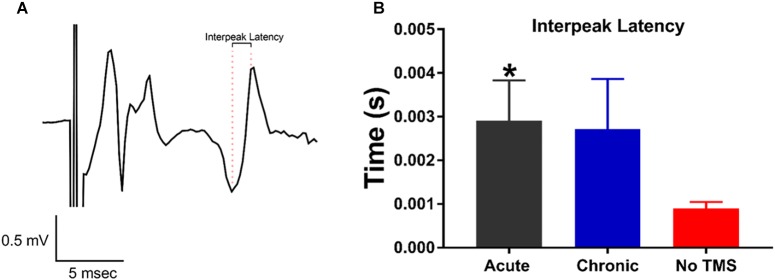
Spinal cord injury (SCI) causes partial or complete damage to sensory and motor pathways and induces immediate changes in cortical function. Current rehabilitative strategies do not address this early alteration, therefore impacting the degree of neuroplasticity and subsequent recovery. The following study aims to test if a non-invasive brain stimulation technique such as repetitive transcranial magnetic stimulation (rTMS) is effective in promoting plasticity and rehabilitation, and can be used as an early intervention strategy in a rat model of SCI. A contusion SCI was induced at segment T9 in adult rats. An rTMS coil was positioned over the brain to deliver high frequency stimulation. Behavior, motor and sensory functions were tested in three groups: SCI rats that received high-frequency (20 Hz) rTMS within 10 min post-injury (acute-TMS; = 7); SCI rats that received TMS starting 2 weeks post-injury (chronic-TMS; = 5), and SCI rats that received sham TMS (no-TMS, = 5). Locomotion was evaluated by the Basso, Beattie, and Bresnahan (BBB) and gridwalk tests. Motor evoked potentials (MEP) were recorded from the forepaw across all groups to measure integrity of motor pathways. Functional MRI (fMRI) responses to contralateral tactile hindlimb stimulation were measured in an 11.7T horizontal bore small-animal scanner. The acute-TMS group demonstrated the fastest improvements in locomotor performance in both the BBB and gridwalk tests compared to chronic and no-TMS groups. MEP responses from forepaw showed significantly greater difference in the inter-peak latency between acute-TMS and no-TMS groups, suggesting increases in motor function. Finally, the acute-TMS group showed increased fMRI-evoked responses to hindlimb stimulation over the right and left hindlimb (LHL) primary somatosensory representations (S1), respectively; the chronic-TMS group showed moderate sensory responses in comparison, and the no-TMS group exhibited the lowest sensory responses to both hindlimbs. The results suggest that rTMS therapy beginning in the acute phase after SCI promotes neuroplasticity and is an effective rehabilitative approach in a rat model of SCI.
脊髓损伤(SCI)会导致感觉和运动通路部分或完全受损,并引起皮质功能的即刻改变。目前的康复策略并未针对这种早期改变,因此影响了神经可塑性程度及后续恢复情况。以下研究旨在测试诸如重复经颅磁刺激(rTMS)这样的非侵入性脑刺激技术是否能有效促进可塑性及康复,以及能否在SCI大鼠模型中用作早期干预策略。在成年大鼠的T9节段诱导挫伤性SCI。将一个rTMS线圈置于大脑上方以施加高频刺激。对三组进行行为、运动和感觉功能测试:在损伤后10分钟内接受高频(20赫兹)rTMS的SCI大鼠(急性TMS组;n = 7);在损伤后2周开始接受TMS的SCI大鼠(慢性TMS组;n = 5),以及接受假TMS的SCI大鼠(无TMS组,n = 5)。通过Basso、Beattie和Bresnahan(BBB)以及网格行走测试评估运动能力。记录所有组前爪的运动诱发电位(MEP)以测量运动通路的完整性。在一台11.7T水平孔径小动物扫描仪中测量对侧后肢触觉刺激的功能磁共振成像(fMRI)反应。与慢性TMS组和无TMS组相比,急性TMS组在BBB和网格行走测试中的运动表现改善最快。前爪的MEP反应显示,急性TMS组和无TMS组之间的峰间期差异显著更大,表明运动功能有所增强。最后,急性TMS组分别在右侧和左侧后肢(LHL)初级体感代表区(S1)对后肢刺激的fMRI诱发反应增强;相比之下,慢性TMS组显示出中等程度的感觉反应,无TMS组对双侧后肢的感觉反应最低。结果表明,SCI后急性期开始的rTMS治疗可促进神经可塑性,是SCI大鼠模型中的一种有效康复方法。