Mammalian Behaviour and Evolution Group, Institute of Integrative Biology, University of Liverpool, Leahurst Campus, Neston, CH64 7TE, UK.
Centre for Proteome Research, Institute of Integrative Biology, University of Liverpool, Liverpool, L69 7ZB, UK.
Sci Rep. 2017 Mar 24;7:44992. doi: 10.1038/srep44992.
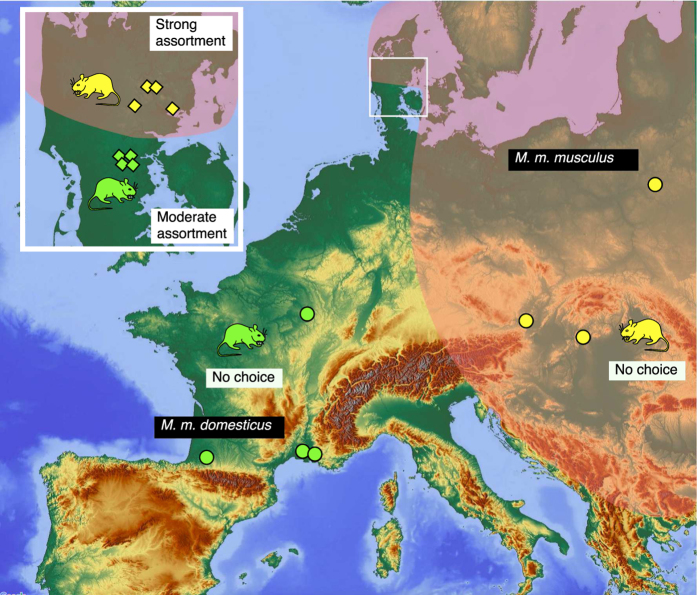
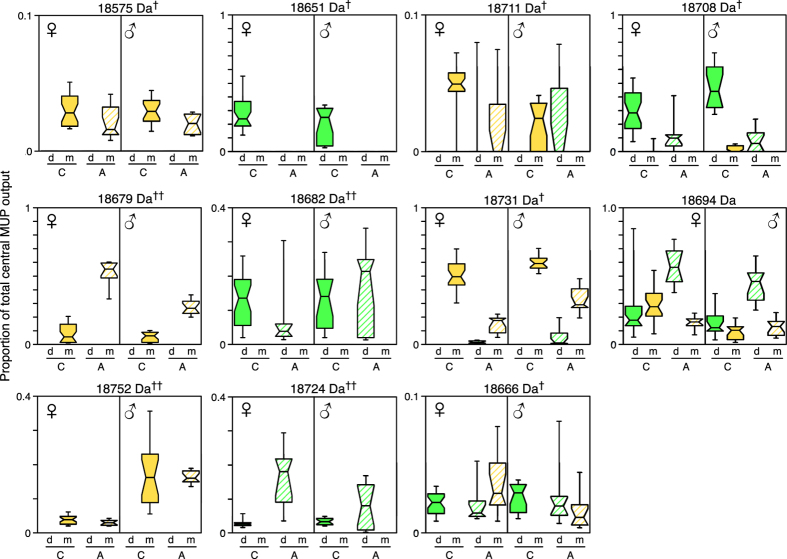
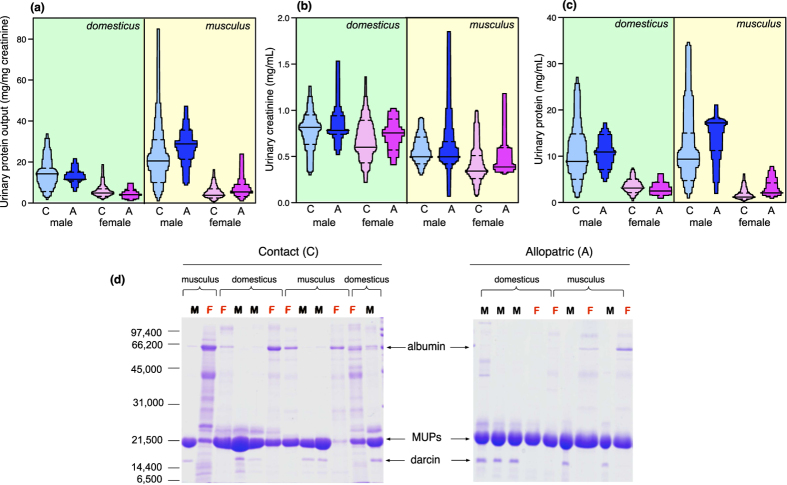
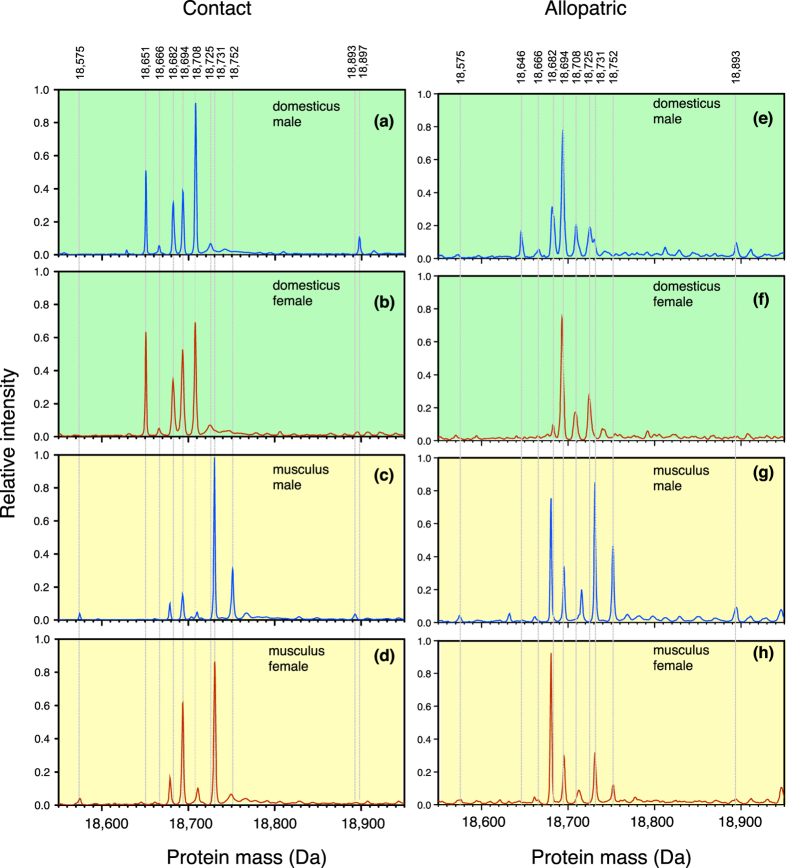
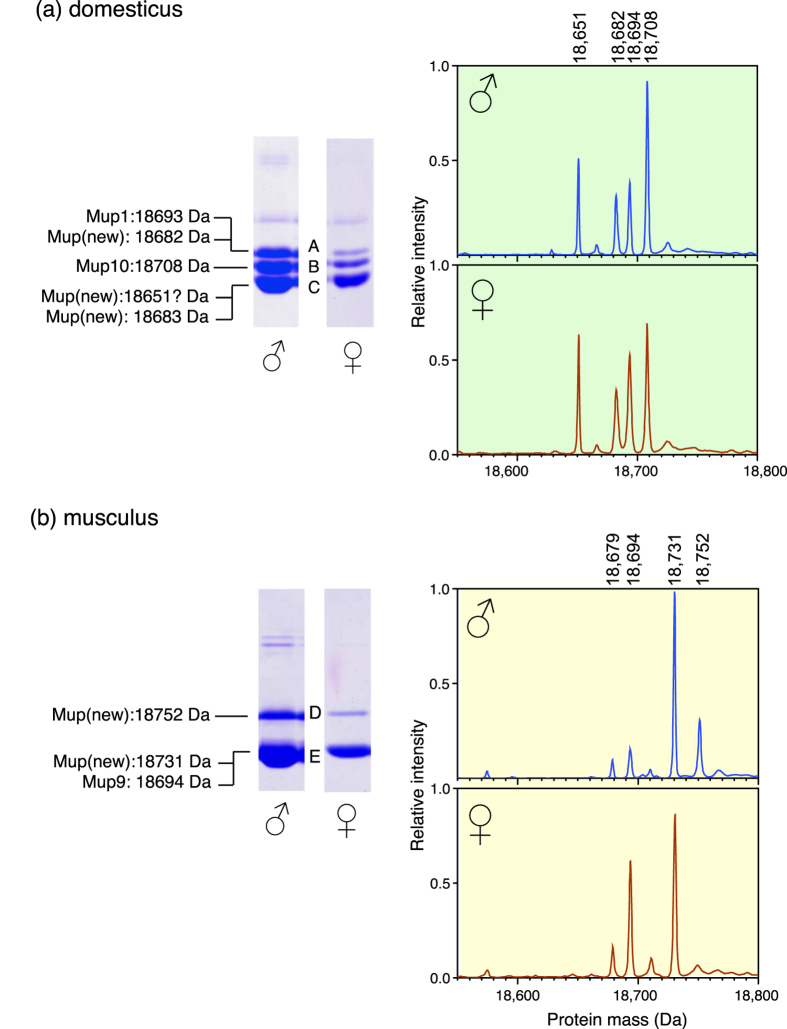
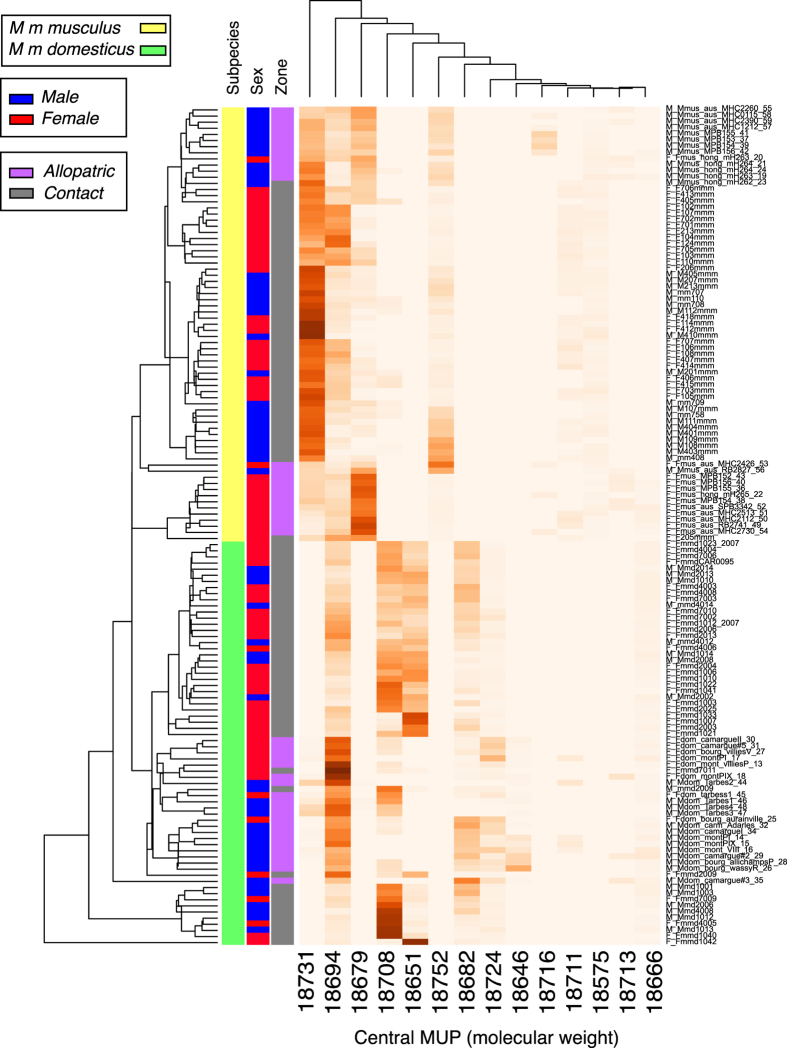
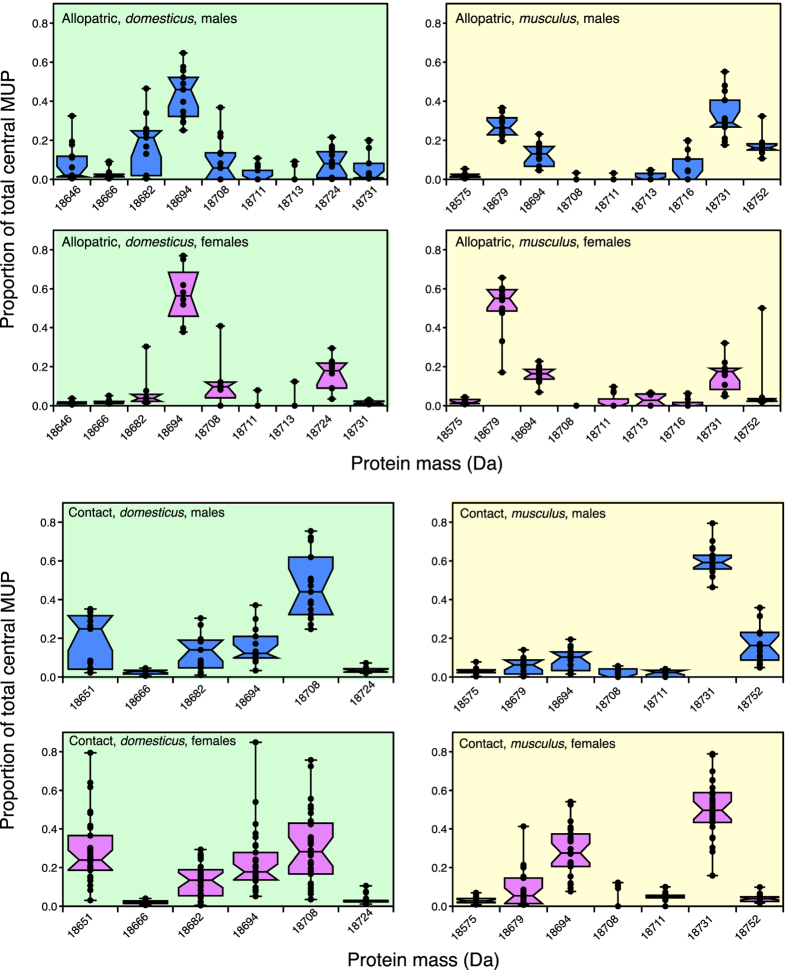
When hybridisation carries a cost, natural selection is predicted to favour evolution of traits that allow assortative mating (reinforcement). Incipient speciation between the two European house mouse subspecies, Mus musculus domesticus and M.m.musculus, sharing a hybrid zone, provides an opportunity to understand evolution of assortative mating at a molecular level. Mouse urine odours allow subspecific mate discrimination, with assortative preferences evident in the hybrid zone but not in allopatry. Here we assess the potential of MUPs (major urinary proteins) as candidates for signal divergence by comparing MUP expression in urine samples from the Danish hybrid zone border (contact) and from allopatric populations. Mass spectrometric characterisation identified novel MUPs in both subspecies involving mostly new combinations of amino acid changes previously observed in M.m.domesticus. The subspecies expressed distinct MUP signatures, with most MUPs expressed by only one subspecies. Expression of at least eight MUPs showed significant subspecies divergence both in allopatry and contact zone. Another seven MUPs showed divergence in expression between the subspecies only in the contact zone, consistent with divergence by reinforcement. These proteins are candidates for the semiochemical barrier to hybridisation, providing an opportunity to characterise the nature and evolution of a putative species recognition signal.
当杂交带来成本时,自然选择被预测有利于进化出允许交配(强化)的特征。在共享杂交区的两个欧洲家鼠亚种——Mus musculus domesticus 和 M.m.musculus 之间,初生的物种形成提供了一个机会,可以从分子水平上理解交配的趋同进化。老鼠尿液的气味可以让亚种之间进行配偶识别,在杂交区可以观察到趋同偏好,但在异域分布区则没有。在这里,我们通过比较丹麦杂交区边界(接触区)和异域种群的尿液样本中的 MUP 表达,评估 MUPs(主要尿液蛋白)作为信号分歧候选物的潜力。质谱特征鉴定出两个亚种中的新型 MUP,涉及到以前在 M.m.domesticus 中观察到的氨基酸变化的新组合。这两个亚种表达了不同的 MUP 特征,大多数 MUP 仅由一个亚种表达。至少有 8 种 MUP 的表达在异域和接触区都表现出明显的亚种分化。另外 7 种 MUP 仅在接触区表现出亚种间的表达差异,这与强化引起的分化一致。这些蛋白质是杂交半化学屏障的候选者,为特征描述提供了机会,即所谓的种间识别信号的本质和进化。