Han Junbin, Liu Hui, Liu Chunling, Jin Hongjun, Perlmutter Joel S, Egan Terrance M, Tu Zhude
Departments of aRadiology bNeurology, Neuroscience, Physical Therapy and Occupational Therapy, Washington University School of Medicine cDepartment of Pharmacological and Physiological Science, Saint Louis University School of Medicine, St. Louis, Missouri, USA.
Nucl Med Commun. 2017 May;38(5):372-382. doi: 10.1097/MNM.0000000000000660.
The P2X7 receptor (P2X7R) is a key regulatory element in the neuroinflammatory cascade that provides a promising target for imaging neuroinflammation. GSK1482160, a P2X7R modulator with nanomolar binding affinity and high selectivity, has been successfully radiolabeled and utilized for imaging P2X7 levels in a mouse model of lipopolysaccharide-induced systemic inflammation. In the current study, we further characterized its binding profile and determined whether [C]GSK1482160 can detect changes in P2X7R expression in a rodent model of multiple sclerosis.
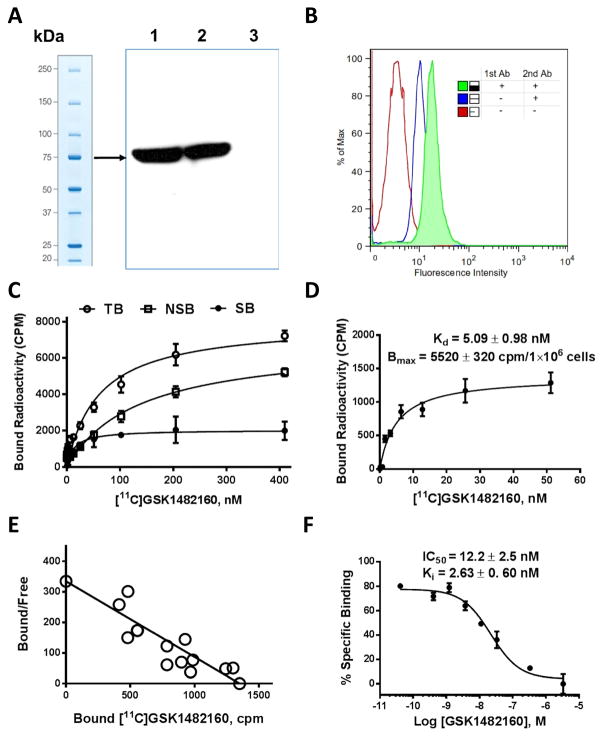
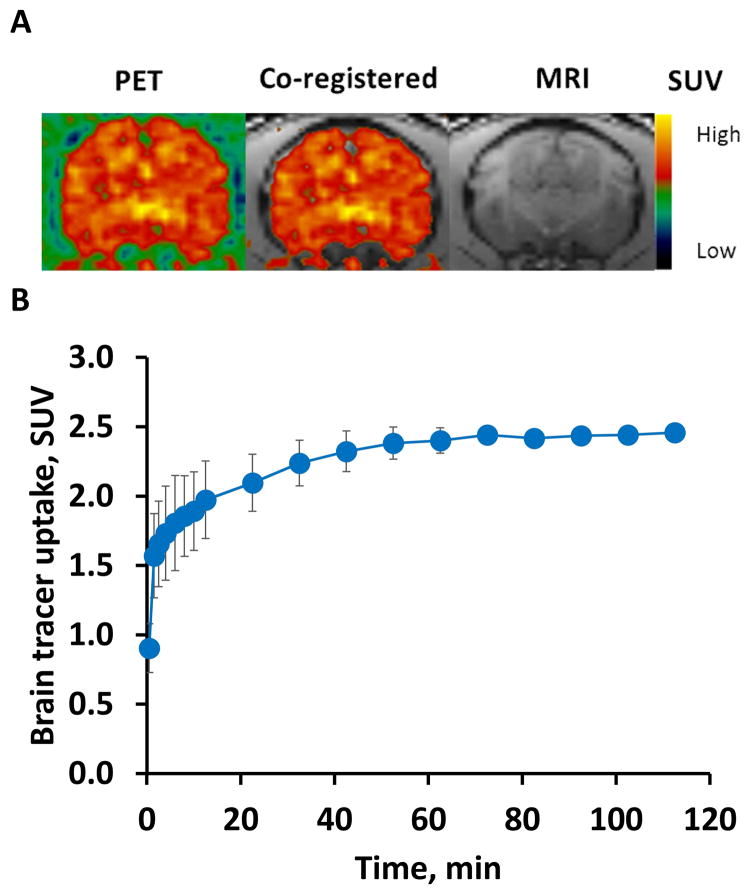
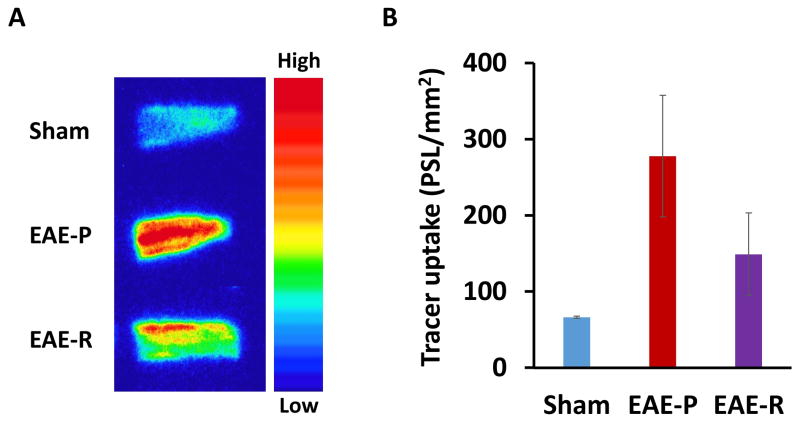
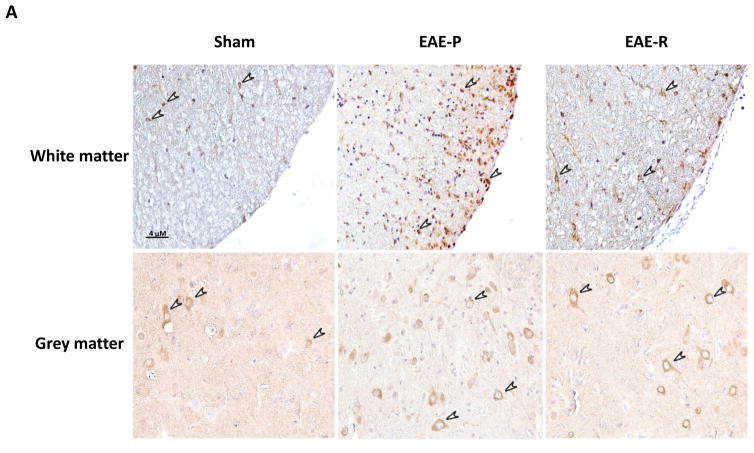
[C]GSK1482160 was synthesized with high specific activity and high radiochemical purity. Radioligand saturation and competition binding assays were performed for [C]GSK1482160 using HEK293-hP2X7R living cells. Micro-PET studies were carried out in nonhuman primates. In vitro autoradiography and immunohistochemistry studies were then carried out to evaluate tracer uptake and P2X7 expression in experimental autoimmune encephalomyelitis (EAE) rat lumbar spinal cord at EAE-peak and EAE-remitting stages compared with sham rats.
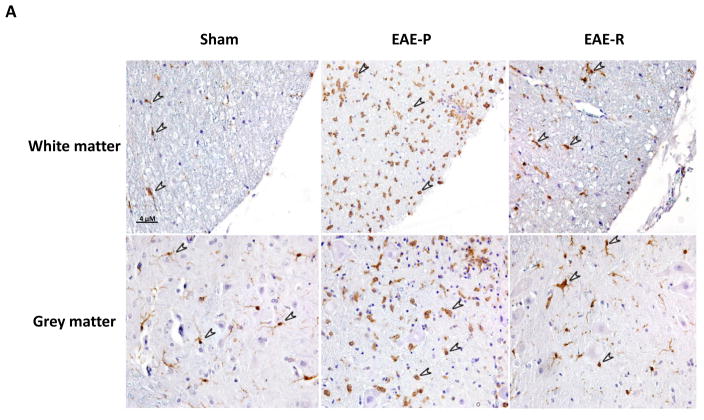
[C]GSK1482160 binds to HEK293-hP2X7R living cells with high binding affinity (Kd=5.09±0.98 nmol/l, Ki=2.63±0.6 nmol/l). Micro-PET studies showed high tracer retention and a homogeneous distribution in the brain of nonhuman primates. In the EAE rat model, tracer uptake of [C]GSK1482160 in rat lumbar spinal cord was the highest at the EAE-peak stage (277.74±79.74 PSL/mm), followed by the EAE-remitting stage(149.00±54.14 PSL/mm) and sham (66.37±1.48 PSL/mm). The tracer uptake correlated strongly with P2X7-positive cell counts, activated microglia numbers, and disease severity.
We conclude that [C]GSK1482160 has the potential for application in monitoring neuroinflammation.
P2X7受体(P2X7R)是神经炎症级联反应中的关键调节因子,为神经炎症成像提供了一个有前景的靶点。GSK1482160是一种具有纳摩尔结合亲和力和高选择性的P2X7R调节剂,已成功进行放射性标记,并用于在脂多糖诱导的全身炎症小鼠模型中对P2X7水平进行成像。在本研究中,我们进一步表征了其结合特性,并确定[碳]GSK1482160是否能够在多发性硬化症啮齿动物模型中检测P2X7R表达的变化。
以高比活度和高放射化学纯度合成[碳]GSK1482160。使用HEK293-hP2X7R活细胞对[碳]GSK1482160进行放射性配体饱和及竞争结合试验。在非人灵长类动物中进行微型正电子发射断层扫描(Micro-PET)研究。然后进行体外放射自显影和免疫组织化学研究,以评估实验性自身免疫性脑脊髓炎(EAE)大鼠在EAE高峰期和EAE缓解期与假手术大鼠相比,其腰段脊髓中示踪剂摄取及P2X7表达情况。
[碳]GSK1482160以高结合亲和力(解离常数Kd = 5.09±0.98纳摩尔/升,抑制常数Ki = 2.63±0.6纳摩尔/升)与HEK293-hP2X7R活细胞结合。Micro-PET研究显示示踪剂在非人灵长类动物大脑中保留率高且分布均匀。在EAE大鼠模型中,[碳]GSK1482160在大鼠腰段脊髓中的示踪剂摄取在EAE高峰期最高(277.74±79.74每平方毫米像素数),其次是EAE缓解期(149.00±54.14每平方毫米像素数)和假手术组(66.37±1.48每平方毫米像素数)。示踪剂摄取与P2X7阳性细胞计数、活化小胶质细胞数量及疾病严重程度密切相关。
我们得出结论,[碳]GSK1482160具有用于监测神经炎症的潜力。