Iijima Hirotaka, Fukutani Naoto, Isho Takuya, Yamamoto Yuko, Hiraoka Masakazu, Miyanobu Kazuyuki, Jinnouchi Masashi, Kaneda Eishi, Aoyama Tomoki, Kuroki Hiroshi, Matsuda Shuichi
Department of Physical Therapy, Human Health Sciences, Graduate School of Medicine, Kyoto University, Kyoto, Japan.
Japan Society for the Promotion of Science, Tokyo, Japan.
BMC Musculoskelet Disord. 2017 Mar 24;18(1):126. doi: 10.1186/s12891-017-1486-4.
This 1-year prospective cohort study aimed to compare the changes in clinical symptoms and functional disability between patients with coexisting patellofemoral (PF) and tibiofemoral (TF) osteoarthritis (OA) and those with isolated TFOA.
Seventy-two patients with medial knee OA were enrolled. Knee pain and functional disability were assessed at baseline and at 1-year follow-up using the Japanese Knee Osteoarthritis Measure (JKOM) and a visual analog scale (VAS). We performed two-way analysis of covariance for the clinical outcome variables to examine, time (baseline and follow-up), group (coexisting PFOA and isolated TFOA), and time-group interaction effects. Furthermore, we conducted post-hoc exploratory analysis to address the possibility that dividing patients according to location of PFOA (i.e., isolated lateral, isolated medial, and mixed [bilateral]) may identify a distinct subgroup with different changes in clinical outcomes at 1-year follow-up.
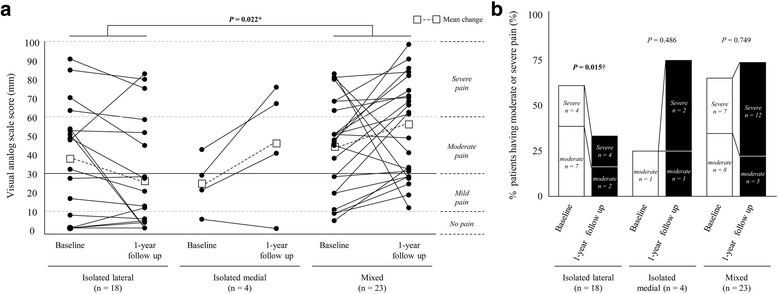
We detected group effects only in scores of the JKOM pain subscale (P = 0.012) and VAS (P = 0.033), adjusted for age, sex, and body mass index. Patients with coexisting PFOA have stable moderate level knee pain and functional disability throughout the year which is significantly worse than that in those with isolated TFOA. Post-hoc subgroup analysis demonstrated that change of knee pain likely varied with location of PFOA. Patients with isolated lateral PFOA had mild/moderate level knee pain, and their VAS scores were likely to improve, whereas those with mixed PFOA exhibited stable to worsening moderate/severe knee pain.
Although we did not detect differences in changes in clinical symptoms and functional disability between patients with coexisting PFOA and those with isolated TFOA, our findings indicate that patients with coexisting PFOA had worse clinical symptoms and functional disability than those with isolated TFOA. The results of the exploratory analysis suggested that patients with coexisting PFOA might have heterogeneous clinical outcomes, and presence of mixed PFOA might be an indicator of severe clinical knee OA.
这项为期1年的前瞻性队列研究旨在比较同时患有髌股关节(PF)和胫股关节(TF)骨关节炎(OA)的患者与单纯患有TF骨关节炎的患者在临床症状和功能障碍方面的变化。
纳入72例膝关节内侧骨关节炎患者。使用日本膝关节骨关节炎测量量表(JKOM)和视觉模拟量表(VAS)在基线和1年随访时评估膝关节疼痛和功能障碍。我们对临床结局变量进行双向协方差分析,以检验时间(基线和随访)、组(同时存在PFOA和单纯TFOA)以及时间-组交互作用。此外,我们进行事后探索性分析,以探讨根据PFOA的位置(即单纯外侧、单纯内侧和混合型[双侧])对患者进行分组是否可能识别出在1年随访时临床结局变化不同的独特亚组。
在调整年龄、性别和体重指数后,我们仅在JKOM疼痛子量表评分(P = 0.012)和VAS评分(P = 0.033)中检测到组效应。同时存在PFOA的患者全年膝关节疼痛和功能障碍处于稳定的中度水平,明显比单纯患有TFOA的患者更严重。事后亚组分析表明,膝关节疼痛的变化可能因PFOA的位置而异。单纯外侧PFOA的患者膝关节疼痛为轻度/中度水平,其VAS评分可能改善,而混合型PFOA的患者膝关节疼痛则表现为稳定至加重的中度/重度。
虽然我们未检测到同时存在PFOA的患者与单纯患有TFOA的患者在临床症状和功能障碍变化方面的差异,但我们的研究结果表明,同时存在PFOA的患者比单纯患有TFOA的患者临床症状和功能障碍更严重。探索性分析结果表明,同时存在PFOA的患者可能有不同的临床结局,混合型PFOA的存在可能是严重临床膝关节OA的一个指标。