Zhao Hua, Shen Jie, Daniel-MacDougall Carrie, Wu Xifeng, Chow Wong-Ho
Department of Epidemiology, the University of Texas MD Anderson Cancer Center, Houston, Texas, USA.
Obesity (Silver Spring). 2017 May;25(5):958-964. doi: 10.1002/oby.21824. Epub 2017 Mar 25.
There is growing evidence that circulating microRNAs (miRNAs) play an important role in obesity. However, whether they can contribute to adult weight gain is still unclear.
In the training set with 40 nonsmoking, healthy women identified from the Mano-A-Mano Mexican American Cohort study, global circulating miRNA profiles in plasma samples were assessed. Cox proportional hazard regression was used to assess the effects of plasma miRNAs on significant weight gain during a 5-year follow-up. Plasma miRNAs associated with significant weight gain were further validated in two testing sets (N = 160 and 100, respectively).
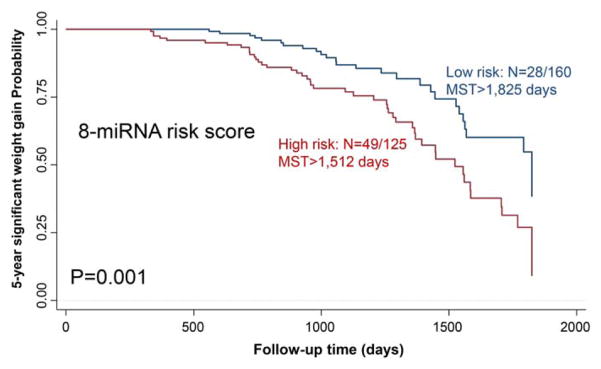
A total of 23 significant plasma miRNAs were identified in the training set. Among them, eight were validated in two testing sets. They were miR-142, miR-122, miR-125b, miR-15b, miR-130b, miR222, miR-519d, and miR-31. Using those eight miRNAs, a risk score for significant weight gain was created. Study participants with a high risk score had 3.01-fold increased risk of having significant weight gain in the whole study population (hazard ratio: 3.01, 95% confidence interval: 1.70-5.47).
The findings provide evidence that circulating miRNAs play important roles in obesity and weight gain and suggest new targets for understanding the mechanisms of weight gain and developing weight loss intervention strategies.
越来越多的证据表明,循环微RNA(miRNA)在肥胖中起重要作用。然而,它们是否会导致成年人体重增加仍不清楚。
在从“手拉手”墨西哥裔美国人队列研究中确定的40名不吸烟的健康女性训练集中,评估血浆样本中的整体循环miRNA谱。采用Cox比例风险回归评估血浆miRNA对5年随访期间显著体重增加的影响。在两个测试集(分别为N = 160和100)中进一步验证与显著体重增加相关的血浆miRNA。
在训练集中共鉴定出23种显著血浆miRNA。其中,8种在两个测试集中得到验证。它们是miR-142、miR-122、miR-125b、miR-15b、miR-130b、miR222、miR-519d和miR-31。利用这8种miRNA创建了显著体重增加的风险评分。在整个研究人群中,高风险评分的研究参与者体重显著增加的风险增加了3.01倍(风险比:3.01,95%置信区间:1.70 - 5.47)。
这些发现提供了证据,表明循环miRNA在肥胖和体重增加中起重要作用,并为理解体重增加机制和制定减肥干预策略提出了新靶点。