Tan Chloe See Wei, Billa Nashiru, Roberts Clive J, Scurr David J
School of Pharmacy, The University of Nottingham, Malaysia Campus, Jalan Broga, Semenyih 43500, Selangor Darul Ehsan, Malaysia.
School of Pharmacy, The University of Nottingham, Park Campus, Nottingham NG7 2RD, UK.
Nanomaterials (Basel). 2014 Dec 19;4(4):905-916. doi: 10.3390/nano4040905.
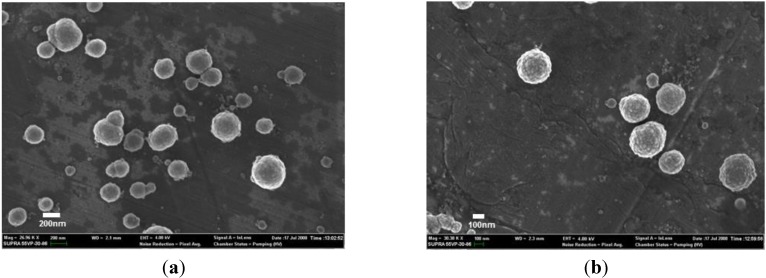
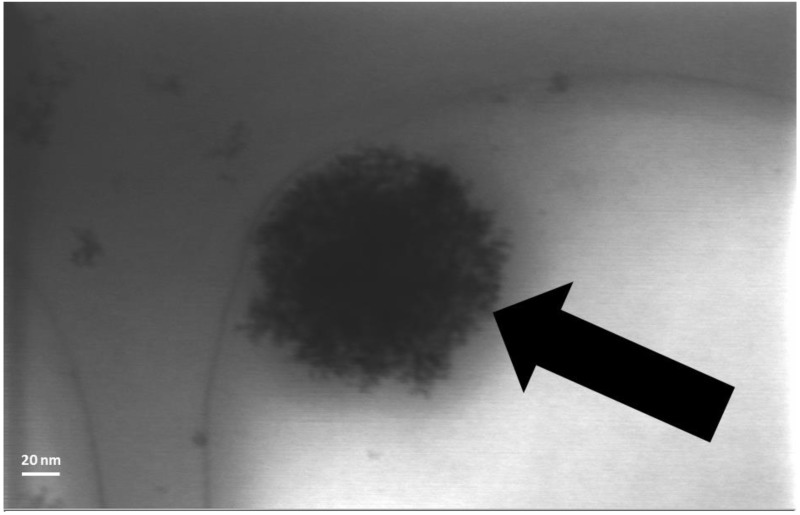
An amphotericin B-containing (AmB) solid lipid nanoparticulate drug delivery system intended for oral administration, comprised of bee's wax and theobroma oil as lipid components was formulated with the aim to ascertain the location of AmB within the lipid matrix: (a) a homogenous matrix; (b) a drug-enriched shell; or (c) a drug enriched core. Both the drug-loaded and drug-free nanoparticles were spherical with AmB contributing to an increase in both the -average diameter (169 ± 1 to 222 ± 2 nm) and zeta potential (40.8 ± 0.9 to 50.3 ± 1.0 mV) of the nanoparticles. A maximum encapsulation efficiency of 21.4% ± 3.0%, corresponding to 10.7 ± 0.4 mg encapsulated AmB within the lipid matrix was observed. Surface analysis and electron microscopic imaging indicated that AmB was dispersed uniformly within the lipid matrix (option (a) above) and, therefore, this is the most suitable of the three models with regard to modeling the propensity for uptake by epithelia and release of AmB in lymph.
一种用于口服给药的含两性霉素B(AmB)的固体脂质纳米颗粒药物递送系统,由蜂蜡和可可脂作为脂质成分制成,其目的是确定AmB在脂质基质中的位置:(a)均匀基质;(b)药物富集壳;或(c)药物富集核心。载药和未载药的纳米颗粒均为球形,AmB导致纳米颗粒的平均直径(169±1至222±2nm)和zeta电位(40.8±0.9至50.3±1.0mV)均增加。观察到最大包封效率为21.4%±3.0%,相当于脂质基质中包封了10.7±0.4mg的AmB。表面分析和电子显微镜成像表明,AmB均匀分散在脂质基质中(上述选项(a)),因此,就模拟上皮细胞摄取和AmB在淋巴中释放的倾向而言,这是三种模型中最合适的一种。