Tang Zixuan, Zhang Huijun, Yan An, Qu Chen
Center for Studies of Psychological Application, School of Psychology, South China Normal University Guangzhou, China.
Center for Studies of Psychological Application, School of Psychology, South China Normal UniversityGuangzhou, China; Guangdong Key Laboratory of Mental Health and Cognitive Science, South China Normal UniversityGuangzhou, China; Scientific Laboratory of Economics Behaviors, School of Economics and Management, South China Normal UniversityGuangzhou, China.
Front Psychol. 2017 Mar 10;8:363. doi: 10.3389/fpsyg.2017.00363. eCollection 2017.
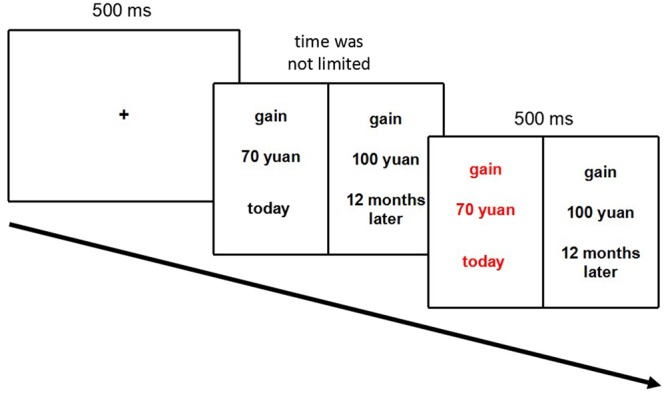
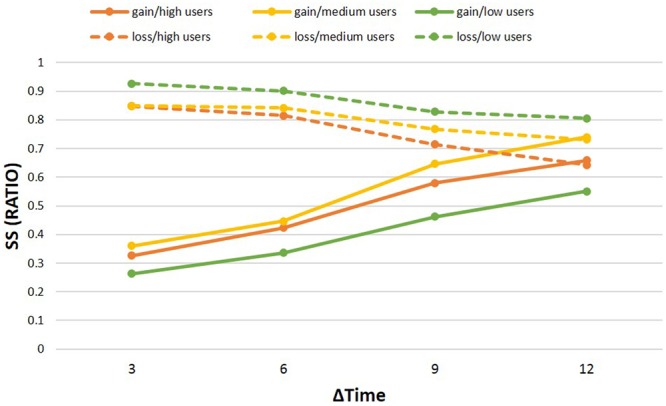
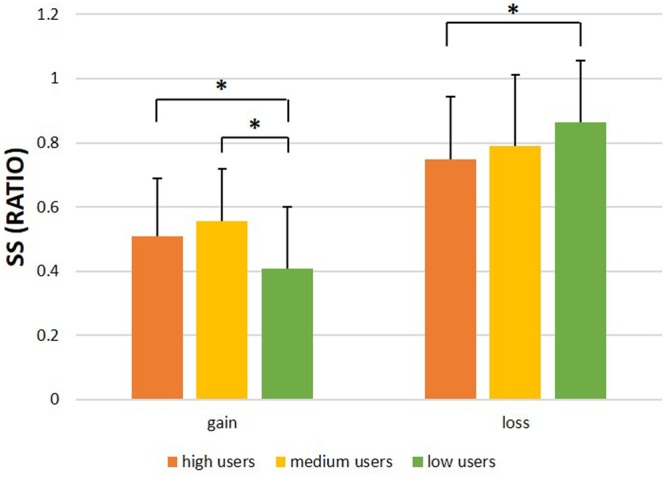
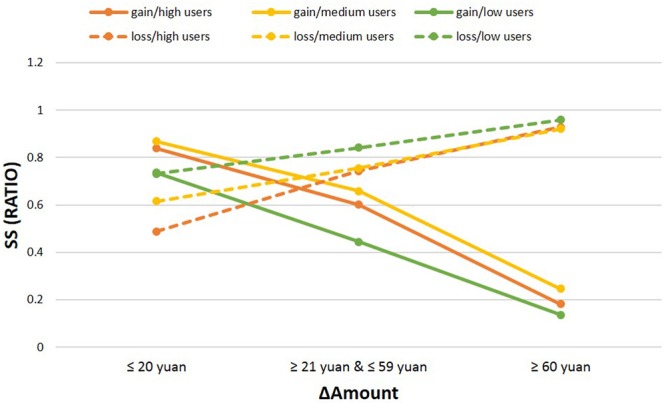
Nowadays the smartphone plays an important role in our lives. While it brings us convenience and efficiency, its overuse can cause problems. Although a great number of studies have demonstrated that people affected by substance abuse, pathological gambling, and internet addiction disorder have lower self-control than average, scarcely any study has investigated the decision making of smartphone high users by using a behavioral paradigm. The present study employed an intertemporal task, the Smartphone Addiction Inventory (SPAI) and the Barratt Impulsiveness Scale 11th version (BIS-11) to explore the decision control of smartphone high users in a sample of 125 college students. Participants were divided into three groups according to their SPAI scores. The upper third (69 or higher), middle third (from 61 to 68) and lower third (60 or lower) of scores were defined as high smartphone users, medium users and low users, respectively. We compared the percentage of small immediate reward/penalty choices in different conditions between the three groups. Relative to the low users group, high users and medium users were more inclined to request an immediate monetary reward. Moreover, for the two dimensions of time and money in intertemporal choice, high users and medium users showed a bias in intertemporal choice task among most of the time points and value magnitude compared to low users. These findings demonstrated that smartphone overuse was associated with problematic decision-making, a pattern similar to that seen in persons affected by a variety of addictions.
如今,智能手机在我们的生活中扮演着重要角色。它给我们带来便利和效率的同时,过度使用也会引发问题。尽管大量研究表明,受药物滥用、病态赌博和网络成瘾障碍影响的人自控力低于平均水平,但几乎没有研究通过行为范式来调查智能手机高使用量用户的决策情况。本研究采用了一项跨期任务、智能手机成瘾量表(SPAI)和第11版巴拉特冲动性量表(BIS-11),以125名大学生为样本,探究智能手机高使用量用户的决策控制情况。参与者根据其SPAI得分被分为三组。得分排名前1/3(69分及以上)、中间1/3(61至68分)和后1/3(60分及以下)分别被定义为智能手机高使用量用户、中等使用量用户和低使用量用户。我们比较了三组在不同条件下选择小的即时奖励/惩罚的百分比。与低使用量用户组相比,高使用量用户和中等使用量用户更倾向于要求即时金钱奖励。此外,在跨期选择的时间和金钱两个维度上,与低使用量用户相比,高使用量用户和中等使用量用户在大多数时间点和价值量级的跨期选择任务中表现出偏差。这些发现表明,智能手机过度使用与有问题的决策有关,这一模式与受各种成瘾影响的人相似。