Manning Catherine, Morgan Michael J, Allen Craig T W, Pellicano Elizabeth
Department of Experimental Psychology, University of Oxford, 9 South Parks Road, Oxford, OX1 3UD UK.
Applied Vision Research Centre, City University, Northampton Square, London, EC1V 0HB UK.
Mol Autism. 2017 Mar 23;8:16. doi: 10.1186/s13229-017-0127-y. eCollection 2017.
Studies reporting altered susceptibility to visual illusions in autistic individuals compared to that typically developing individuals have been taken to reflect differences in perception (e.g. reduced global processing), but could instead reflect differences in higher-level decision-making strategies.
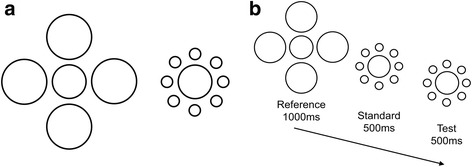
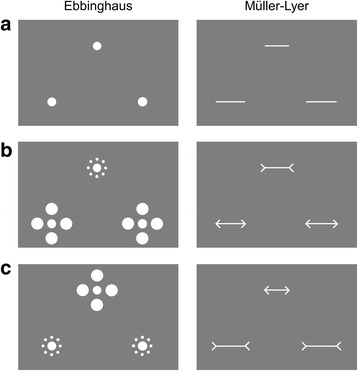
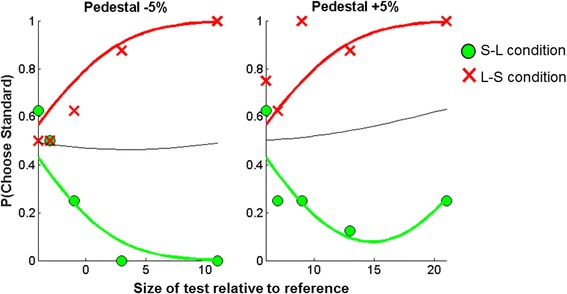
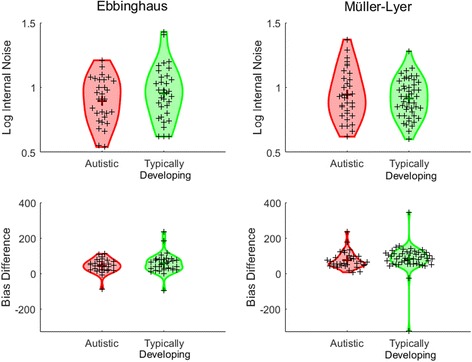
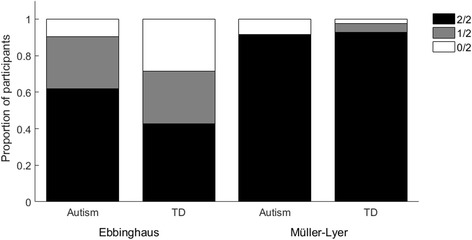
We measured susceptibility to two contextual illusions (Ebbinghaus, Müller-Lyer) in autistic children aged 6-14 years and typically developing children matched in age and non-verbal ability using three methods. In experiment 1, we used a new two-alternative-forced-choice method with a roving pedestal designed to minimise cognitive biases. Here, children judged which of two comparison stimuli was most similar in size to a reference stimulus. In experiments 2 and 3, we used methods previously used with autistic populations. In experiment 2, children judged whether stimuli were the 'same' or 'different', and in experiment 3, we used a method-of-adjustment task.
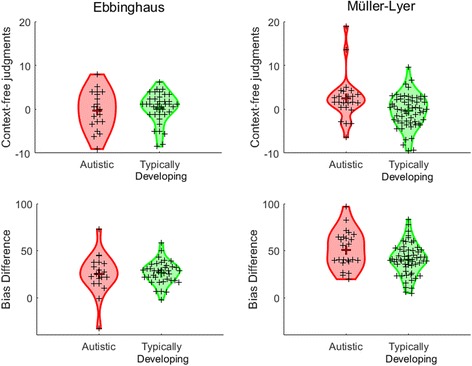
Across all tasks, autistic children were equally susceptible to the Ebbinghaus illusion as typically developing children. Autistic children showed a susceptibility to the Müller-Lyer illusion, but only in the method-of-adjustment task. This result may reflect differences in decisional criteria.
Our results are inconsistent with theories proposing reduced contextual integration in autism and suggest that previous reports of altered susceptibility to illusions may arise from differences in decision-making, rather than differences in perception per se. Our findings help to elucidate the underlying reasons for atypical responses to perceptual illusions in autism and call for the use of methods that reduce cognitive bias when measuring illusion susceptibility.
与正常发育个体相比,有关自闭症个体对视觉错觉易感性改变的研究被认为反映了感知差异(例如整体加工能力降低),但也可能反映了高级决策策略的差异。
我们使用三种方法测量了6至14岁自闭症儿童以及年龄和非语言能力相匹配的正常发育儿童对两种情境错觉(艾宾浩斯错觉、缪勒-莱尔错觉)的易感性。在实验1中,我们使用了一种新的二选一强制选择方法,带有一个移动的参照刺激,旨在最小化认知偏差。在此,儿童判断两个比较刺激中哪个在大小上与参照刺激最相似。在实验2和3中,我们使用了先前用于自闭症群体的方法。在实验2中,儿童判断刺激是“相同”还是“不同”,在实验3中,我们使用了一种调整任务法。
在所有任务中,自闭症儿童对艾宾浩斯错觉的易感性与正常发育儿童相同。自闭症儿童对缪勒-莱尔错觉表现出易感性,但仅在调整任务法中。这一结果可能反映了决策标准的差异。
我们的结果与提出自闭症中情境整合减少的理论不一致,并表明先前关于错觉易感性改变的报告可能源于决策差异,而非感知本身的差异。我们的研究结果有助于阐明自闭症中对感知错觉非典型反应的潜在原因,并呼吁在测量错觉易感性时使用减少认知偏差的方法。