Singh Ruchi, Verma Arushi, Aljabari Salim, Vasylyeva Tetyana L
Department of Pediatrics, Texas Tech University Health Sciences Center, 1400 S. Coulter, Amarillo, TX 79106 USA.
BMC Obes. 2017 Mar 22;4:11. doi: 10.1186/s40608-017-0148-2. eCollection 2017.
Obesity is a pro-inflammatory state that may predispose patients to acute coronary syndrome characterized by chronic low grade inflammation resulting in endothelial dysfunction (ED). The aim of the study was to evaluate urinary biomarkers of inflammation and ED in adolescents with obesity.
Sixty three subjects were recruited for the study. Twenty healthy adolescents with normal body mass (NW), 14 overweight (OW), 29 obese (OA) subjects were selected. An EndoPat 2000 device was used to measure the reactive hyperemia index (RHI). First morning fasting urine samples were tested for interleukin 6 (IL-6), endothelin 1 (ET-1), alpha-1-acid glycoprotein (AGP), tumor necrosis factor- α (TNF-α) and corrected to urinary creatinine.
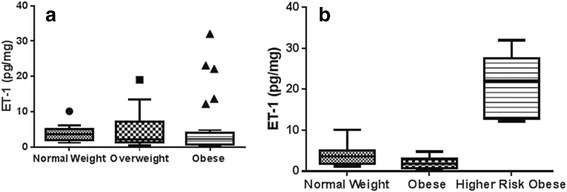
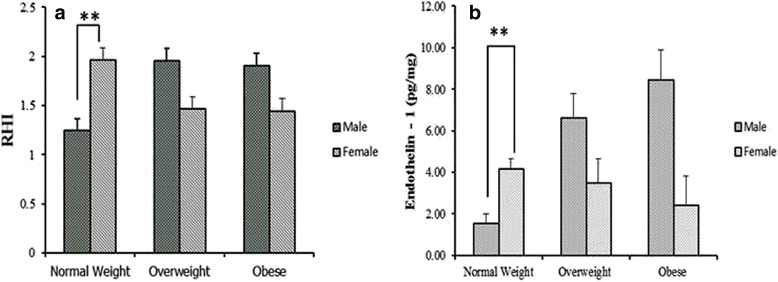
Urinary TNF-α was significantly higher in OA group (52.4 ± 15.3 pg/mg) compared to adolescents with NW (14.1 ± 1.2 pg/mg, = 0.04). ET-1 levels were found to be higher in OW (5.18 ± 1.6 pg/mg) compared with NW (3 · 47 ± 0.3 pg/mg, = 0.24); and higher in OA (8.48 ± 3.1 pg/mg) compared to both NW ( = 0.19) and OW ( = 0.40). Similarly a higher AGP level was observed in OW (864.8 ± 156 ng/mg) and OA (808.3 ± 186 ng/mg) compared to NW (653 ± 69 ng/mg) ( = 0.16 & 0.49 respectively). Inflammatory markers namely, TNF-α, IL-6 and AGP significantly and positively correlated with each other and with ET-1, a marker for endothelial dysfunction. This significant correlation was also observed when tested separately in the subgroups (NW, OW and OA). There were no differences in RHI levels among the study groups.
Urinary TNF-alpha is significantly elevated in obese adolescents and correlates with urinary ET-1, which is recognized as a biomarker for endothelial dysfunction. Since obesity is a chronic inflammatory state, elevated urinary TNF-alpha might be used as a non invasive tool to monitor the level of that inflammation.
肥胖是一种促炎状态,可能使患者易患以慢性低度炎症导致内皮功能障碍(ED)为特征的急性冠状动脉综合征。本研究的目的是评估肥胖青少年炎症和内皮功能障碍的尿液生物标志物。
招募了63名受试者进行研究。选择了20名体重正常(NW)的健康青少年、14名超重(OW)青少年和29名肥胖(OA)受试者。使用EndoPat 2000设备测量反应性充血指数(RHI)。检测首次晨尿样本中的白细胞介素6(IL-6)、内皮素1(ET-1)、α1-酸性糖蛋白(AGP)、肿瘤坏死因子-α(TNF-α),并校正尿肌酐。
与NW青少年(14.1±1.2 pg/mg,P = 0.04)相比,OA组的尿TNF-α显著更高(52.4±15.3 pg/mg)。发现OW组(5.18±1.6 pg/mg)的ET-1水平高于NW组(3.47±0.3 pg/mg,P = 0.24);且OA组(8.48±3.1 pg/mg)的ET-1水平高于NW组(P = 0.19)和OW组(P = 0.40)。同样,与NW组(653±69 ng/mg)相比,OW组(864.8±156 ng/mg)和OA组(808.3±186 ng/mg)的AGP水平更高(分别为P = 0.16和0.49)。炎症标志物TNF-α、IL-6和AGP之间以及与内皮功能障碍标志物ET-1之间均显著正相关。在亚组(NW、OW和OA)中单独检测时也观察到这种显著相关性。研究组之间的RHI水平无差异。
肥胖青少年的尿TNF-α显著升高,且与尿ET-1相关,尿ET-1被认为是内皮功能障碍的生物标志物。由于肥胖是一种慢性炎症状态,升高的尿TNF-α可能用作监测该炎症水平的非侵入性工具。