Li Yuanyuan, Zhao Ying, Feng Limin, Guo Renyong
Department of Laboratory Medicine, The First Affiliated Hospital, College of Medicine, Zhejiang University, Hangzhou, China.
BMJ Open. 2017 Mar 27;7(3):e013206. doi: 10.1136/bmjopen-2016-013206.
Inflammation-based prognostic markers (neutrophil-lymphocyte ratio (NLR), prognostic nutritional index (PNI), red cell distribution width (RDW) and lymphocyte-monocyte ratio (LMR)) are associated with overall survival in some diseases. This study assessed their prognostic value in mortality and severity in acute pancreatitis (AP).
A retrospective cohort study.
Patients with AP were recruited from the emergency department at our hospital.
A total of 359 patients with AP (31 non-survivors) were enrolled.
Mortality and severity of AP were the primary and secondary outcome measures, respectively. Biochemistry and haematology results of the first test after admission were collected. Independent relationships between severe AP (SAP) and markers were assessed using multivariate logistic regression models. Mortality prediction ability was evaluated using receiver operating characteristic (ROC) curves. Overall survival was evaluated using the Kaplan-Meier method, with differences compared using the log-rank test. Independent relationships between mortality and each predictor were estimated using the Cox proportional hazard models.
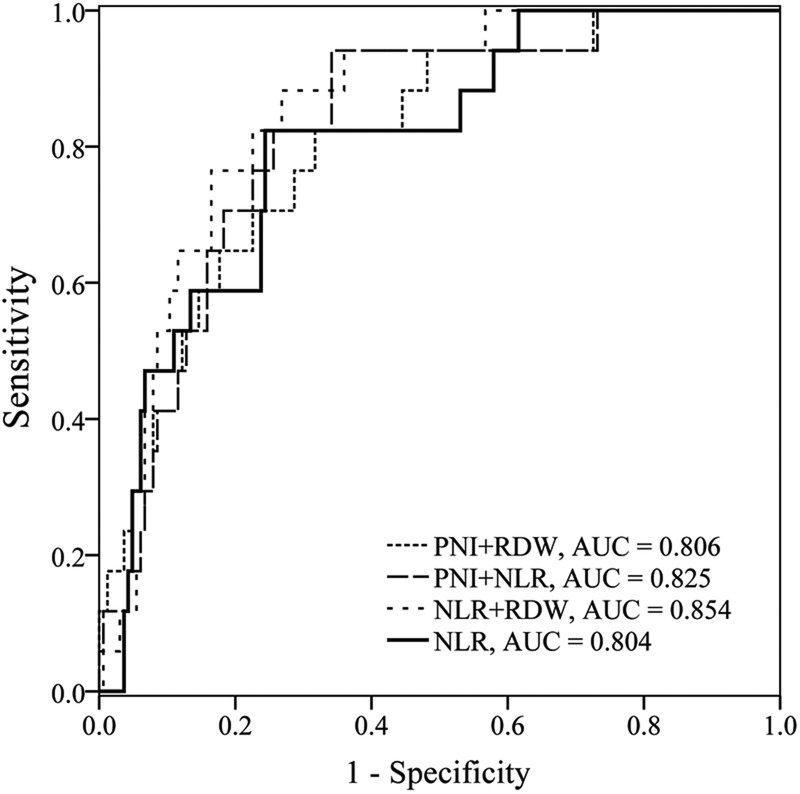
Compared with survivors of AP, non-survivors had higher RDW (p<0.001), higher NLR (p<0.001), lower LMR (p<0.001) and lower PNI (p<0.001) at baseline. C reactive protein (CRP; OR=8.251, p<0.001), RDW (OR=2.533, p=0.003) and PNI (OR=7.753, p<0.001) were independently associated with the occurrence of SAP. For predicting mortality, NLR had the largest area under the ROC curve (0.804, p<0.001), with a 16.64 cut-off value, 82.4% sensitivity and 75.6% specificity. RDW was a reliable marker for excluding death owing to its lowest negative likelihood ratio (0.11). NLR (HR=4.726, p=0.004), CRP (HR=3.503, p=0.003), RDW (HR=3.139, p=0.013) and PNI (HR=2.641, p=0.011) were independently associated with mortality of AP.
NLR was the most powerful marker of overall survival in this patient series.
基于炎症的预后标志物(中性粒细胞与淋巴细胞比值(NLR)、预后营养指数(PNI)、红细胞分布宽度(RDW)和淋巴细胞与单核细胞比值(LMR))在某些疾病中与总生存期相关。本研究评估了它们在急性胰腺炎(AP)患者死亡率和严重程度方面的预后价值。
一项回顾性队列研究。
AP患者从我院急诊科招募。
共纳入359例AP患者(31例非幸存者)。
AP的死亡率和严重程度分别为主要和次要观察指标。收集入院后首次检查的生化和血液学结果。使用多变量逻辑回归模型评估重症急性胰腺炎(SAP)与标志物之间的独立关系。使用受试者工作特征(ROC)曲线评估死亡率预测能力。采用Kaplan-Meier法评估总生存期,使用对数秩检验比较差异。使用Cox比例风险模型估计死亡率与各预测因素之间的独立关系。
与AP幸存者相比,非幸存者在基线时的RDW更高(p<0.001)、NLR更高(p<0.001)、LMR更低(p<0.001)和PNI更低(p<0.001)。C反应蛋白(CRP;OR=8.251,p<0.001)、RDW(OR=2.533,p=0.003)和PNI(OR=7.753,p<0.001)与SAP的发生独立相关。对于预测死亡率,NLR在ROC曲线下的面积最大(0.804,p<0.001),临界值为16.64,灵敏度为82.4%,特异性为75.6%。RDW因其最低的阴性似然比(0.11)是排除死亡的可靠标志物。NLR(HR=4.726,p=0.004)、CRP(HR=3.503,p=0.003)、RDW(HR=3.139,p=0.013)和PNI(HR=2.641,p=0.011)与AP的死亡率独立相关。
在本患者系列中,NLR是总生存期最有力的标志物。