Schwartz Bryan G, Ludeman Daniel J, Mayeda Guy S, Kloner Robert A, Economides Christina, Burstein Steven
Heart Institute, Good Samaritan Hospital, Los Angeles, California, USA.
Department of Cardiology, Good Samaritan Hospital, Los Angeles, California, USA.
Cardiol Res. 2012 Apr;3(2):54-66. doi: 10.4021/cr121w. Epub 2012 Mar 20.
Patients with cardiogenic shock (CS) are routinely treated with intra-aortic balloon pumps (IABPs). The utility of 2 new percutaneous left ventricular assist devices (PLVADs), the Impella and TandemHeart, is unknown. The objective of this study was to describe the use of PLVADs for patients with CS at our institution.
All cases involving PLVADs in patients with CS between between January 1, 2008 and June 30, 2010 at a private, tertiary referral hospital were reviewed retrospectively.
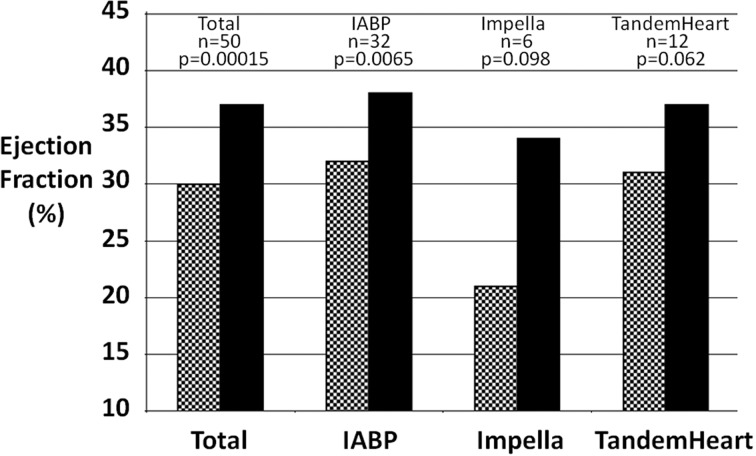
All 76 cases were identified (50 IABP only, 7 Impella, 19 TandemHeart). Most Impella (5/7) and TandemHeart (10/19) patients were initially treated with an IABP before "upgrading" for increased hemodynamic support. All 76 devices (100%) were initiated successfully. Percutaneous revascularization was attempted in 63 patients with angiographic success in 57 (90%). The incidences of major complications were similar between groups, except bleeding occurred less frequently with the IABP. Mean ejection fraction on presentation was 30.4±16.5% and increased by a mean of 6.6±11.4% (P < 0.001). With the institutional approach of treating patients with CS initially with vasopressors and IABPs, then upgrading to an Impella or TandemHeart device for patients refractory to IABP therapy, the overall mortality rate was 40%.
The Impella and TandemHeart devices can be initiated successfully in patients with CS, are associated with high rates of angiographic success during high risk percutaneous interventions and may benefit the myocardium during myocardial infarction. Randomized trials are warranted investigating use of the Impella and TandemHeart devices in patients with CS and in patients refractory to conventional IABP therapy.
心源性休克(CS)患者通常接受主动脉内球囊反搏(IABP)治疗。两种新型经皮左心室辅助装置(PLVAD),即Impella和TandemHeart的效用尚不清楚。本研究的目的是描述在我们机构中PLVAD在CS患者中的使用情况。
回顾性分析2008年1月1日至2010年6月30日在一家私立三级转诊医院中所有涉及CS患者使用PLVAD的病例。
共识别出76例病例(仅使用IABP的50例,使用Impella的7例,使用TandemHeart的19例)。大多数Impella(5/7)和TandemHeart(10/19)患者最初在“升级”以增加血流动力学支持之前接受IABP治疗。所有76台装置(100%)均成功启动。63例患者尝试进行经皮血管重建,其中57例血管造影成功(90%)。除IABP出血发生率较低外,各组主要并发症发生率相似。就诊时平均射血分数为30.4±16.5%,平均增加6.6±11.4%(P<0.001)。采用本机构最初用血管升压药和IABP治疗CS患者,然后将对IABP治疗无效的患者升级为使用Impella或TandemHeart装置的方法,总死亡率为40%。
Impella和TandemHeart装置可在CS患者中成功启动,在高风险经皮干预期间血管造影成功率高,并且在心肌梗死期间可能对心肌有益。有必要进行随机试验,研究Impella和TandemHeart装置在CS患者以及对传统IABP治疗无效的患者中的使用情况。