Ilyas Abid, Ishtiaq Wasib, Assad Salman, Ghazanfar Haider, Mansoor Salman, Haris Muhammad, Qadeer Aayesha, Akhtar Aftab
Internal Medicine, Shifa College of Medicine, Islamabad, Pakistan.
Department of Pulmonology & Critical Care Medicine, Shifa International Hospital, Islamabad, Pakistan.
Cureus. 2017 Feb 12;9(2):e1025. doi: 10.7759/cureus.1025.
The objective of our study is to assess the correlation between inferior vena cava (IVC) diameters, central venous pressure (CVP) and the IVC collapsibility index for estimating the volume status in critically ill patients.
This cross-sectional study used the convenient sampling of 100 adult medical intensive care unit (ICU) patients for a period of three months. Patients ≥ 18 years of age with an intrathoracic central venous catheter terminating in the distal superior vena cava connected to the transducer to produce a CVP waveform were included in the study. A Mindray diagnostic ultrasound system model Z6 ultrasound machine (Mindray, NJ, USA) was used for all examinations. An Ultrasonic Transducer model 3C5P (Mindray, NJ, USA) for IVC imaging was utilized. A paired sampled t-test was used to compute the p-values.
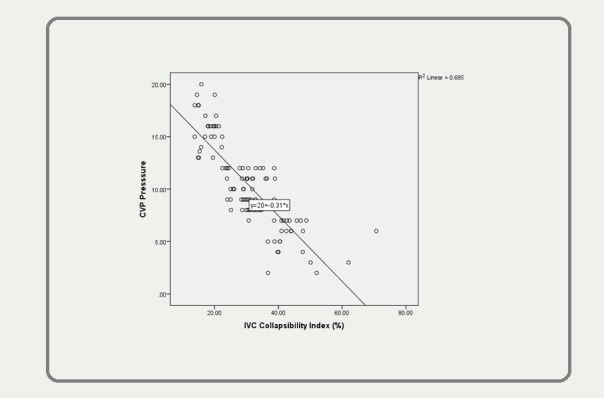
A total of 32/100 (32%) females and 68/100 (68%) males were included in the study with a mean age of 50.4 ± 19.3 years. The mean central venous pressure maintained was 10.38 ± 4.14 cmH2O with an inferior vena cava collapsibility index of 30.68 ± 10.93. There was a statistically significant relation among the mean CVP pressure, the IVC collapsibility index, the mean maximum and minimum IVC between groups as determined by one-way analysis of variance (ANOVA) (p < 0.001). There was a strong negative correlation between CVP and IVC collapsibility index (%), which was statistically significant (r = -0.827, n = 100, p < 0.0005). A strong positive correlation between CVP and maximum IVC diameter (r = 0.371, n = 100, p < 0.0005) and minimum IVC diameter (r = 0.572, n = 100, p < 0.0005) was found.
There is a positive relationship of CVP with minimum and maximum IVC diameters but an inverse relationship with the IVC collapsibility index.
本研究的目的是评估下腔静脉(IVC)直径、中心静脉压(CVP)与IVC塌陷指数之间的相关性,以估计危重症患者的容量状态。
本横断面研究采用便利抽样法,选取100例成年医学重症监护病房(ICU)患者,为期三个月。纳入年龄≥18岁、胸腔内中心静脉导管末端位于上腔静脉远端并连接至传感器以产生CVP波形的患者。所有检查均使用迈瑞Z6型诊断超声系统(美国新泽西州迈瑞公司)。使用3C5P型超声换能器(美国新泽西州迈瑞公司)进行IVC成像。采用配对样本t检验计算p值。
本研究共纳入32/100(32%)名女性和68/100(68%)名男性,平均年龄为50.4±19.3岁。维持的平均中心静脉压为10.38±4.14 cmH2O,IVC塌陷指数为30.68±10.93。通过单因素方差分析(ANOVA)确定,各组间平均CVP压力、IVC塌陷指数、平均最大和最小IVC之间存在统计学显著关系(p<0.001)。CVP与IVC塌陷指数(%)之间存在强负相关,具有统计学意义(r=-0.827,n=100,p<0.0005)。发现CVP与最大IVC直径(r=0.371,n=100,p<0.0005)和最小IVC直径(r=0.572,n=100,p<0.0005)之间存在强正相关。
CVP与最小和最大IVC直径呈正相关,但与IVC塌陷指数呈负相关。