Blakey Robert, Askelund Adrian D, Boccanera Matilde, Immonen Johanna, Plohl Nejc, Popham Cassandra, Sorger Clarissa, Stuhlreyer Julia
Centre for Criminology, University of Oxford Oxford, UK.
Department of Psychology, University of Oslo Oslo, Norway.
Front Psychol. 2017 Mar 14;8:294. doi: 10.3389/fpsyg.2017.00294. eCollection 2017.
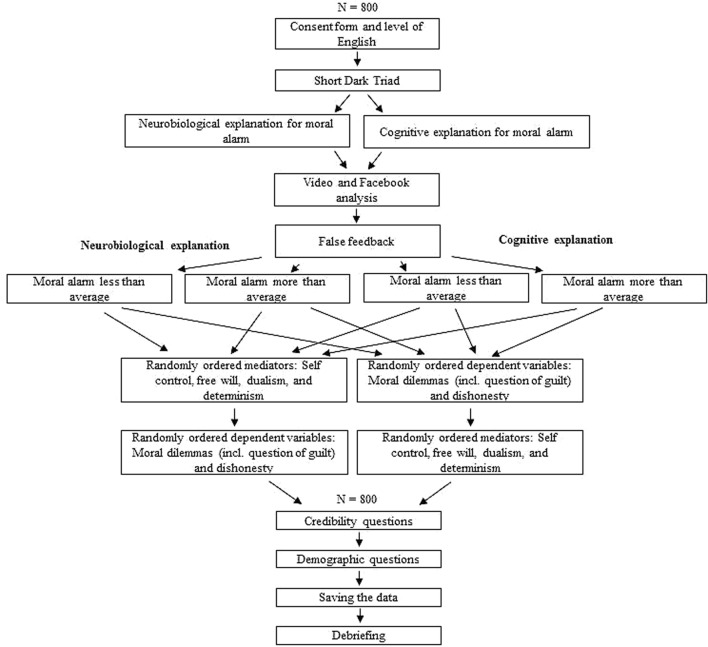
Neuroscience has identified brain structures and functions that correlate with psychopathic tendencies. Since psychopathic traits can be traced back to physical neural attributes, it has been argued that psychopaths are not truly responsible for their actions and therefore should not be blamed for their psychopathic behaviors. This experimental research aims to evaluate what effect communicating this theory of psychopathy has on the moral behavior of lay people. If psychopathy is blamed on the brain, people may feel less morally responsible for their own psychopathic tendencies and therefore may be more likely to display those tendencies. An online study will provide participants with false feedback about their psychopathic traits supposedly based on their digital footprint (i.e., Facebook likes), thus classifying them as having either above-average or below-average psychopathic traits and describing psychopathy in cognitive or neurobiological terms. This particular study will assess the extent to which lay people are influenced by feedback regarding their psychopathic traits, and how this might affect their moral behavior in online tasks. Public recognition of these potential negative consequences of neuroscience communication will also be assessed. A field study using the lost letter technique will be conducted to examine lay people's endorsement of neurobiological, as compared to cognitive, explanations of criminal behavior. This field and online experimental research could inform the future communication of neuroscience to the public in a way that is sensitive to the potential negative consequences of communicating such science. In particular, this research may have implications for the future means by which neurobiological predictors of offending can be safely communicated to offenders.
神经科学已经确定了与精神病态倾向相关的大脑结构和功能。由于精神病态特征可以追溯到身体的神经属性,有人认为精神病患者对自己的行为并不真正负有责任,因此不应因其精神病态行为而受到指责。这项实验研究旨在评估传播这种精神病态理论对普通人道德行为的影响。如果将精神病态归咎于大脑,人们可能会觉得自己对自身的精神病态倾向在道德上负有较少责任,因此可能更有可能表现出这些倾向。一项在线研究将根据参与者的数字足迹(即脸书点赞)为他们提供关于其精神病态特征的虚假反馈,从而将他们归类为具有高于平均水平或低于平均水平的精神病态特征,并从认知或神经生物学角度描述精神病态。这项具体研究将评估普通人在多大程度上受到关于其精神病态特征反馈的影响,以及这可能如何影响他们在在线任务中的道德行为。还将评估公众对神经科学传播这些潜在负面后果的认知情况。将进行一项使用失物招领技术的实地研究,以检验与认知解释相比,普通人对犯罪行为的神经生物学解释的认可程度。这项实地和在线实验研究可以为未来向公众传播神经科学提供参考,使其对传播此类科学的潜在负面后果保持敏感。特别是,这项研究可能对未来安全地向罪犯传达犯罪的神经生物学预测因素的方式产生影响。