Suyal Deep C, Kumar Saurabh, Yadav Amit, Shouche Yogesh, Goel Reeta
Department of Microbiology, College of Basic Sciences and Humanities, G. B. Pant University of Agriculture and Technology Pantnagar, India.
Microbial Culture Collection, National Centre for Cell Science, Pune University Campus Pune, India.
Front Microbiol. 2017 Mar 14;8:430. doi: 10.3389/fmicb.2017.00430. eCollection 2017.
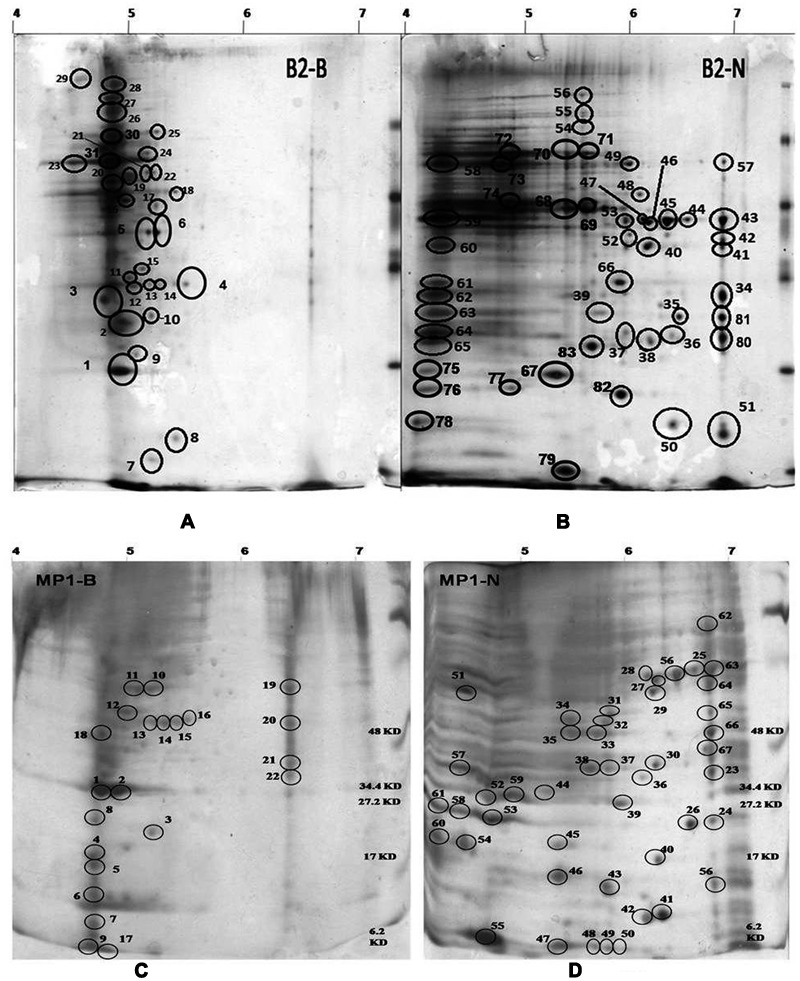
Nitrogen (N) deficiency and low temperature conditions are the prominent facet of Western Himalayan agro-ecosystems. A slight change in the environment alters the protein expression of the microorganisms. Therefore, proteomes of the two psychrotrophs B2 and MP1 were analyzed using two dimensional electrophoresis and MALDI-TOF-MS, to determine the physiological response of altitudinally different but indigenous microorganisms in response to cold stress under N depleting conditions. Functional assessment of 150 differentially expressed proteins from both the psychrotrophs revealed several mechanisms might be involved in cold stress adaptation, protein synthesis/modifications, energy metabolism, cell growth/maintenance, etc. In both the proteomes, abundance of the proteins related to energy production and stress were significantly increased while, proteins related to biosynthesis and energy consuming processes decreased. and proteins were found to be expressed in both B2 and MP1, similarly to previously studied diazotrophs under low temperature N fixing conditions and therefore, can be considered as a biomarker for monitoring the nitrogen fixation in cold niches. Nevertheless, in both the diazotrophs, a good fraction of the proteins were related to hypothetical proteins which are still uncharacterized, thereby, suggesting the need for in-depth studies on cold adapted diazotrophs and their adaptive mechanisms.
氮(N)缺乏和低温条件是西喜马拉雅农业生态系统的突出特征。环境的微小变化会改变微生物的蛋白质表达。因此,利用二维电泳和基质辅助激光解吸电离飞行时间质谱(MALDI-TOF-MS)分析了两种嗜冷菌B2和MP1的蛋白质组,以确定在氮缺乏条件下,海拔不同但本地的微生物对冷胁迫的生理反应。对两种嗜冷菌中150种差异表达蛋白质的功能评估表明,冷胁迫适应、蛋白质合成/修饰、能量代谢、细胞生长/维持等过程可能涉及多种机制。在这两种蛋白质组中,与能量产生和胁迫相关的蛋白质丰度显著增加,而与生物合成和能量消耗过程相关的蛋白质减少。并且发现某些蛋白质在B2和MP1中均有表达,这与之前在低温固氮条件下研究的固氮菌相似,因此可被视为监测寒冷生态位中固氮作用的生物标志物。然而,在这两种固氮菌中,相当一部分蛋白质与仍未被表征的假定蛋白质有关,从而表明有必要对适应寒冷的固氮菌及其适应机制进行深入研究。