Zhang Xuan, Zhao Jing, Gao Xiangyang, Pei Dongsheng, Gao Chao
Department of Oncology, Xuzhou Medical College, Xuzhou, Jiangsu 221002, P.R. China.
Department of Oncology, The Affiliated Hospital of Xuzhou Medical College, Xuzhou, Jiangsu 221002, P.R. China.
Exp Ther Med. 2017 Feb;13(2):595-603. doi: 10.3892/etm.2016.3992. Epub 2016 Dec 22.
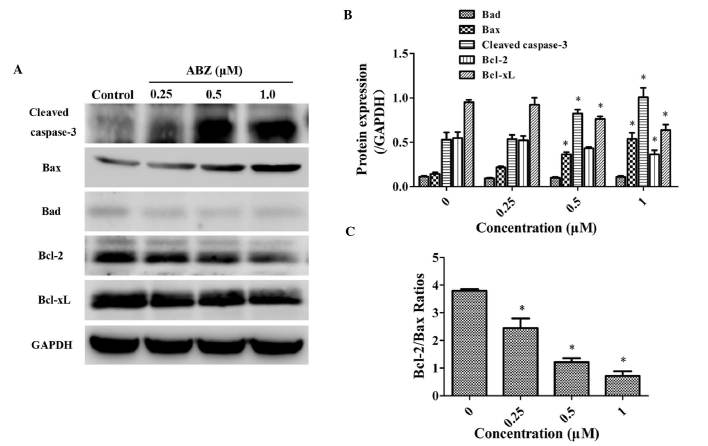
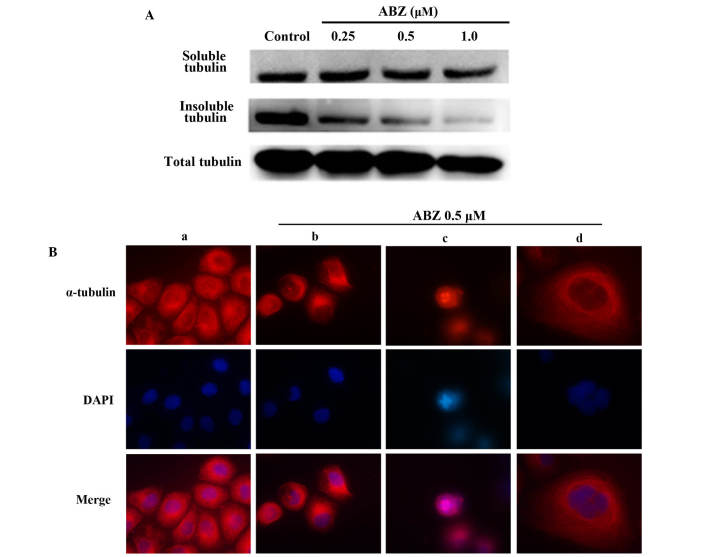
As microtubules have a vital function in the cell cycle, oncologists have developed microtubule inhibitors capable of preventing uncontrolled cell division, as in the case of cancer. The anthelmintic drug albendazole (ABZ) has been demonstrated to inhibit hepatocellular, ovarian and prostate cancer cells via microtubule targeting. However, its activity against human gastric cancer (GC) cells has remained to be determined. In the present study, ABZ was used to treat GC cells (MKN-45, SGC-7901 and MKN-28). A a CCK-8 cell proliferation assay was performed to assess the effects of ABZ on cell viability and cell cycle changes were assessed using flow cytometry. SGC-7901 cells were selected for further study, and flow cytometry was employed to determine the apoptotic rate, immunofluorescence analysis was employed to show changes of the microtubule structure as well as the subcellular localization and expression levels of cyclin B1, and western blot analysis was used to identify the dynamics of microtubule assembly. The expression levels of relevant proteins, including cyclin B1 and Cdc2, the two subunits of mitosis-promoting factor as well as apoptosis-asociated proteins were also assessed by western blot analysis. The results showed that ABZ exerted its anti-cancer activity in GC cell lines by disrupting microtubule formation and function to cause mitotic arrest, which is also associated with the accumulation of cyclin B1, and consequently induces apoptosis.
由于微管在细胞周期中具有至关重要的功能,肿瘤学家已开发出能够阻止如癌症中出现的不受控制的细胞分裂的微管抑制剂。驱虫药阿苯达唑(ABZ)已被证明可通过靶向微管来抑制肝癌细胞、卵巢癌细胞和前列腺癌细胞。然而,其对人胃癌(GC)细胞的活性仍有待确定。在本研究中,ABZ被用于处理GC细胞(MKN - 45、SGC - 7901和MKN - 28)。进行CCK - 8细胞增殖试验以评估ABZ对细胞活力的影响,并使用流式细胞术评估细胞周期变化。选择SGC - 7901细胞进行进一步研究,采用流式细胞术测定凋亡率,采用免疫荧光分析显示微管结构的变化以及细胞周期蛋白B1的亚细胞定位和表达水平,并使用蛋白质印迹分析来确定微管组装的动态变化。还通过蛋白质印迹分析评估了相关蛋白质的表达水平,包括有丝分裂促进因子的两个亚基细胞周期蛋白B1和Cdc2以及凋亡相关蛋白。结果表明,ABZ通过破坏微管形成和功能导致有丝分裂停滞,从而在GC细胞系中发挥其抗癌活性,这也与细胞周期蛋白B1的积累有关,并因此诱导细胞凋亡。