Peng You-Fan, Cao Ling, Zeng Yan-Hua, Zhang Zhao-Xia, Chen Dan, Zhang Qiong, Zhu You-Sen
Laboratory Medicine Diagnostic Centre, The First Affiliated Hospital, Xin Jiang Medical University, Xinjiang Urumqi, China.
Department of Rheumatology, The First Affiliated Hospital, Xin Jiang Medical University.
Open Med (Wars). 2015 Apr 14;10(1):249-253. doi: 10.1515/med-2015-0037. eCollection 2015.
It has been well documented that the platelet to lymphocyte ratio (PLR) and the neutrophil to lymphocyte ratio (NLR) are associated with outcomes for patients with gastric cancer, non-small cell lung cancer and acute heart failure. Inflammation may be the hidden factor that explains the correlation between NLP, PLR, and these diseases. However, to date, the data concerning NLR, PLR, and its association with inflammation are lacking in patients with rheumatoid arthritis (RA), thus, our aim to discuss whether NLR and PLR are associated with RA.
Patients with RA and healthy individuals were included according to the determined criteria, and laboratory indicators were measured.
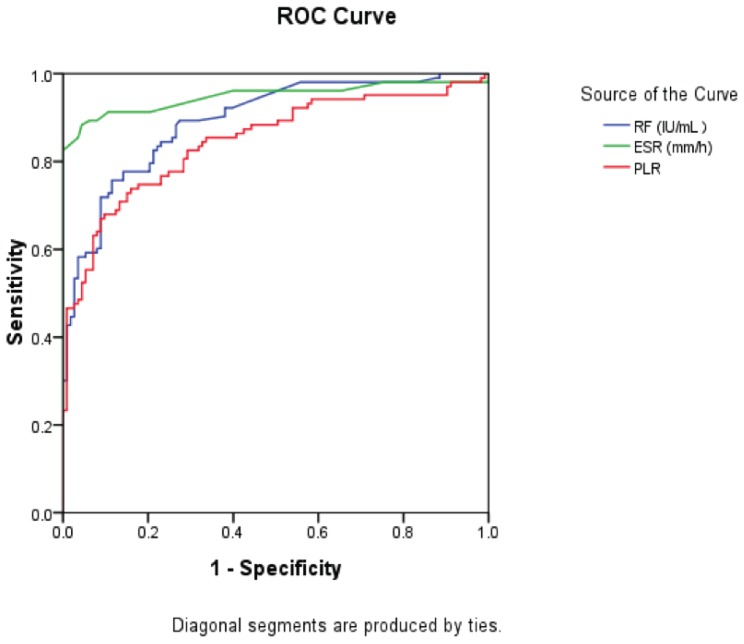
PLR and NLR were significantly higher in RA patients compared with healthy controls (3.20±2.06 vs. 1.56±0.47, P<0.01; 192.85±101.78 vs. 103.49±28.68, P<0.01). When leukocytes, neutrophil percentage, neutrophil, lymphocyte, platelet, C-reactive protein (CRP), erythrocyte sedimentation rate (ESR), and rheumatoid factor (RF) were considered as confounders (crude model), our results indicated that ESR and RF were correlated to RA. Of note, ESR, RF, and PLR were associated with RA after further adjustment based on crude model for PLR and NLR. Receiver operating characteristic (ROC) curves analysis showed that PLR values higher than >115.7 evaluated RA with a sensitivity of 82.5%, a specificity of 74.8% and area under the curve ( AUC ) of 0.847.
Our results suggest that PLR is associated with RA, and PLR may be an underlying indicator indicating the chronic subclinical inflammation in patients with RA.
已有充分文献证明,血小板与淋巴细胞比值(PLR)和中性粒细胞与淋巴细胞比值(NLR)与胃癌、非小细胞肺癌及急性心力衰竭患者的预后相关。炎症可能是解释NLP、PLR与这些疾病之间相关性的潜在因素。然而,迄今为止,类风湿关节炎(RA)患者中关于NLR、PLR及其与炎症关联的数据尚缺乏,因此,我们旨在探讨NLR和PLR是否与RA相关。
根据既定标准纳入RA患者和健康个体,并测量实验室指标。
与健康对照相比,RA患者的PLR和NLR显著更高(3.20±2.06对1.56±0.47,P<0.01;192.85±101.78对103.49±28.68,P<0.01)。当将白细胞、中性粒细胞百分比、中性粒细胞、淋巴细胞、血小板、C反应蛋白(CRP)、红细胞沉降率(ESR)和类风湿因子(RF)视为混杂因素(粗模型)时,我们的结果表明ESR和RF与RA相关。值得注意的是,在基于PLR和NLR的粗模型进行进一步调整后,ESR、RF和PLR与RA相关。受试者工作特征(ROC)曲线分析表明,PLR值高于>115.7时评估RA的灵敏度为82.5%,特异度为74.8%,曲线下面积(AUC)为0.847。
我们的结果表明PLR与RA相关,且PLR可能是RA患者慢性亚临床炎症的潜在指标。