Brämberg Elisabeth Björk, Bergström Gunnar, Jensen Irene, Hagberg Jan, Kwak Lydia
Unit of Intervention and Implementation Research for Worker Health, Institute of Environmental Medicine, Nobels väg 13, Karolinska Institutet, 171 77, Stockholm, Sweden.
Centre for Occupational and Environmental Medicine, Stockholm County Council, Solnavägen 4, 113 65, Stockholm, Sweden.
BMC Musculoskelet Disord. 2017 Mar 29;18(1):132. doi: 10.1186/s12891-017-1497-1.
Among the working population, non-specific low-back pain and neck pain are one of the most common reasons for sickness absenteeism. The aim was to evaluate the effects of an early intervention of yoga - compared with strength training or evidence-based advice - on sickness absenteeism, sickness presenteeism, back and neck pain and disability among a working population.
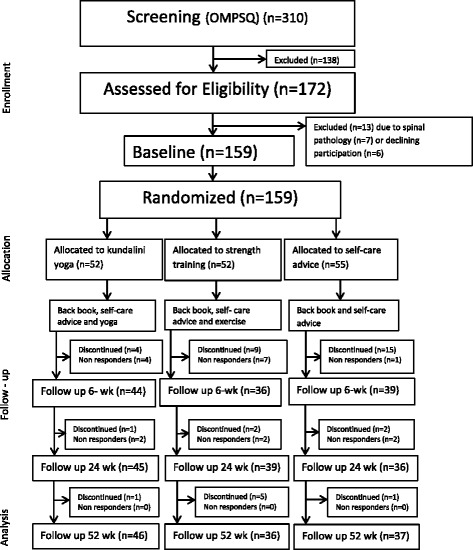
A randomized controlled trial was conducted on 159 participants with predominantly (90%) chronic back and neck pain. After screening, the participants were randomized to kundalini yoga, strength training or evidence-based advice. Primary outcome was sickness absenteeism. Secondary outcomes were sickness presenteeism, back and neck pain and disability. Self-reported questionnaires and SMS text messages were completed at baseline, 6 weeks, 6 and 12 months.
The results did not indicate that kundalini yoga and strength training had any statistically significant effects on the primary outcome compared with evidence-based advice. An interaction effect was found between adherence to recommendations and sickness absenteeism, indicating larger significant effects among the adherers to kundalini yoga versus evidence-based advice: RR = 0.47 (CI 0.30; 0.74, p = 0.001), strength training versus evidence-based advice: RR = 0.60 (CI 0.38; 0.96, p = 0.032). Some significant differences were also found for the secondary outcomes to the advantage of kundalini yoga and strength training.
Guided exercise in the forms of kundalini yoga or strength training does not reduce sickness absenteeism more than evidence-based advice alone. However, secondary analyses reveal that among those who pursue kundalini yoga or strength training at least two times a week, a significantly reduction in sickness absenteeism was found. Methods to increase adherence to treatment recommendations should be further developed and applied in exercise interventions.
Clinicaltrials.gov NCT01653782, date of registration: June, 28, 2012, retrospectively registered.
在工作人群中,非特异性下背痛和颈痛是病假缺勤的最常见原因之一。目的是评估与力量训练或循证建议相比,瑜伽早期干预对工作人群病假缺勤、带病出勤、背痛和颈痛以及残疾状况的影响。
对159名主要(90%)患有慢性背痛和颈痛的参与者进行了一项随机对照试验。筛选后,参与者被随机分配到昆达里尼瑜伽组、力量训练组或循证建议组。主要结局是病假缺勤。次要结局是带病出勤、背痛和颈痛以及残疾状况。在基线、6周、6个月和12个月时完成自我报告问卷和短信。
结果表明,与循证建议相比,昆达里尼瑜伽和力量训练对主要结局没有任何统计学上的显著影响。在遵循建议与病假缺勤之间发现了交互作用,表明与循证建议相比,坚持昆达里尼瑜伽的人有更大的显著效果:风险比(RR)=0.47(可信区间[CI]0.30;0.74,p=0.001),力量训练与循证建议相比:RR=0.60(CI 0.38;0.96,p=0.032)。在次要结局方面也发现了一些有利于昆达里尼瑜伽和力量训练的显著差异。
以昆达里尼瑜伽或力量训练形式进行的指导性运动并不比单独的循证建议更能减少病假缺勤。然而,二次分析显示,在每周至少进行两次昆达里尼瑜伽或力量训练的人群中,病假缺勤显著减少。应进一步开发并在运动干预中应用提高对治疗建议依从性的方法。
Clinicaltrials.gov NCT01653782,注册日期:2012年6月28日,回顾性注册。