Ho Kenneth K Y, Lee Jin Woo, Durand Grégory, Majumder Sagardip, Liu Allen P
Department of Mechanical Engineering, University of Michigan, Ann Arbor, Michigan, United States of America.
Institut des Biomolécules Max Mousseron, UMR 5247, CNRS-Université Montpellier-ENSCM et Université d'Avignon et des Pays de Vaucluse, Avignon, France.
PLoS One. 2017 Mar 30;12(3):e0174689. doi: 10.1371/journal.pone.0174689. eCollection 2017.
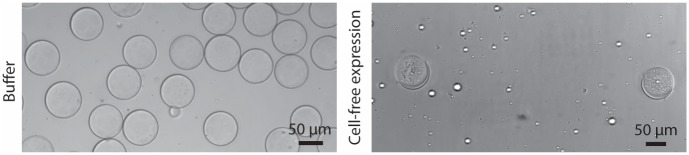
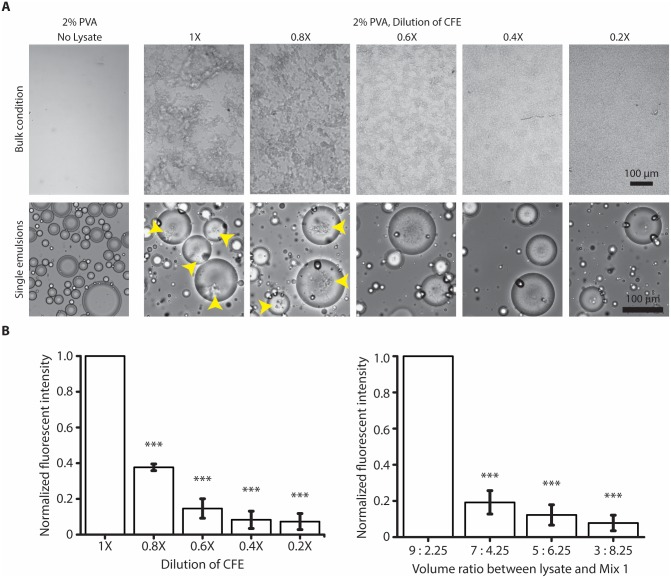
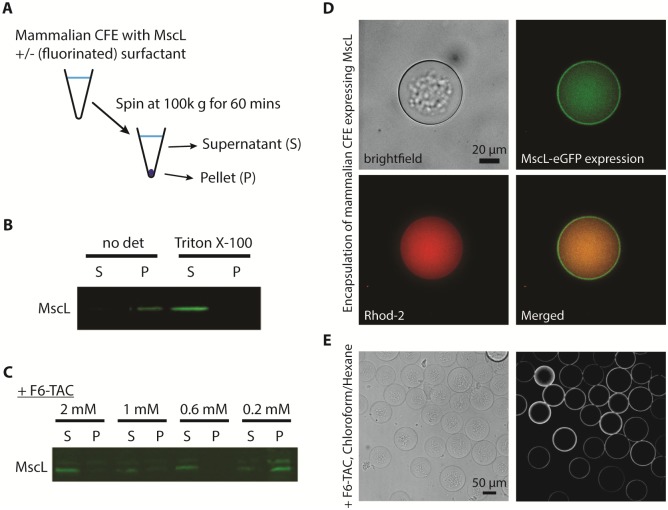
Development of artificial cell models requires encapsulation of biomolecules within membrane-bound compartments. There have been limited studies of using mammalian cell-free expression (CFE) system as the 'cytosol' of artificial cells. We exploit glass capillary droplet microfluidics for the encapsulation of mammalian CFE within double emulsion templated vesicles. The complexity of the physicochemical properties of HeLa cell-free lysate poses a challenge compared with encapsulating simple buffer solutions. In particular, we discovered the formation of aggregates in double emulsion templated vesicles encapsulating mammalian HeLa CFE, but not with bacterial CFE. The aggregates did not arise from insolubility of the proteins made from CFE nor due to the interaction of mammalian CFE with the organic solvents in the middle phase of the double emulsions. We found that aggregation is dependent on the concentration of poly(vinyl) alcohol (PVA) surfactant, a critical double emulsion-stabilizing surfactant, and the lysate concentration in mammalian CFE. Despite vesicle instability and reduced protein expression, we demonstrate protein expression by encapsulating mammalian CFE system. Using mass spectrometry and Western blot, we identified and verified that actin is one of the proteins inside the mammalian CFE that aggregated with PVA surfactant. Our work establishes a baseline description of mammalian CFE system encapsulated in double emulsion templated vesicles as a platform for building artificial cells.
人工细胞模型的构建需要将生物分子封装在膜结合的隔室内。关于使用哺乳动物无细胞表达(CFE)系统作为人工细胞“细胞质”的研究有限。我们利用玻璃毛细管液滴微流控技术将哺乳动物CFE封装在双乳液模板化囊泡中。与封装简单缓冲溶液相比,HeLa无细胞裂解液复杂的物理化学性质带来了挑战。特别是,我们发现在封装哺乳动物HeLa CFE的双乳液模板化囊泡中形成了聚集体,但在封装细菌CFE时未出现这种情况。这些聚集体并非源于CFE产生的蛋白质不溶性,也不是由于哺乳动物CFE与双乳液中间相中的有机溶剂相互作用所致。我们发现聚集取决于聚乙烯醇(PVA)表面活性剂的浓度,PVA是一种关键的双乳液稳定表面活性剂,以及哺乳动物CFE中的裂解液浓度。尽管囊泡不稳定且蛋白质表达降低,但我们通过封装哺乳动物CFE系统证明了蛋白质表达。使用质谱和蛋白质免疫印迹法,我们鉴定并验证肌动蛋白是哺乳动物CFE中与PVA表面活性剂聚集的蛋白质之一。我们的工作为封装在双乳液模板化囊泡中的哺乳动物CFE系统作为构建人工细胞的平台建立了基线描述。