Liu Fan, Wang Zhiyao, Qiu Yue, Wei Min, Li Chunyan, Xie Yikuan, Shen Le, Huang Yuguang, Ma Chao
Department of Human Anatomy, Histology and Embryology, Institute of Basic Medical Sciences, Chinese Academy of Medical Sciences, School of Basic Medicine, Peking Union Medical College, Beijing, 100005, China.
Department of Anesthesiology, Peking Union Medical College Hospital, Chinese Academy of Medical Sciences, Peking Union Medical College, Beijing, 100730, China.
J Neuroinflammation. 2017 Mar 31;14(1):70. doi: 10.1186/s12974-017-0822-9.
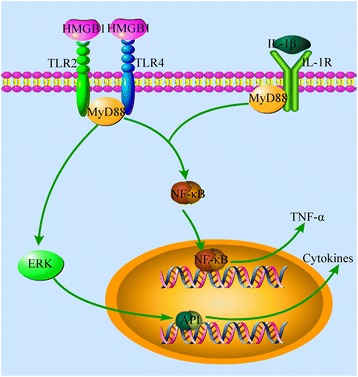
MyD88 is the adaptor protein of MyD88-dependent signaling pathway of TLRs and IL-1 receptor and regulates innate immune response. However, it was not clear whether and how MyD88 and related signaling pathways in the dorsal root ganglion (DRG) and spinal dorsal horn (SDH) are involved in neuropathic pain.
Chronic constriction injury (CCI) was used to induce neuropathic pain in the rat. The expression of MyD88, TRIF, IBA1, and GFAP was detected with immunofluorescent staining and Western blot. The expression of interleukin-1 beta (IL-1β), high mobility group box 1 (HMGB1), NF-κB-p65, phosphorylated NF-κB-p65, ERK, phosphorylated ERK, and tumor necrosis factor-alpha (TNF-α) was detected with Western blot. Pain-related behavioral effects of MyD88 homodimerization inhibitory peptide (MIP) were accessed up to 3 weeks after intrathecal administration.
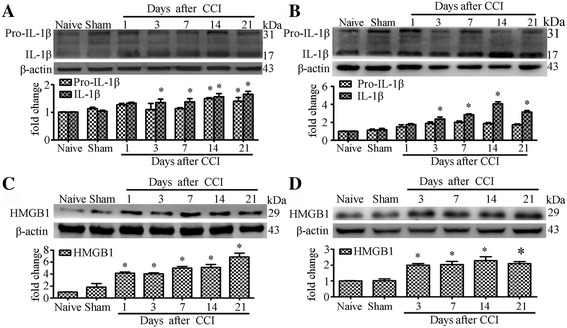
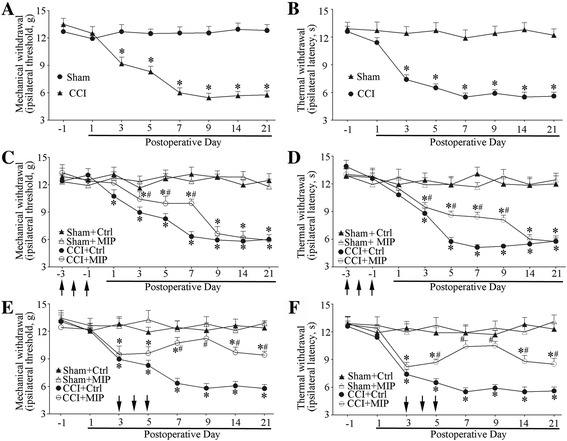
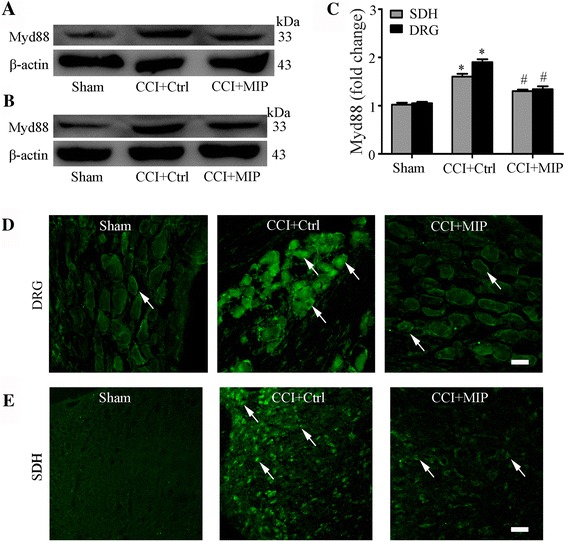
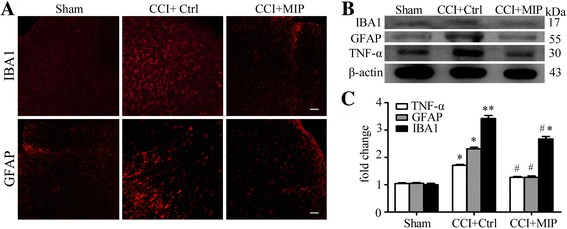
Peripheral nerve injury significantly increased the protein level of MyD88 in the DRG and SDH, but had no effect on TRIF. MyD88 was found partly distributed in the nociceptive neurons in the DRGs and the astrocytes and microglia in the SDH. HMGB1 and IL-1β were also found upregulated in nociceptive pathways of CCI rats. Intrathecal application of MIP significantly alleviated mechanical and thermal hyperalgesia in the CCI rats and also reversed CCI-induced upregulation of MyD88 in both DRG and SDH. Further investigation revealed that suppression of MyD88 protein reduced the release of TNF-α and glial activation in the SDH in the CCI rats.
MyD88-dependent TIR pathway in the DRG and SDH may play a role in CCI-induced neuropathic pain. MyD88 might serve as a potential therapeutic target for neuropathic pain.
髓样分化因子88(MyD88)是Toll样受体(TLRs)和白细胞介素-1受体的MyD88依赖性信号通路的衔接蛋白,可调节先天性免疫反应。然而,背根神经节(DRG)和脊髓背角(SDH)中的MyD88及相关信号通路是否以及如何参与神经性疼痛尚不清楚。
采用慢性缩窄损伤(CCI)诱导大鼠神经性疼痛。通过免疫荧光染色和蛋白质免疫印迹法检测MyD88、TIR结构域衔接蛋白诱导干扰素β(TRIF)、离子钙接头蛋白1(IBA1)和胶质纤维酸性蛋白(GFAP)的表达。通过蛋白质免疫印迹法检测白细胞介素-1β(IL-1β)、高迁移率族蛋白B1(HMGB1)、核因子κB p65(NF-κB-p65)、磷酸化核因子κB p65、细胞外信号调节激酶(ERK)、磷酸化ERK和肿瘤坏死因子-α(TNF-α)的表达。在鞘内注射MyD88同源二聚化抑制肽(MIP)后长达3周观察其对疼痛相关行为的影响。
外周神经损伤显著增加了DRG和SDH中MyD88的蛋白水平,但对TRIF无影响。发现MyD88部分分布于DRG中的伤害性神经元以及SDH中的星形胶质细胞和小胶质细胞。还发现HMGB1和IL-1β在CCI大鼠的伤害性通路中上调。鞘内注射MIP可显著减轻CCI大鼠的机械性和热痛觉过敏,还可逆转CCI诱导的DRG和SDH中MyD88的上调。进一步研究表明,抑制MyD88蛋白可减少CCI大鼠SDH中TNF-α的释放和胶质细胞活化。
DRG和SDH中依赖MyD88的TIR通路可能在CCI诱导的神经性疼痛中起作用。MyD88可能是神经性疼痛的一个潜在治疗靶点。