Joachim Bastian, Stechern André, Ludwig Thomas, Konzett Jürgen, Pawley Alison, Ruzié-Hamilton Lorraine, Clay Patricia L, Burgess Ray, Ballentine Christopher J
Institute for Mineralogy and Petrography, University of Innsbruck, Innrain 52, 6020 Innsbruck, Austria.
Department of Earth Sciences, University of Oxford, South Parks Road, Oxford, OX1 3 AN United Kingdom.
Contrib Mineral Petrol. 2017;172(4):15. doi: 10.1007/s00410-017-1329-1. Epub 2017 Mar 16.
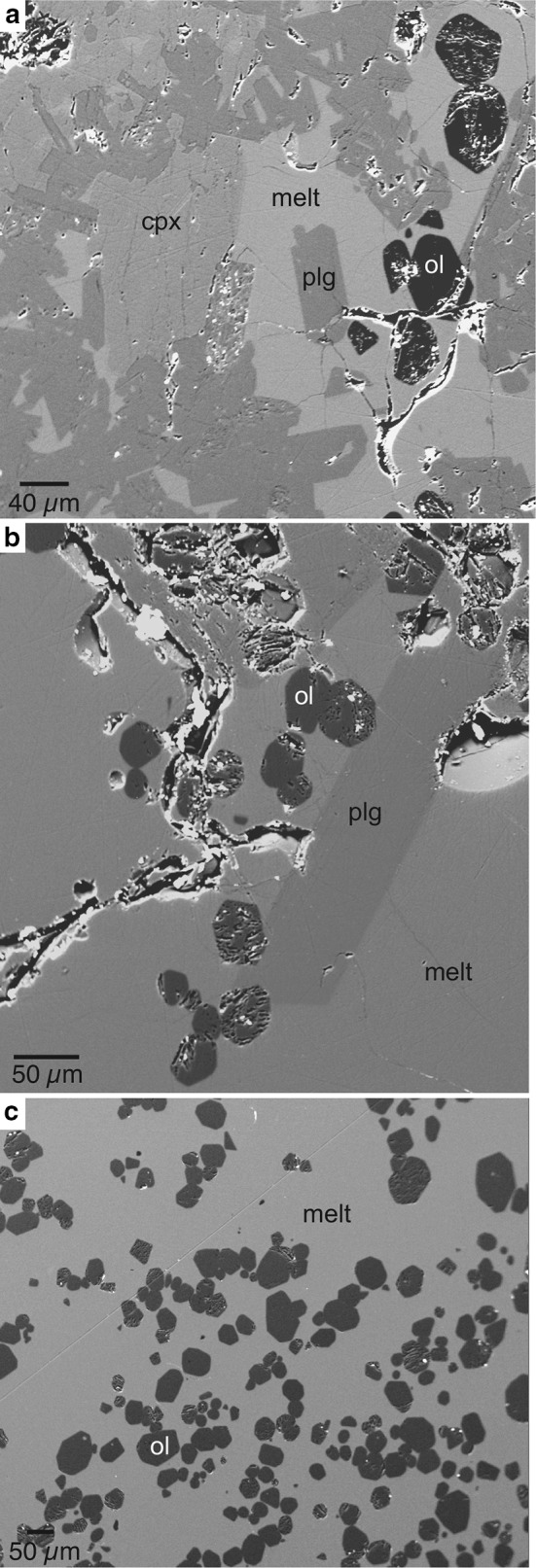
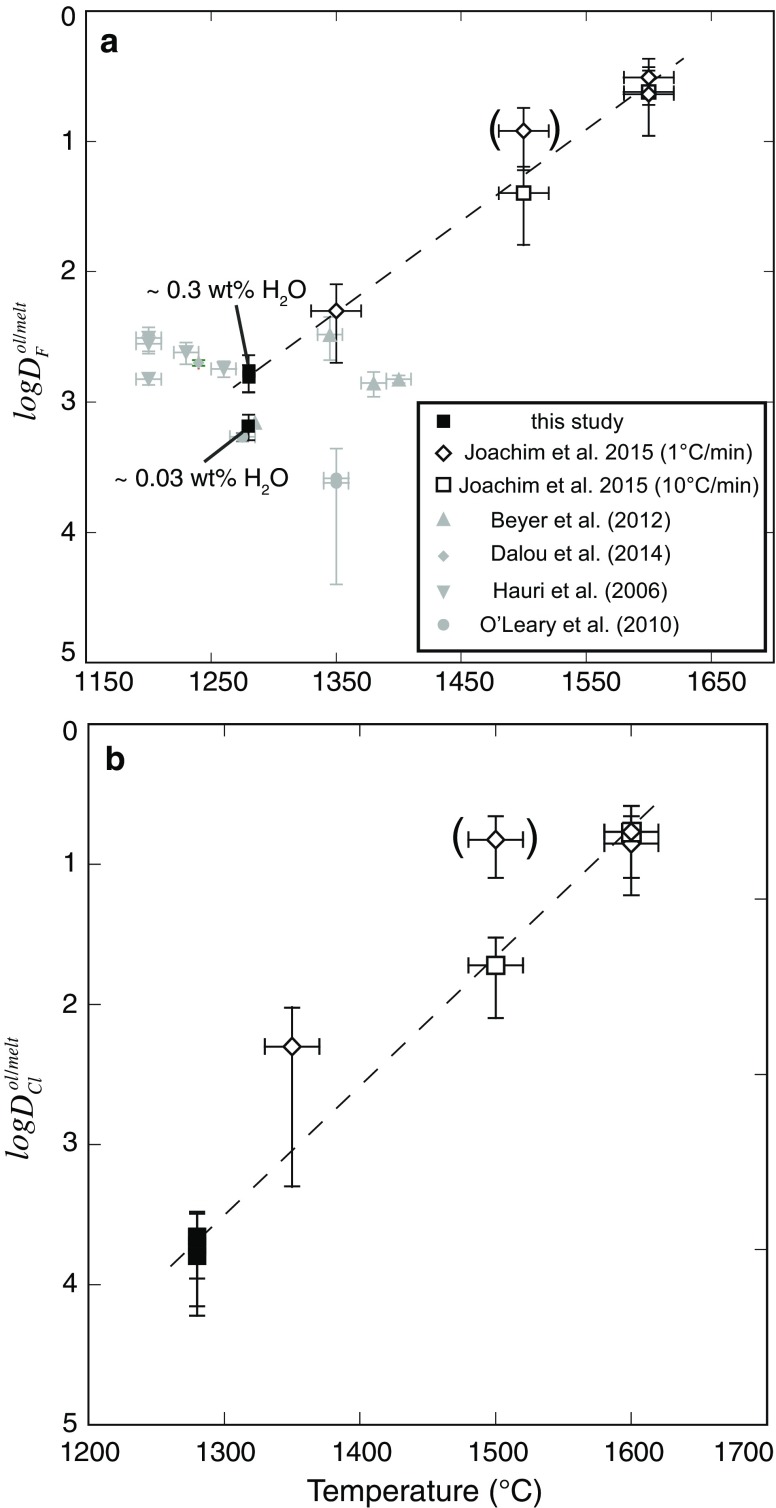
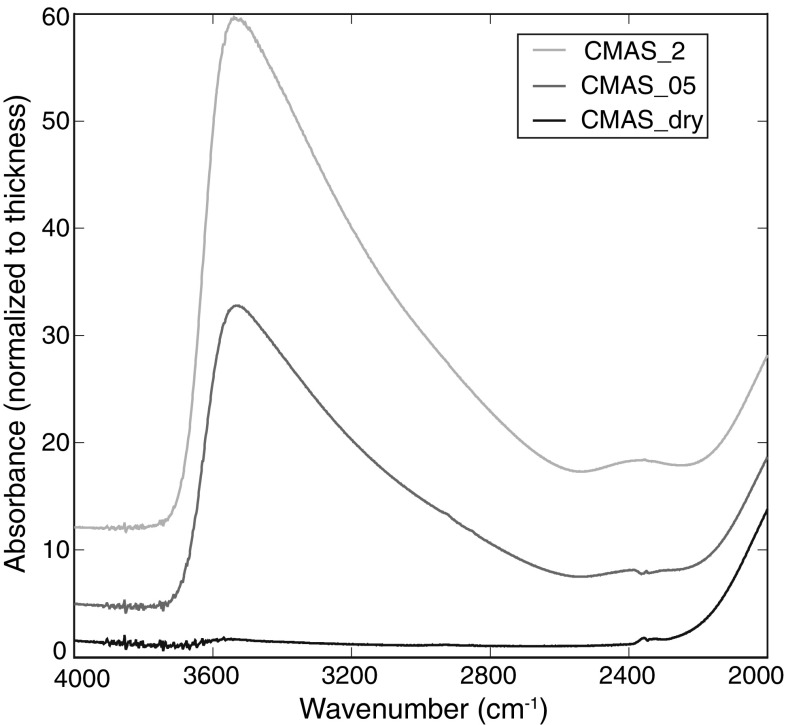
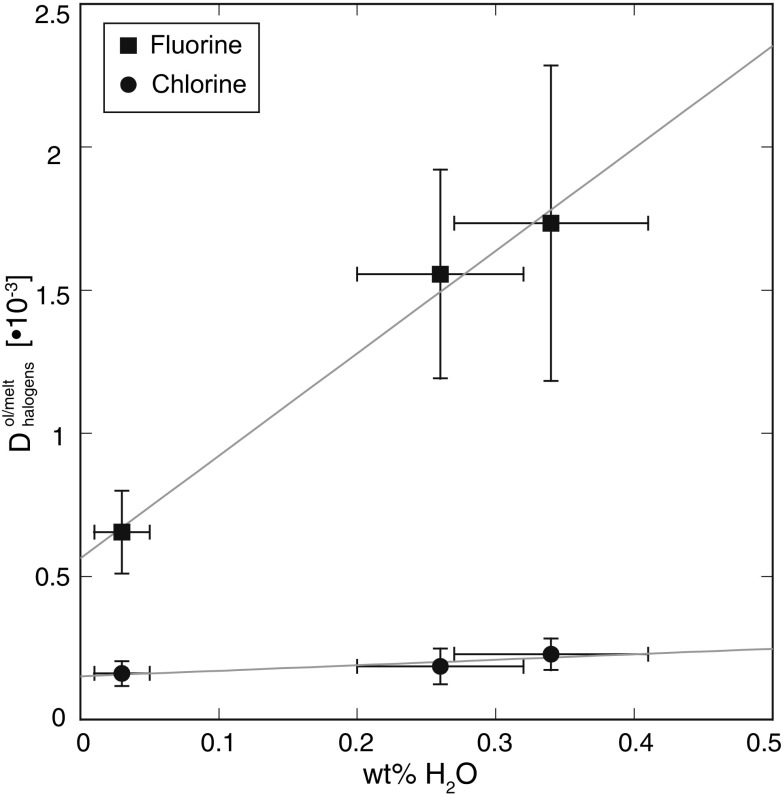
Halogens show a range from moderate (F) to highly (Cl, Br, I) volatile and incompatible behavior, which makes them excellent tracers for volatile transport processes in the Earth's mantle. Experimentally determined fluorine and chlorine partitioning data between mantle minerals and silicate melt enable us to estimate Mid Ocean Ridge Basalt (MORB) and Ocean Island Basalt (OIB) source region concentrations for these elements. This study investigates the effect of varying small amounts of water on the fluorine and chlorine partitioning behavior at 1280 °C and 0.3 GPa between olivine and silicate melt in the Fe-free CMAS+F-Cl-Br-I-HO model system. Results show that, within the uncertainty of the analyses, water has no effect on the chlorine partitioning behavior for bulk water contents ranging from 0.03 (2) wt% HO (D = 1.6 ± 0.9 × 10) to 0.33 (6) wt% HO (D = 2.2 ± 1.1 × 10). Consequently, with the effect of pressure being negligible in the uppermost mantle (Joachim et al. Chem Geol 416:65-78, 2015), temperature is the only parameter that needs to be considered for the determination of chlorine partition coefficients between olivine and melt at least in the simplified iron-free CMAS+F-Cl-Br-I-HO system. In contrast, the fluorine partition coefficient increases linearly in this range and may be described at 1280 °C and 0.3 GPa with ( = 0.99): [Formula: see text]. The observed fluorine partitioning behavior supports the theory suggested by Crépisson et al. (Earth Planet Sci Lett 390:287-295, 2014) that fluorine and water are incorporated as clumped OH/F defects in the olivine structure. Results of this study further suggest that fluorine concentration estimates in OIB source regions are at least 10% lower than previously expected (Joachim et al. Chem Geol 416:65-78, 2015), implying that consideration of the effect of water on the fluorine partitioning behavior between Earth's mantle minerals and silicate melt is vital for a correct estimation of fluorine abundances in OIB source regions. Estimates for MORB source fluorine concentrations as well as chlorine abundances in both mantle source regions are within uncertainty not affected by the presence of water.
卤素表现出从中度挥发性(氟)到高度挥发性(氯、溴、碘)以及不相容行为的范围,这使得它们成为地球地幔中挥发性物质传输过程的优秀示踪剂。通过实验测定地幔矿物与硅酸盐熔体之间的氟和氯分配数据,使我们能够估算这些元素在大洋中脊玄武岩(MORB)和大洋岛玄武岩(OIB)源区的浓度。本研究在无铁的CMAS + F - Cl - Br - I - HO模型体系中,研究了在1280°C和0.3 GPa条件下,不同少量水对橄榄石与硅酸盐熔体之间氟和氯分配行为的影响。结果表明,在分析的不确定性范围内,对于总水含量从0.03(2)wt% HO(D = 1.6 ± 0.9×10)到0.33(6)wt% HO(D = 2.2 ± 1.1×10),水对氯的分配行为没有影响。因此,由于在最上地幔中压力的影响可忽略不计(约阿希姆等人,《化学地质学》416:65 - 78,2015),至少在简化的无铁CMAS + F - Cl - Br - I - HO体系中,温度是确定橄榄石与熔体之间氯分配系数时唯一需要考虑的参数。相比之下,在此范围内氟分配系数呈线性增加,在1280°C和0.3 GPa条件下可用( = 0.99)描述:[公式:见原文]。观察到的氟分配行为支持了克雷皮松等人(《地球与行星科学快报》390:287 - 295,2014)提出的理论,即氟和水以聚集的OH/F缺陷形式并入橄榄石结构中。本研究结果进一步表明,大洋岛玄武岩源区的氟浓度估计值至少比先前预期低10%(约阿希姆等人,《化学地质学》416:65 - 78,2015),这意味着考虑水对地球地幔矿物与硅酸盐熔体之间氟分配行为的影响对于正确估算大洋岛玄武岩源区的氟丰度至关重要。大洋中脊玄武岩源区氟浓度以及两个地幔源区氯丰度的估计值在不确定性范围内不受水的存在影响。