Sasai Hideo, Aoyama Yuka, Otsuka Hiroki, Abdelkreem Elsayed, Nakama Mina, Hori Tomohiro, Ohnishi Hidenori, Turner Lesley, Fukao Toshiyuki
Department of Pediatrics Graduate School of Medicine Gifu University Gifu Japan.
Department of PediatricsGraduate School of MedicineGifu UniversityGifuJapan; Department of Biomedical SciencesCollege of Life and Health SciencesChubu UniversityKasugaiJapan.
Mol Genet Genomic Med. 2017 Feb 8;5(2):177-184. doi: 10.1002/mgg3.275. eCollection 2017 Mar.
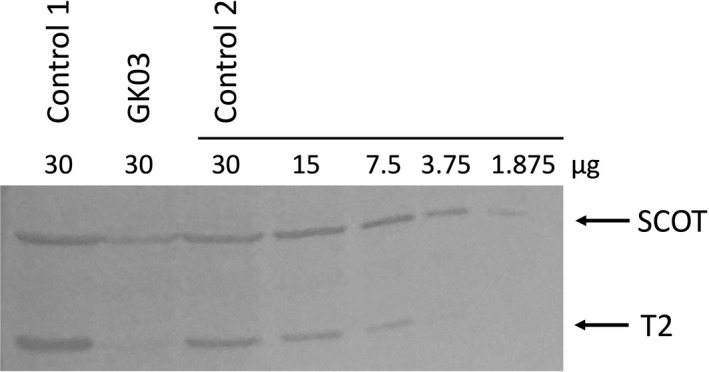
β-ketothiolase (T2, gene symbol ) deficiency is an autosomal recessive disorder, affecting isoleucine and ketone body metabolism. We encountered a patient (GK03) with T2 deficiency whose T2 mRNA level was <10% of the control, but in whom a previous routine cDNA analysis had failed to find any mutations. Genomic PCR-direct sequencing showed homozygosity for c.941-9T>A in the polypyrimidine stretch at the splice acceptor site of intron 9 of . Initially, we regarded this variant as not being disease-causing by a method of predicting the effect of splicing using in silico tools. However, based on other findings of exon 10 splicing, we eventually hypothesized that this mutation causes exon 10 skipping.
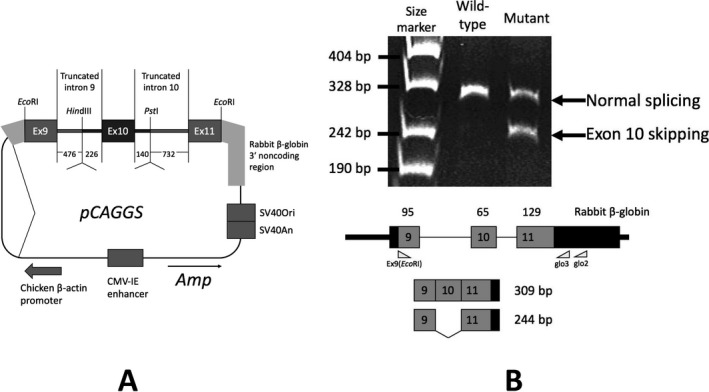
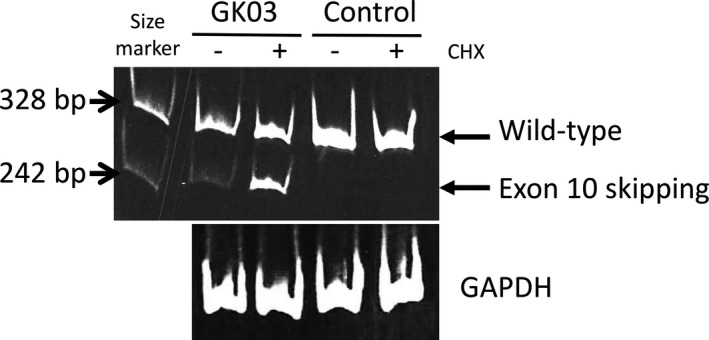
cDNA analysis was performed using GK03's fibroblasts treated with/without cycloheximide (CHX), since exon 10 skipping caused a frameshift and nonsense-mediated mRNA decay (NMD). Minigene splicing experiment was done to confirm aberrant splicing.
cDNA analysis using fibroblasts cultured with cycloheximide indeed showed the occurrence of exon 10 skipping. A minigene splicing experiment clearly showed that the c.941-9T>A mutant resulted in transcripts with exon 10 skipping. There are few reports describing that single-nucleotide substitutions in polypyrimidine stretches of splice acceptor sites cause aberrant splicing.
We showed that c.941-9T>A induces aberrant splicing in the gene. Our ability to predict the effects of mutations on splicing using in silico tools is still limited. cDNA analysis and minigene splicing experiments remain useful alternatives to reveal splice defects.
β-酮硫解酶(T2,基因符号 )缺乏症是一种常染色体隐性疾病,会影响异亮氨酸和酮体代谢。我们遇到了一名患有T2缺乏症的患者(GK03),其T2 mRNA水平低于对照的10%,但之前的常规cDNA分析未能发现任何突变。基因组PCR直接测序显示,在 内含子9剪接受体位点的多嘧啶序列中,c.941 - 9T>A呈纯合状态。最初,我们通过使用电子工具预测剪接效果的方法,认为该变异不是致病因素。然而,基于外显子10剪接的其他发现,我们最终推测该突变导致外显子10跳跃。
使用用/不用环己酰亚胺(CHX)处理的GK03成纤维细胞进行cDNA分析,因为外显子10跳跃会导致移码和无义介导的mRNA降解(NMD)。进行小基因剪接实验以确认异常剪接。
使用用环己酰亚胺培养的成纤维细胞进行的cDNA分析确实显示了外显子10跳跃的发生。小基因剪接实验清楚地表明,c.941 - 9T>A突变体导致了外显子10跳跃转录本。很少有报告描述剪接受体位点的多嘧啶序列中的单核苷酸取代会导致异常剪接。
我们表明c.941 - 9T>A在 基因中诱导异常剪接。我们使用电子工具预测突变对剪接影响的能力仍然有限。cDNA分析和小基因剪接实验仍然是揭示剪接缺陷的有用替代方法。