Sharma Anup, Mendonca Janet, Ying James, Kim Hea-Soo, Verdone James E, Zarif Jelani C, Carducci Michael, Hammers Hans, Pienta Kenneth J, Kachhap Sushant
Prostate Cancer Program, Department of Oncology, The Sidney Kimmel Comprehensive Cancer Center, Johns Hopkins Medical Institutions, Baltimore, MD, USA.
Department of Urology, The James Buchanan Brady Urological Institute, The Johns Hopkins University, Baltimore, MD, USA.
Mol Oncol. 2017 Jun;11(6):655-669. doi: 10.1002/1878-0261.12059. Epub 2017 May 2.
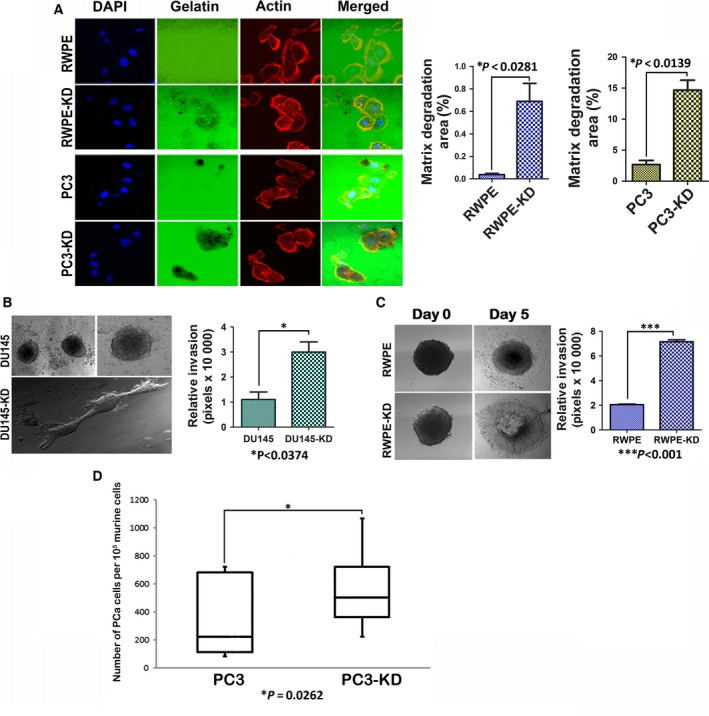
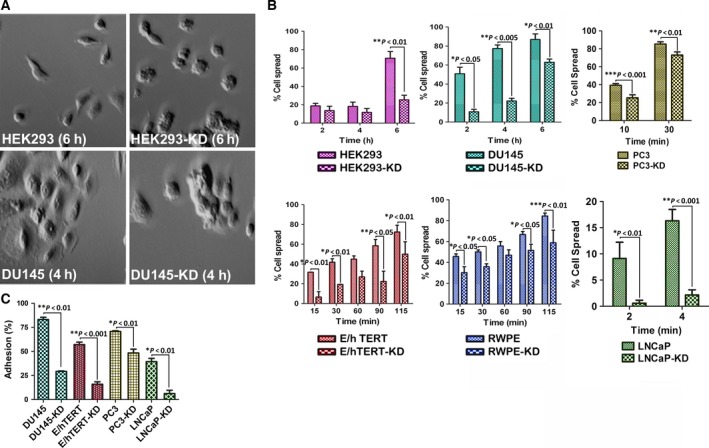
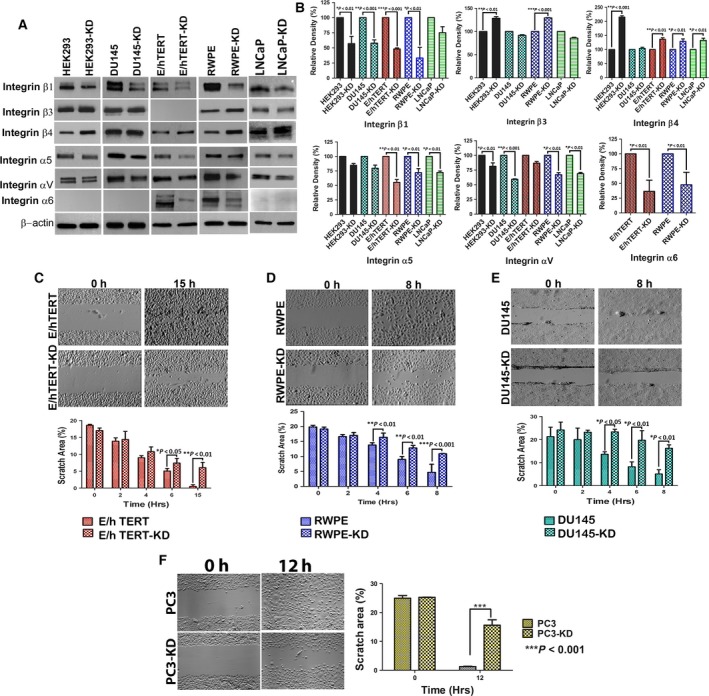
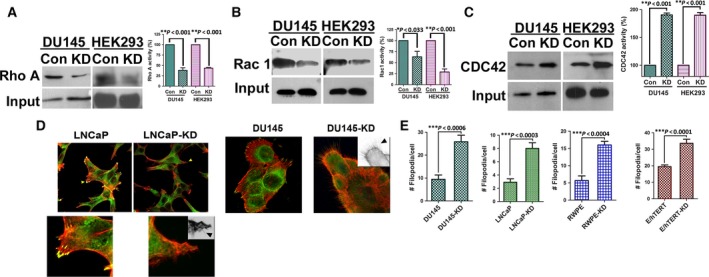
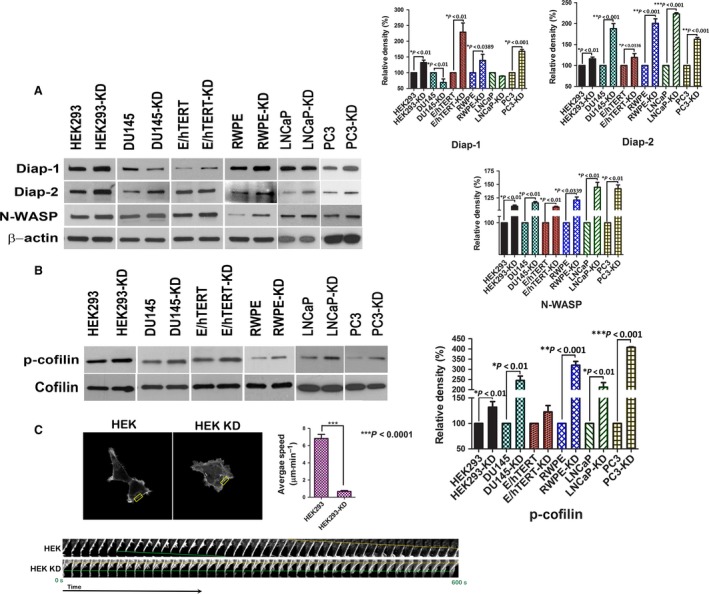
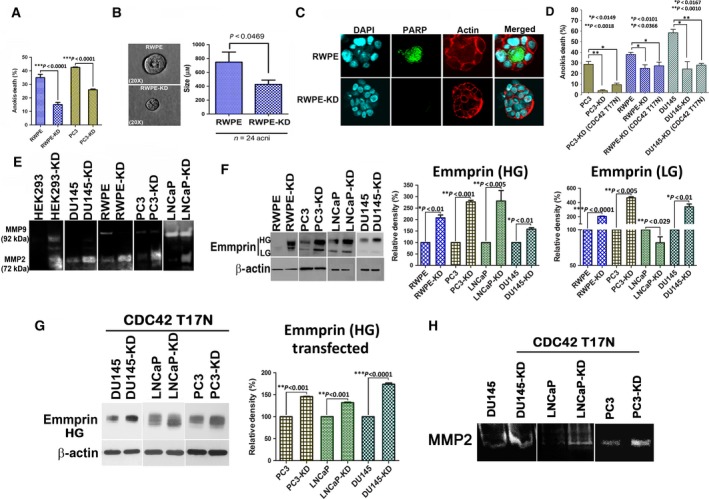
Experimental and clinical evidence suggests that N-myc downregulated gene 1 (NDRG1) functions as a suppressor of prostate cancer metastasis. Elucidating pathways that drive survival and invasiveness of NDRG1-deficient prostate cancer cells can help in designing therapeutics to target metastatic prostate cancer cells. However, the molecular mechanisms that lead NDRG1-deficient prostate cancer cells to increased invasiveness remain largely unknown. In this study, we demonstrate that NDRG1-deficient prostate tumors have decreased integrin expression and reduced cell adhesion and motility. Our data indicate that loss of NDRG1 differentially affects Rho GTPases. Specifically, there is a downregulation of active RhoA and Rac1 GTPases with a concomitant upregulation of active Cdc42 in NDRG1-deficient cells. Live cell imaging using a fluorescent sensor that binds to polymerized actin revealed that NDRG1-deficient cells have restricted actin dynamics, thereby affecting cell migration. These cellular and molecular characteristics are in sharp contrast to what is expected after loss of a metastasis suppressor. We further demonstrate that NDRG1-deficient cells have increased resistance to anoikis and increased invasiveness which is independent of its elevated Cdc42 activity. Furthermore, NDRG1 regulates expression and glycosylation of EMMPRIN, a master regulator of matrix metalloproteases. NDRG1 deficiency leads to an increase in EMMPRIN expression with a concomitant increase in matrix metalloproteases and thus invadopodial activity. Using a three-dimensional invasion assay and an in vivo metastasis assay for human prostate xenografts, we demonstrate that NDRG1-deficient prostate cancer cells exhibit a collective invasion phenotype and are highly invasive. Thus, our findings provide novel insights suggesting that loss of NDRG1 leads to a decrease in actin-mediated cellular motility but an increase in cellular invasion, resulting in increased tumor dissemination which positively impacts metastatic outcome.
实验和临床证据表明,N - myc下调基因1(NDRG1)作为前列腺癌转移的抑制因子发挥作用。阐明驱动NDRG1缺陷型前列腺癌细胞存活和侵袭的途径有助于设计针对转移性前列腺癌细胞的治疗方法。然而,导致NDRG1缺陷型前列腺癌细胞侵袭性增加的分子机制在很大程度上仍不清楚。在本研究中,我们证明NDRG1缺陷型前列腺肿瘤中整合素表达降低,细胞粘附和运动性减弱。我们的数据表明,NDRG1的缺失对Rho GTP酶有不同的影响。具体而言,在NDRG1缺陷型细胞中,活性RhoA和Rac1 GTP酶下调,同时活性Cdc42上调。使用与聚合肌动蛋白结合的荧光传感器进行活细胞成像显示,NDRG1缺陷型细胞的肌动蛋白动力学受限,从而影响细胞迁移。这些细胞和分子特征与转移抑制因子缺失后的预期形成鲜明对比。我们进一步证明,NDRG1缺陷型细胞对失巢凋亡的抗性增加且侵袭性增加,这与其升高的Cdc42活性无关。此外,NDRG1调节基质金属蛋白酶的主要调节因子EMMPRIN的表达和糖基化。NDRG1缺陷导致EMMPRIN表达增加,同时基质金属蛋白酶增加,从而导致侵袭伪足活性增加。使用三维侵袭试验和人前列腺异种移植的体内转移试验,我们证明NDRG1缺陷型前列腺癌细胞表现出集体侵袭表型且具有高度侵袭性。因此,我们的研究结果提供了新的见解,表明NDRG1的缺失导致肌动蛋白介导的细胞运动性降低,但细胞侵袭增加,导致肿瘤扩散增加,这对转移结果产生积极影响。