Dalton M, Finlayson G, Walsh B, Halseth A E, Duarte C, Blundell J E
School of Psychology, Faculty of Medicine and Health, University of Leeds, Leeds, UK.
Orexigen Therapeutics Inc., La Jolla, CA, USA.
Int J Obes (Lond). 2017 Aug;41(8):1232-1236. doi: 10.1038/ijo.2017.89. Epub 2017 Apr 4.
Food cravings are associated with dysregulated eating behaviour and obesity, and may impede successful weight loss attempts. Gaining control over food craving is therefore a component in the management of obesity. The current paper examined whether early changes in control over food craving (assessed using the Craving Control subscale on the Control of Eating Questionnaire (CoEQ)) was predictive of weight loss in four phase 3 clinical trials investigating a sustained-release combination of naltrexone/bupropion (NB) in obese adults. The underlying component structure of the CoEQ was also examined.
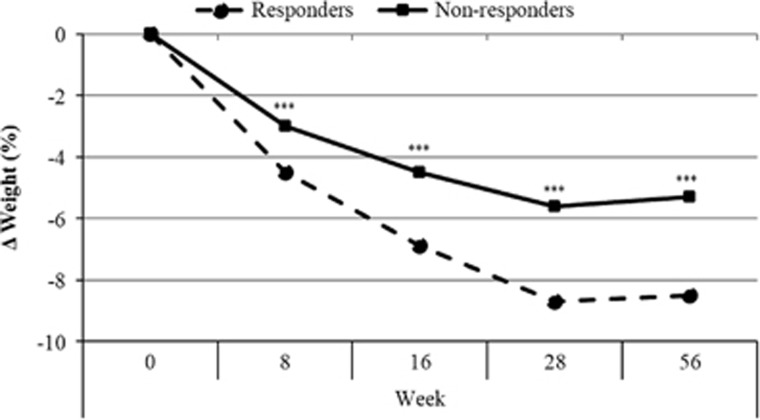
In an integrated analysis of four 56-week phase 3 clinical trials, subjects completed the CoEQ and had their body weight measured at baseline and at weeks 8, 16, 28 and 56. All analyses were conducted on subjects who had complete weight and CoEQ measurements at baseline and week 56, and had completed 56 weeks of NB (n=1310) or placebo (n=736). A latent growth curve model was used to examine whether early changes in the CoEQ subscales were associated with decreases in weight loss over time. Confirmatory factor analysis (CFA) was used to determine the psychometric properties of the CoEQ.
The factor structure of the CoEQ was consistent with previous findings with a four-factor solution being confirmed: Craving Control, Positive Mood, Craving for Sweet and Craving for Savoury with good internal consistency (Cronbach's α=0.72-0.92). Subjects with the greatest improvement in Craving Control at week 8 exhibited a greater weight loss at week 56.
These findings highlight the importance of the experience of food cravings in the treatment of obesity and support the use of the CoEQ as a psychometric tool for the measurement of food cravings in research and the pharmacological management of obesity.
食物渴望与饮食行为失调和肥胖相关,可能会阻碍减肥尝试的成功。因此,控制食物渴望是肥胖管理的一个组成部分。本文研究了在四项针对肥胖成年人的纳曲酮/安非他酮缓释组合(NB)的3期临床试验中,对食物渴望的控制(使用饮食控制问卷(CoEQ)中的渴望控制分量表进行评估)的早期变化是否可预测体重减轻。同时还研究了CoEQ的潜在组成结构。
在对四项为期56周的3期临床试验进行综合分析时,受试者完成了CoEQ,并在基线以及第8、16、28和56周测量了体重。所有分析均针对在基线和第56周有完整体重和CoEQ测量值且完成了56周NB治疗(n = 1310)或安慰剂治疗(n = 736)的受试者进行。使用潜在生长曲线模型来检验CoEQ分量表的早期变化是否与随时间体重减轻的减少相关。验证性因素分析(CFA)用于确定CoEQ的心理测量特性。
CoEQ的因素结构与先前的研究结果一致,确认了一个四因素解决方案:渴望控制、积极情绪、对甜食的渴望和对咸味食物的渴望,内部一致性良好(Cronbach's α = 0.72 - 0.92)。在第8周渴望控制改善最大的受试者在第56周体重减轻更多。
这些发现突出了食物渴望体验在肥胖治疗中的重要性,并支持将CoEQ用作研究中测量食物渴望以及肥胖药物管理的心理测量工具。