Zhang Yan, Wang Zheng, Hao Xuezhi, Hu Xingsheng, Wang Hongyu, Wang Yan, Ying Jianming
Department of Medical Oncology, National Cancer Center/Cancer Hospital, Chinese Academy of Medical Sciences & Peking Union Medical College, Beijing 100021, China.
Department of Pathology, Beijing Hospital, National Center of Gerontology, Beijing 100730, China.
Chin J Cancer Res. 2017 Feb;29(1):18-24. doi: 10.21147/j.issn.1000-9604.2017.01.03.
To investigate the clinical features of patients with non-small cell lung cancer (NSCLC) harboring uncommon epidermal growth factor receptor (EGFR) mutations, and the treatment outcomes of EGFR tyrosine kinase inhibitors (TKIs) in these patients.
We retrospectively analyzed the data of 128 NSCLC patients pathologically diagnosed with uncommon EGFR mutation in the Department of Pathology, National Cancer Center/Cancer Hospital, Chinese Academy of Medical Sciences & Peking Union Medical College and Beijing Hospital from January 2010 to December 2015, including 40 advanced patients who received EGFR-TKI.
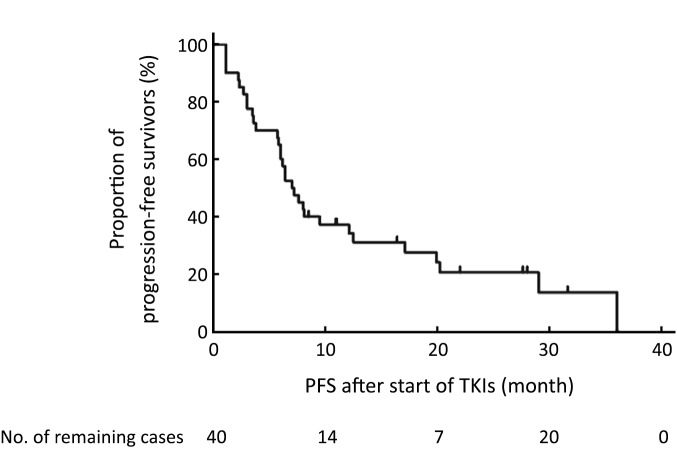
Among the total 128 patients, 11 patients were non-adenocarcinoma, including squamous carcinoma (3.9%), adenosquamous carcinoma (2.3%), large cell carcinoma (0.8%), and composite neuroendocrine carcinoma (1.6%). Single mutations accounted for 75.0% (96/128), including G719X (29.7%), S768I (18.0%), 20 exon insertion (13.3%), L861Q (12.5%), T790M (0.8%), and T725 (0.8%). Thirty-two patients harbored complex mutations. Forty advanced patients received EGFR-TKI, the objective response rate (ORR) was 20.0%, the disease control rate (DCR) was 85.0%, and the progression-free survival (PFS) was 6.4 [95% confidence interval (95% CI), 4.8-7.9] months. The exploratory analysis of tumor response and PFS in 33 patients with G719X/S768I/L861Q subtypes showed that ORR was 21.2% (7/33), the DCR was 93.9% (31/33), and PFS was 7.6 (95% CI, 5.8-9.4) months. Patients with exon 20 insertion mutation and T790M experienced rapid disease progression with PFS no more than 2.7 months.
Uncommon EGFR-mutant NSCLCs are heterogeneous, EGFR-TKIs can have different efficacy in this specific subtype, and thus further individual assessment is required for each case.
探讨携带罕见表皮生长因子受体(EGFR)突变的非小细胞肺癌(NSCLC)患者的临床特征,以及EGFR酪氨酸激酶抑制剂(TKIs)对这些患者的治疗效果。
回顾性分析2010年1月至2015年12月在中国医学科学院北京协和医学院肿瘤医院病理科、国家癌症中心及北京医院病理确诊为罕见EGFR突变的128例NSCLC患者的数据,其中40例晚期患者接受了EGFR-TKI治疗。
128例患者中,11例为非腺癌,包括鳞癌(3.9%)、腺鳞癌(2.3%)、大细胞癌(0.8%)和复合性神经内分泌癌(1.6%)。单基因突变占75.0%(96/128),包括G719X(29.7%)、S768I(18.0%)、20外显子插入(13.3%)、L861Q(12.5%)、T790M(0.8%)和T725(0.8%)。32例患者存在复合突变。40例晚期患者接受EGFR-TKI治疗,客观缓解率(ORR)为20.0%,疾病控制率(DCR)为85.0%,无进展生存期(PFS)为6.4 [95%置信区间(95%CI),4.8 - 7.9]个月。对33例G719X/S768I/L861Q亚型患者的肿瘤反应和PFS进行探索性分析,结果显示ORR为21.2%(7/33),DCR为93.9%(31/33),PFS为7.6(95%CI,5.8 - 9.4)个月。20外显子插入突变和T790M患者疾病进展迅速,PFS不超过2.7个月。
罕见EGFR突变的NSCLC具有异质性,EGFR-TKIs对该特定亚型可能有不同疗效,因此需对每个病例进行进一步的个体化评估。