Zhu Fengtao, Yang Xing, Wu Yan, Wang Yasi, Tang Xiao-Feng, Tang Bing
State Key Laboratory of Virology, College of Life Sciences, Wuhan University Wuhan, China.
State Key Laboratory of Virology, College of Life Sciences, Wuhan UniversityWuhan, China; Hubei Provincial Cooperative Innovation Center of Industrial FermentationWuhan, China.
Front Microbiol. 2017 Mar 21;8:481. doi: 10.3389/fmicb.2017.00481. eCollection 2017.
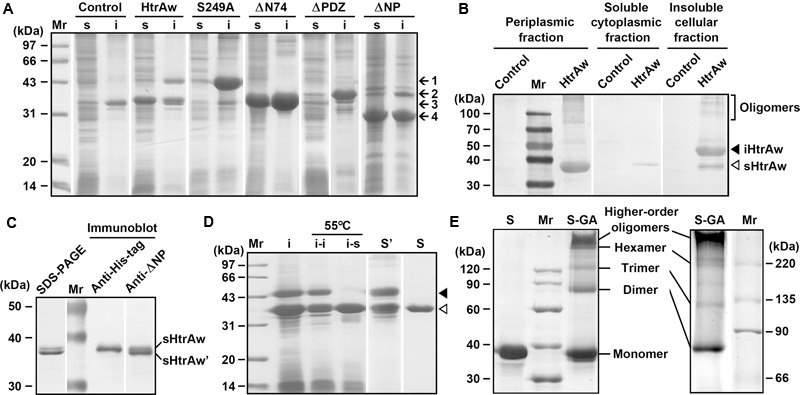
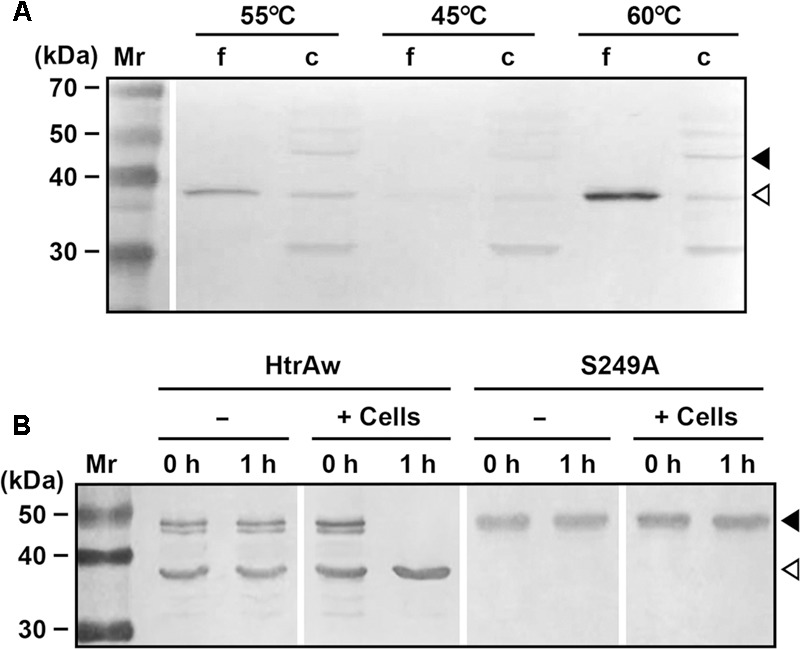
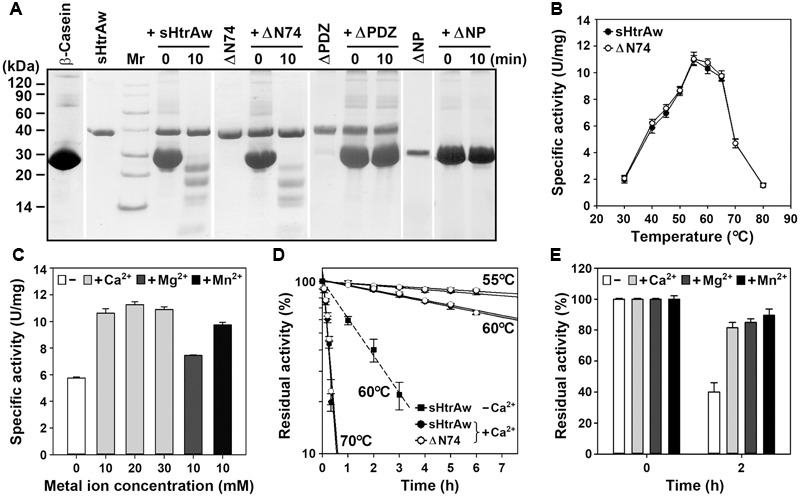
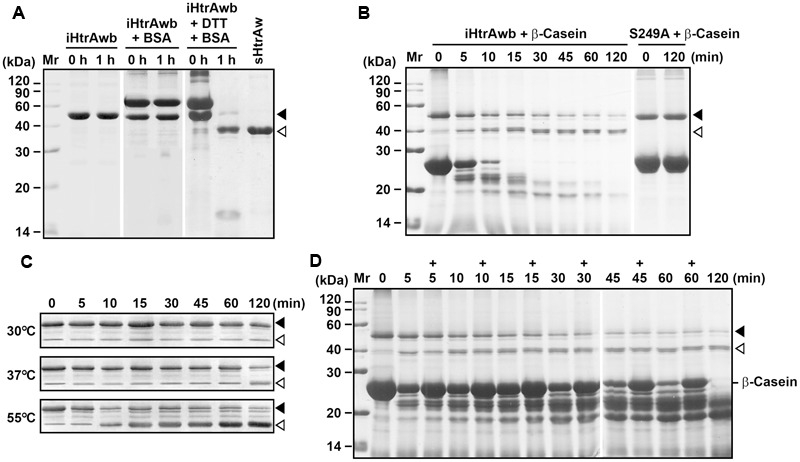
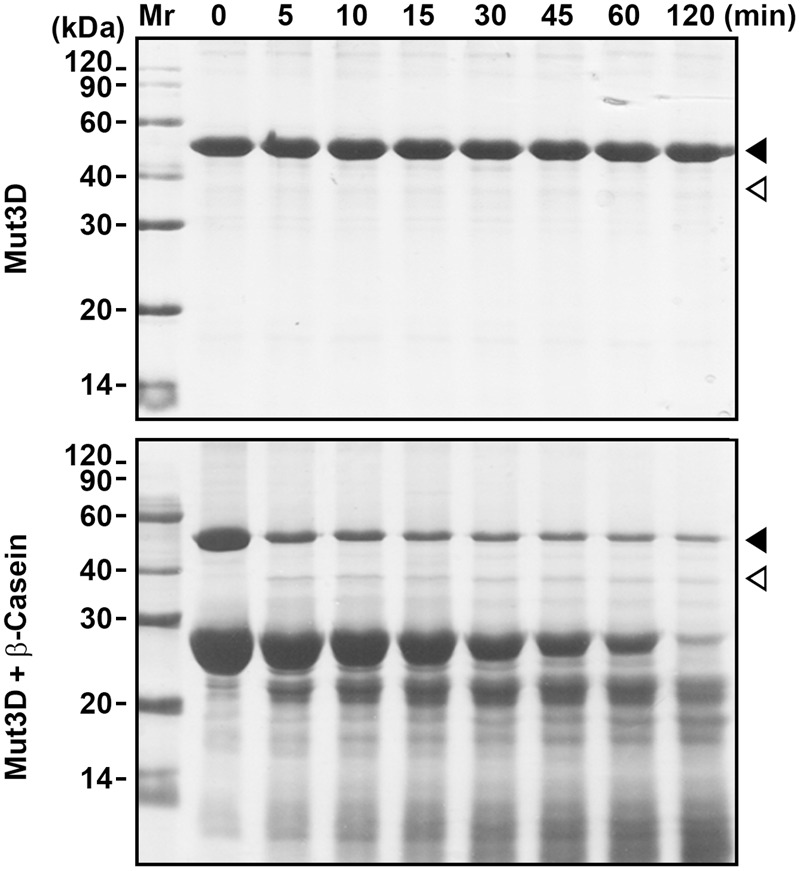
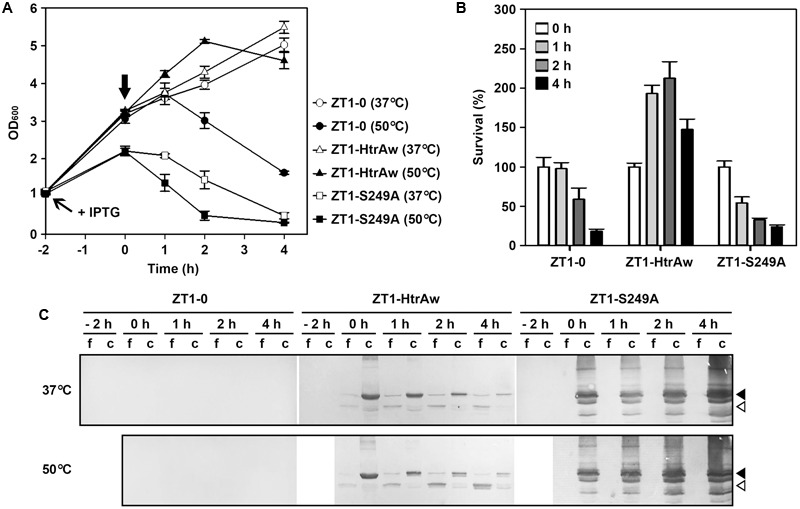
High-temperature requirement A (HtrA)-like proteases participate in protein quality control in prokaryotes and eukaryotes by degrading damaged proteins; however, little is known about HtrAs produced by thermophiles. HtrAw is an HtrA-like protease of thermophilic sp. WF146. The intact form of HtrAw (iHtrAw) consisting of a transmembrane segment-containing N-terminal domain, a trypsin-like protease domain, and a C-terminal PDZ domain was produced in . Purified iHtrAw itself is unable to cleave the N-terminal domain, but requires protein substrates to autoprocess the N-terminal domain intermolecularly, yielding a short form (sHtrAw). Mutation at the substrate-binding site in the PDZ domain affects the conversion of iHtrAw to sHtrAw. Deletion analysis revealed that the N-terminal domain is not necessary for enzyme folding, activity, and thermostability. Compared with other known HtrAs, HtrAw contains an additional Ca-binding Dx[DN]xDG motif important for enzyme stability and/or activity. When produced in an / double deletion mutant of , iHtrAw localized predominantly to the cell pellet, and the amount of sHtrAw in the culture supernatant increased at elevated temperatures. Moreover, HtrAw increased the heat resistance of the mutant. In strain WF146, HtrAw exists in both a cell-associated intact form and a cell-free short form; an increase in growth temperature enhanced HtrAw production and the amount of cell-free short form. Release of the short form of HtrAw from the membrane may have the advantage of allowing the enzyme to freely access and degrade damaged proteins surrounding the bacterium living at high temperatures.
高温需求A(HtrA)样蛋白酶通过降解受损蛋白质参与原核生物和真核生物的蛋白质质量控制;然而,关于嗜热菌产生的HtrA知之甚少。HtrAw是嗜热菌sp. WF146的一种HtrA样蛋白酶。由含跨膜区段的N端结构域、胰蛋白酶样蛋白酶结构域和C端PDZ结构域组成的完整形式的HtrAw(iHtrAw)在……中产生。纯化的iHtrAw本身无法切割N端结构域,但需要蛋白质底物进行分子间自加工N端结构域,产生短形式(sHtrAw)。PDZ结构域中底物结合位点的突变会影响iHtrAw向sHtrAw的转化。缺失分析表明,N端结构域对于酶的折叠、活性和热稳定性不是必需的。与其他已知的HtrA相比,HtrAw含有一个额外的对酶稳定性和/或活性重要的钙结合Dx[DN]xDG基序。当在……的/双缺失突变体中产生时,iHtrAw主要定位于细胞沉淀,并且培养上清液中sHtrAw的量在升高的温度下增加。此外,HtrAw提高了……突变体的耐热性。在菌株WF146中,HtrAw以细胞相关的完整形式和无细胞的短形式存在;生长温度的升高增强了HtrAw的产生和无细胞短形式的量。HtrAw短形式从膜上的释放可能具有允许酶自由接近并降解生活在高温下细菌周围受损蛋白质的优势。