
旁路移植术和远端血管结扎术后血栓形成的持续性坐骨动脉瘤的症状性生长
Symptomatic Growth of a Thrombosed Persistent Sciatic Artery Aneurysm after Bypass and Distal Exclusion.
作者信息
Kim Song-Yi, Cho Sungsin, Cho Min-Ji, Min Sang-Il, Ahn Sanghyun, Ha Jongwon, Min Seung-Kee
机构信息
Department of Surgery, Seoul National University Hospital, Seoul, Korea.
出版信息
Vasc Specialist Int. 2017 Mar;33(1):33-36. doi: 10.5758/vsi.2017.33.1.33. Epub 2017 Mar 31.
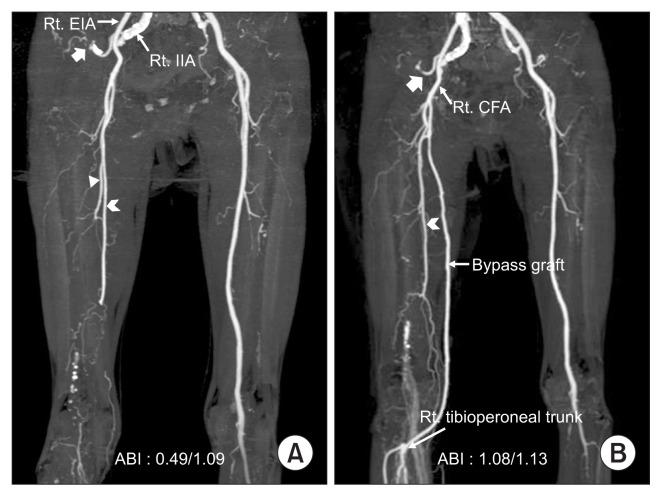
A 71-year-old woman presented with an enlarging mass in the right buttock, with pain and tingling sensation in sitting position. Five years ago, she was diagnosed with acute limb ischemia due to acute thrombosis of right persistent sciatic artery (PSA), and she underwent successful thromboembolectomy and femoro-tibioperoneal trunk bypass. Computed tomography angiography revealed a huge PSA aneurysm (PSAA). During the previous bypass, the distal popliteal artery was ligated just above the distal anastomosis to exclude the PSAA, whose proximal end was already thrombosed. However, PSAA has grown to cause compression symptoms, and the mechanism of aneurysm growth can be ascribed to type 1a or type 2 endoleak. In order to relieve the compression symptoms, aneurysm excision was performed without any injury to the sciatic nerve. A postoperative tingling sensation due to sciatic-nerve stimulation in the supine position resolved spontaneously one month after surgery.
一名71岁女性因右臀部肿物增大伴坐位时疼痛和刺痛感就诊。5年前,她因右侧坐骨动脉(PSA)急性血栓形成导致急性肢体缺血,接受了成功的血栓切除术和股-胫腓干旁路移植术。计算机断层血管造影显示巨大的PSA动脉瘤(PSAA)。在之前的旁路手术中,腘动脉远端在远端吻合口上方结扎以排除PSAA,其近端已形成血栓。然而,PSAA增大导致压迫症状,动脉瘤生长机制可归因于1a型或2型内漏。为缓解压迫症状,在未损伤坐骨神经的情况下进行了动脉瘤切除术。术后因仰卧位坐骨神经刺激引起的刺痛感在术后1个月自发缓解。



 Zotero 插件