Peng H, Yeh F, Lin J, Best L G, Cole S A, Lee E T, Howard B V, Zhao J
Department of Epidemiology, College of Public Health and Health Professions, College of Medicine, University of Florida, Gainesville, FL, USA.
Center for American Indian Health Research, University of Oklahoma Health Science Center, Oklahoma City, OK, USA.
J Thromb Haemost. 2017 Jun;15(6):1078-1085. doi: 10.1111/jth.13689. Epub 2017 May 3.
Essentials Plasminogen activator inhibitor-1 (PAI-1) advanced cellular senescence in experiment studies. No population study exists on the association between PAI-1 and biological aging in American Indians. We found cross-sectional and longitudinal associations between higher PAI-1 and shorter telomere length. Our findings suggest a pathway linking PAI-1 with biological aging beyond metabolic factors.
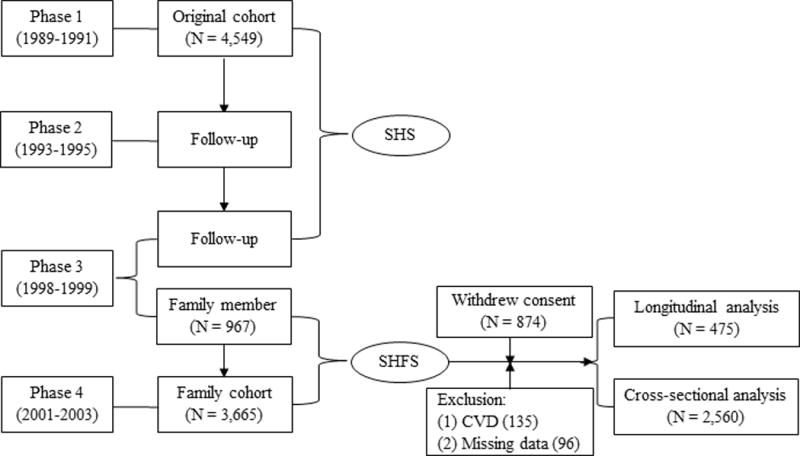
Background Plasminogen activator inhibitor-1 (PAI-1) promotes cellular aging both in vitro and in vivo. Telomere length is a marker of biological aging. Objectives To examine the cross-sectional and longitudinal associations between plasma PAI-1 and leukocyte telomere length in a large-scale epidemiological study of American Indians. Methods We measured leukocyte telomere length (LTL) and plasma PAI-1 in 2560 American Indians who were free of overt cardiovascular disease (CVD) and participated in the Strong Heart Family Study (SHFS) clinical examination in 2001-2003. LTL and PAI-1 were repeatedly measured in 475 participants who attended SHFS clinical visits in both 2001-2003 and 1998-1999. A generalized estimating equation model was used to examine the cross-sectional and longitudinal associations between PAI-1 and LTL, adjusting for known risk factors. Results A higher level of plasma PAI-1 was negatively associated with shorter age-adjusted LTL (β = -0.023; 95% CI, -0.034 to -0.013). This association was attenuated (β = -0.015; 95% CI, -0.029 to -0.002) after adjustments for demographics, study site, lifestyle (smoking, drinking and physical activity) and metabolic factors (obesity, blood pressure, fasting glucose, insulin, lipids and kidney function). Further adjustment for hsCRP did not change this association (β = -0.015; 95% CI, -0.029 to -0.001). Longitudinal analysis revealed that change in plasma PAI-1 was also inversely associated with change in LTL after adjusting for demographics, follow-up years, lifestyle factors, changes in metabolic factors, baseline levels of PAI-1 and LTL (β = -0.0005; 95% CI, -0.0009 to -0.0001). Conclusions A higher level of plasma PAI-1 was associated with shorter LTL in American Indians. This finding may suggest a potential role of PAI-1 in biological aging among American Indians.
在实验研究中,纤溶酶原激活物抑制剂-1(PAI-1)可促进细胞衰老。目前尚无关于美国印第安人中PAI-1与生物衰老之间关联的人群研究。我们发现PAI-1水平较高与端粒长度较短之间存在横断面和纵向关联。我们的研究结果提示了一条将PAI-1与生物衰老联系起来的途径,且该途径独立于代谢因素。
背景 纤溶酶原激活物抑制剂-1(PAI-1)在体外和体内均可促进细胞衰老。端粒长度是生物衰老的一个标志物。目的 在一项针对美国印第安人的大规模流行病学研究中,检验血浆PAI-1与白细胞端粒长度之间的横断面和纵向关联。方法 我们测量了2560名无明显心血管疾病(CVD)且在2001 - 2003年参加了强心脏家族研究(SHFS)临床检查的美国印第安人的白细胞端粒长度(LTL)和血浆PAI-1。对475名在1998 - 1999年和2001 - 2003年都参加了SHFS临床检查的参与者重复测量了LTL和PAI-1。使用广义估计方程模型来检验PAI-1与LTL之间的横断面和纵向关联,并对已知风险因素进行调整。结果 血浆PAI-1水平较高与年龄调整后的较短LTL呈负相关(β = -0.023;95%CI,-0.034至-0.013)。在对人口统计学、研究地点、生活方式(吸烟、饮酒和体育活动)和代谢因素(肥胖、血压、空腹血糖、胰岛素、血脂和肾功能)进行调整后,这种关联减弱(β = -0.015;95%CI,-0.029至-0.002)。进一步对超敏C反应蛋白进行调整并没有改变这种关联(β = -0.015;95%CI,-0.029至-0.001)。纵向分析显示,在对人口统计学、随访年限、生活方式因素、代谢因素变化、PAI-1和LTL的基线水平进行调整后,血浆PAI-1的变化也与LTL的变化呈负相关(β = -0.0005;95%CI,-0.0009至-0.0001)。结论 在美国印第安人中,血浆PAI-1水平较高与较短的LTL相关。这一发现可能提示PAI-1在美国印第安人生物衰老中具有潜在作用。